
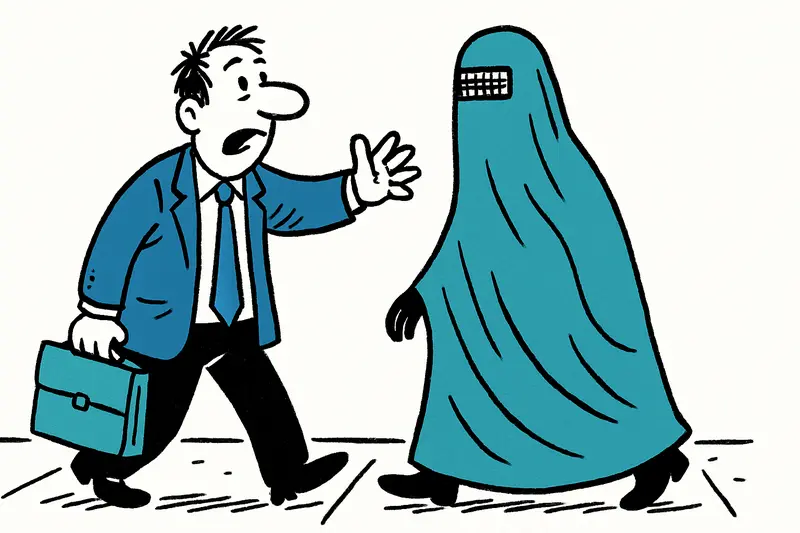
Burqa debate in the Balearic Islands: Between symbolic politics and everyday life
Burqa debate in the Balearic Islands: Between symbolic politics and everyday life
The Balearic Parliament is calling on Madrid for a nationwide ban on the full-face veil. Who benefits politically, who remains unheard — and what effect would this have on Mallorca's streets?
Burqa debate in the Balearic Islands: Between symbolic politics and everyday life
Key question: Should Madrid introduce a nationwide ban on the full-face veil — and what would that concretely change in Palma and on Mallorca?
The Parliament of the Balearic Islands has decided: a resolution from the conservative Partido Popular, asking Madrid to prohibit the complete covering of the face in public spaces, was adopted with votes from the right‑wing populist Vox faction. Left-wing and regionalist forces voted against or abstained. The formality of a regional parliament's joint decision sounds like symbolic politics — but behind the paragraph lie concrete questions for everyday life on the island.
Critical analysis: On paper, the initiators cite "European case law", such as the ECHR judgment S.A.S. v. France (2014), which they say allows for restrictions on the full-face veil; the PP explicitly limits its proposal to the so-called full-face veil, while Vox wanted to go further and also regulate the wearing of the hijab. Politically, it reads like a race: the conservatives emphasize freedom and the "making invisible" of women, and Vox also calls the headscarf a patriarchal symbol. Opponents see the move as a grab for votes and an adoption of right‑wing populist themes.
What is missing from the public discourse: the voices of those who would be most affected — Muslim women on Mallorca, female heads of municipalities, educators, medical staff — are hardly audible in the debate. Also little discussed is the practical question of enforcement: who is supposed to check whether it is coercion or a personal religious practice? What penalties are envisaged, who documents violations, and what consequences arise for sensitive areas such as schools, health centers and tourism, issues discussed in the Balearic Islands Plan Visitor Limits: Between Everyday Life and Economic Interests?
An everyday scene from Palma: on a windy February afternoon at the market in Santa Catalina the women selling at the fish stalls call out to customers. One woman in a scarf pays for her purchases, another pulls the fabric closer to her face because the bora wind whistles through the neighborhood. Such simple moments illustrate how legal interventions in public space can quickly intrude into private situations — checks on the Passeig Mallorca, discussions at bus stops or uncertainties at the airport are conceivable.
Law and realpolitik are inseparable: a regional parliament can only call for action — it cannot impose a national ban. If Madrid follows the call, the central government would face the task of formulating clear rules compatible with the constitution and European law. Without this legal clarity, there is a risk of patchworks of differing regulations and administrative-practice-based inequalities between municipalities.
Concrete approaches instead of mere prohibition rhetoric: first, politics must put the distinction between voluntary religious practice and coercion at the center and consistently pursue measures against coercion — through prevention, victim support and specialized counseling services. Second, police and regulatory services need clear action guidelines and training so that controls do not degenerate into discrimination. Third, specific exceptions for identification purposes (e.g. at authorities, airports) should be regulated more transparently to resolve everyday situations pragmatically. Fourth, more should be invested in integration and Language dispute in Mallorca: subsidies, comparisons and the question of cultural justice rather than relying solely on bans. And fifth: the affected communities must be involved in the solutions — otherwise measures remain ineffective or counterproductive.
What the Balearic initiative reveals politically is more than a dispute over pieces of cloth: it shows how migration, integration and culture wars have become campaign resources. The debate does not run only along legal lines but also along a competition between PP and Vox for the conservative electorate — this became clear in parliament and in controversies such as the Poster Dispute in the Balearic Islands: How Much Provocation Can Public Space Tolerate?.
Concise conclusion: A blanket ban can serve political staging but does not solve the deeper problems of coercion, inequality and lack of inclusion. Mallorca needs practical, legally secure regulations and local services that prevent coercion and promote participation instead of symbolic bans. Otherwise there is a risk that women will be further pushed to the margins by prohibitions — and the police will be left with cases for which no one on the ground has developed solutions.
Frequently asked questions
Could a nationwide ban on the full-face veil affect everyday life in Mallorca?
Is wearing a headscarf or full-face veil in Mallorca currently illegal?
How would a face-covering ban be enforced in Palma?
Why is the burqa debate in Mallorca seen as symbolic politics?
What would a face-covering ban mean for Muslim women in Mallorca?
How could schools and health centers in Mallorca be affected by a veil ban?
What legal limits would Madrid face before banning the burqa across Spain?
What would be a more practical approach than a burqa ban in Mallorca?
Similar News

New trick at Palma Airport: suitcase stolen from the belt — a reality check
On September 28 a 36-year-old allegedly stole a suitcase from the baggage belt of a 51-year-old German passenger at Palm...
Urgent Clearing of Palma's Torrents: Flood Prevention or Symptom of Short-Sighted Planning?
The city of Palma is responding to storm forecasts and has cleared several torrents. We ask: Is the short-term clearing ...
Evaneos and Mexico: A Reality Check for Sustainable Travel
Travel advertising often reads like a promise: local, sustainable, unique. But how deep do these promises really go? A c...

From Megapark to the Altar: Party Singer Now Offers Weddings in Mallorca
A well-known party artist combines partying and marriage: instead of a traditional church there are ceremonies at the Me...

The Maricarmen Case: Why an Eviction Is Forcing Spain's Housing Debate
Images of an 87-year-old woman on a stretcher have sparked a debate in Spain that also runs deep in Mallorca. Who protec...
More to explore
Discover more interesting content

Can Cap de Bou

Townhouse Lleo 72
