
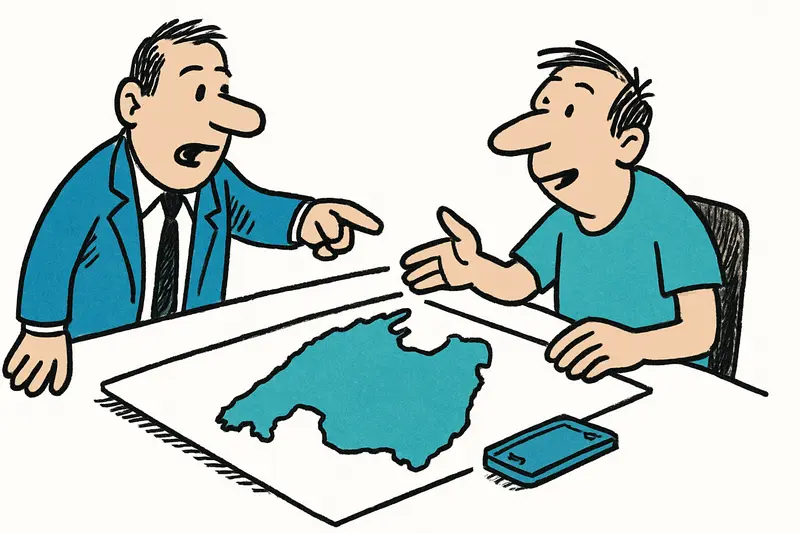
'Germany should buy Mallorca': A post from Biberach that provokes more than laughter
A provocative Instagram post by a local chapter of the Young Liberals in Biberach has sparked debate in Mallorca — between satire, political youth work and genuine questions about sovereignty, ownership and tourism.
A short post, a loud echo
Early in the morning, the coffee machine rattling in the kitchen, you scroll through feeds — and stop at an image: "Germany should buy Mallorca," read an Instagram post by a local chapter of the Young Liberals from Biberach. Short, striking, a little provocative. In Palma's cafés, on the Paseo Marítimo and in small bars inland, the message did not cause panic, more of a weary smile; observers have even noted fewer Germans are coming to Mallorca this summer.
The central question: What is it really about?
Is it just a joke, a PR stunt or a prompt for thought, as with a TikTok sketch that prompted discussion about life on the island? Behind the provocative wording lies a range of topics discussed daily on the island: Who has access to property? How does mass tourism affect local communities? And what remains of an island when it is primarily treated as an investment object? In Biberach people may laugh at the suggestion; in Pollença or in a small village on the Tramuntana slopes such an idea can sound very different: concern, puzzlement or pure irony.
International law, sovereignty and realpolitik
Practically, the idea is hardly feasible. Spain is sovereign; islands are not sold like holiday homes. International law, EU membership, bilateral relations — these are not checkboxes to be crossed off at a local meeting. Still, the post opens a door: How do young people think about relationships in Europe? Is it political humor, or an expression of frustration about the way politics seeks attention today?
What is missing from the public debate
Most commentators stop at the punchline. Less often is the perspective of people on Mallorca illuminated: the steadily increasing supply of holiday flats, drivers of displacement in rental prices, seasonal employment — these are real problems that don't disappear if you laugh about them. The role of German buyers in some places is also a sensitive topic; the decline of German visitors is fueling debates in Palma, showing how economic shifts shape local concerns. It's not just about nationality, but market mechanisms, lobbying interests and lacking regional planning.
The responsibility of political youth organisations
Youth organisations are allowed to provoke — that's part of their role. But provocation carries responsibility. A bold post can entertain, but it can also raise expectations or fuel fears. If youth work aims for maximum reach instead of substantive engagement, debate stays superficial. Better would be: A proposal wins when it sparks debates that become concrete — for example about sustainable tourism, charitable investments or cross-border projects.
Concrete alternatives instead of buy-out ideas
Instead of an unrealistic purchase option, politically active groups could propose courses of action that actually make a difference: subsidy programs for affordable housing, municipal funds for sustainable infrastructure, partnerships between municipalities (town twinning) or investments in public transport on the island. Such proposals would be less striking, but far more useful — and might provoke just as lively discussions in Palma's street cafés.
A call for genuine conversation
In the end remains the image of an editor sipping an espresso, irritated by the buzzing of mopeds along the Avinguda, asking: Does provocation advance real discourse? Maybe a little. Even better: if humor opens the door, we should step through it and talk to each other — not only in Biberach, but also in Sóller, Llucmajor and Palma. Politics lives from encounters, not from headlines.
Conclusion: The Instagram post from Biberach is more than a gag. It says something about the hopes and fears of our time — about property, identity and the way political youth work operates today. Those who truly want to change something should channel the energy into concrete, cross-border solutions: instead of 'buying Mallorca', cooperate with Mallorca.
Postscript: If you're still looking for an estate agent in Biberach — take it with a sense of humor. And if you come to Palma, don't forget sunscreen; the debate stays hotter than a summer noon on the Paseo Marítimo.
Frequently asked questions
Why did the post “Germany should buy Mallorca” cause so much discussion?
What are the main housing problems in Mallorca right now?
Is Mallorca still a good place to visit if fewer Germans are coming?
How hot does Mallorca get in summer, and what should I pack?
Can you still swim in Mallorca in the shoulder season?
What is daily life like in Palma when tourism debates heat up?
What makes Pollença feel different from Palma in debates about Mallorca?
What practical ideas are being discussed to make Mallorca more sustainable?
Similar News
Who Bears the Burden? Mallorca Between Tenant Protection and Landlord Fears
Madrid's new housing decrees strengthen tenant rights — but on Mallorca concern is growing: will the law drive small lan...
On the Edge: What Mallorca's Airport Loses If a Major Low-Cost Carrier Falters
The company that operates numerous connections from Palma to France and domestically is negotiating with creditors to re...
Ballermann star Frenzy wins 'Villa of Temptation' and donates prize money to Mallorca animal rescue
Ballermann singer Frenzy won the German reality show and donated the remaining prize money — around €14,080 — to an anim...
70 Trees Removed on Avenida Jaume I: What's Happening in Santa Ponça?
On October 1 the final redevelopment phase on Avenida Jaume I in Santa Ponça begins: 70 trees and old streetlights are t...

When a Boundary Is Crossed: The Case of Isi Glück and the Responsibility of Venue Operators
The singer from Mallorca reports an assault backstage in Halle. A clear guiding question, analysis of missing protective...
More to explore
Discover more interesting content

Can Cap de Bou

Townhouse Lleo 72
