

Boats in front of bathers: Why crossings are reaching beaches again
Boats in front of bathers: Why crossings are reaching beaches again
One morning in eastern Mallorca small boats landed ahead of beachgoers. Within 24 hours authorities registered 52 arrivals on the Balearic Islands. An interim assessment and calls for action for politicians and aid organizations.
Boats in front of bathers: Why crossings are reaching beaches again
Within 24 hours dozens of people landed on Mallorca's and Formentera's coasts – a reality check
In the morning, the sun already warm on people's shoulders, one heard the usual bustle in Cala d'Or: children shoveling sand, voices, a lifeguard whistling as he watched the water. Then the unusual sound: an engine approaching, voices, police lights on the water. Seven people came ashore on the small beach Caló des Pou in the municipality of Santanyí – right before the eyes of holidaymakers and locals.
Key question: How can it be that these days boats are once again reaching the beaches of the Balearic Islands and that this is happening visibly in the middle of everyday tourist life?
The raw numbers give initial clues: within little more than a day authorities on the Balearics registered 52 people in four boats. On Formentera one boat with 15 people landed in the area around Pilar de la Mola, another was discovered with 22 people about half a nautical mile south of the island. Another eight people were found ashore on Thursday in the area of the Ma-19 near Santanyí, according to emergency services. The Balearic authorities also report that since the beginning of the year 1,806 people have already arrived on the islands in 93 boats; in the previous year there were 7,321 people in 401 boats, mostly from Algeria. A chronicle of operations and local voices is available in Six boats, 75 people: When the nights on the coasts grow denser.
Critical analysis: The figures do not point to a single cause, but to a web of supply and demand, geographic proximity and limited control capacities. Small, often overcrowded boats choose stretches of coast that are far from large ports. That increases visibility when a landing nevertheless occurs at popular beaches. Several factors coincide: shifting search-and-rescue and security presence at sea that adapts to needs, route changes due to closures elsewhere, and the fact that the Balearics lie on the route of the western Mediterranean. Local reporting on rising landings along the southern shore underscores this pressure, see South Coast at the Limit: When Boats and Plastic Overwhelm Communities.
What is missing from public debate: the immediate consequences for everyday life and administration. In one afternoon a beach landing not only produces a striking image but also creates additional personnel needs for rescue services, administrative shifts, interpreters and medical initial examinations. Many people on site experience concern and helplessness — beachgoers who lose their peace; hoteliers who must react at short notice; beach guards who suddenly care for people who have fled. The question of how and where people are housed after initial reception and how they are legally registered often slips behind the headlines.
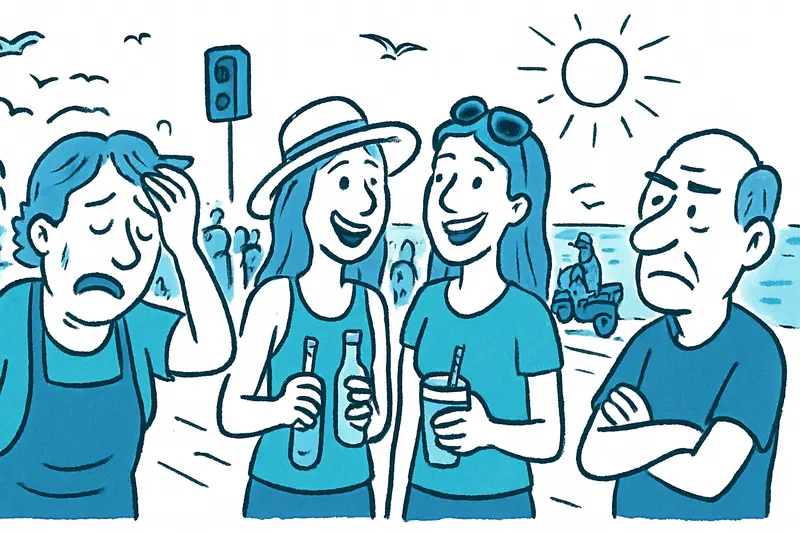
Everyday scene in Mallorca: On the Passeig Mallorca tourists stroll, but conversations that day revolve around what was seen on the beach. A fisherman in the port of Cala d'Or says he notices the boats more often when the wind comes from the southwest. A tense kiosk vendor says it is difficult to have two worlds in one place: sunny holidays and those who leave everything behind, a tension also discussed in reports about Between Waves and Berth: Mallorca's Problem with 'Floating Holiday Rentals'.
Concrete, practicable solutions: better on-site coordination between search-and-rescue services, the Guardia Civil and local emergency services so that medical initial care and registration are carried out quickly, humanely and locally; clearer procedures for accommodation nearby so that hotels and beaches are not used as emergency shelters at short notice; strengthened early detection at sea through combined patrols and remote sensing without endangering people in distress; and expansion of local interpreter and advisory resources to give those first affected immediate information.
Another point is transparency towards the public: citizens should be clearly informed about the procedures — who takes which responsibility, how long initial examinations take, where people are registered. That reduces speculation and spares the nerves of those who want to spend their leisure time on busy beaches.
Punchy conclusion: The landings at Caló des Pou and on Formentera are more than images for the headlines; they are indicators that migration movements are changing and that our islands increasingly serve as destinations or transit points. Politics and local administration must act on two levels: in the short term to guarantee humane and proper initial care; in the long term to address root causes and promote international cooperation. Locally this means above all: faster coordination, better information and fixed contact points so that both people who have fled and locals do not become improvised parts of the same beach scene.
Frequently asked questions
Why are boats still landing on beaches in Mallorca?
What happens when people arrive by boat on a Mallorca beach?
How common are migrant boat arrivals in the Balearic Islands this year?
Are beachgoers in Mallorca in any danger when a boat arrives?
What should visitors in Mallorca do if they see a boat landing on the beach?
Why does Caló des Pou in Santanyí appear in news about boat arrivals?
What is happening in Cala d'Or when boat arrivals are seen nearby?
How do boat landings affect everyday life in Mallorca towns and resorts?
Similar News

Stolen Motorcycle in Palma: Fatal Crash in Coll d'en Rabassa Shortly After Theft
A motorcycle parked on Plaza Miquel Dolç in Son Gotleu was reportedly stolen in the early hours. Hours later two men cra...

When More Guests Mean Less: Mallorca's Restaurants at the Limit
Despite record visitor numbers, the revenues of many restaurants are shrinking. Why more visitors don't automatically me...
Ballermann 2026: Heat, crowded promenade and rising prices – how much longer?
Bright sunshine, over 35 degrees in the shade and busy venues at Playa de Palma: Tourists enjoy the parties, restaurateu...

Stolen motorcycle, high-speed escape, deadly crash: An accident in Palma that raises questions
A motorcycle stolen in Son Gotleu ended up hours later on the Cardenal-Rossell in Coll d'en Rabassa in a deadly collisio...

Found dead in Son Gotleu: Dog walk ends fatally — what is missing in the investigation?
A 68-year-old man was found dead on Sunday morning on Tomás Rullàn street in Son Gotleu. According to his partner, he ha...
More to explore
Discover more interesting content

Boat Tour with BBQ along Es Trenc Beach

Private transfer from Mallorca Airport (PMI) to Pollensa
