
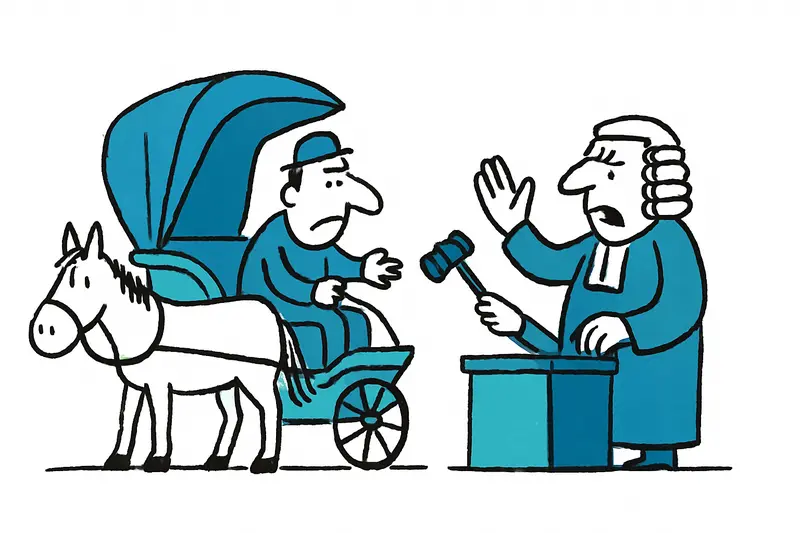
Court Overturns Palma's Heat Rule for Horse-Drawn Carriages — What's Missing Now
The Balearic High Court annulled a 2022 regulation because an equality assessment was missing. Carriages may run again under a yellow heat warning, while bans remain in place at orange and red levels. A reality check from Palma.
Court Overturns Palma's Heat Rule for Horse-Drawn Carriages — What's Missing Now
Key question: Does the formal error protect the horses or prevent better rules?
The Balearic High Court has declared a 2022 regulation invalid because a mandatory equality assessment was not presented when it was enacted. As a result, in Palma horse-drawn carriages are once again operating under a yellow heat warning, while bans remain in place for orange and red warning levels.
At first glance this sounds like a legal detail. But in Palma's old town the consequences are immediately noticeable: on the Passeig del Born hooves clack on the cobblestones again, taxi drivers honk, and tourist groups seek shade under plane trees. This everyday scene shows how closely administration, tourism and animal welfare are linked, which is reflected in Palma Struggles to End Horse-Drawn Carriages: Majority but No Final Decision.
Critical analysis: The core of the problem is not just the missing paperwork. With its decision, the court raises the question of how much formal procedural errors may outweigh material objectives. The regulation aimed to protect horses in extreme weather. That goal remains sensible. But the court emphasized that rules with constitutional and equality relevance must be developed following prescribed steps. Result: a protective framework is temporarily on ice until the city corrects the procedure.
What is often missing in the public debate: the discussion is reduced to two camps — 'for carriages' or 'against carriages' — losing sight of the middle ground. Less debated are concrete control mechanisms: How often do veterinarians check the horses, as raised by Palma orders medical checks for carriage horses — turning point for horse-drawn carriages? Who measures the temperature along narrow streets exposed to the sun? What rest breaks and drinking stations are mandatory? And how are violations sanctioned?
Another blind spot is the social perspective. Coachmen often earn modestly; some families have worked in this trade for generations. An abrupt ban affects livelihoods. At the same time public space demands modern solutions, without placing the responsibility solely on the animals' backs.
Concrete solutions Palma should implement now: the city must redraw the regulation formally, this time with all required assessments, including an independent equality assessment and an animal welfare report. At the same time, clear, comprehensible operational criteria must be included: mandatory break intervals, shade and water supply zones along classic routes, regular veterinary checks with publicly available records, and digital temperature sensors at exposed points.
Practical options could also include a tiered system: under a yellow warning only short trips in shaded sections; under orange and red a transport ban. Transition models for coachmen are conceivable, for example subsidies for cooling equipment or retraining offers for alternative tourist services.
What the administration must deliver now is transparency. An open register showing which horses were checked when, which rules apply and how inspections are carried out would build trust. And: citizen participation can help establish robust routes that balance tourism interests and animal welfare.
Concise conclusion: The court ruling is not a free pass for unregulated driving, but neither is it a clear victory for animal welfare. Above all it shows one thing: good intentions are not enough without clean procedures. Palma now has the responsibility to create a regulatory framework that is legally sound, protects animals and does not leave the people who depend on this trade out in the rain. That this is possible can be seen in other urban debates, for example After Two Collapsed Horses: Palma Faces a Decision — Rethinking Carriage Rides, but what is missing here is the will for proper implementation.
Frequently asked questions
Are horse-drawn carriages still allowed in Palma during hot weather?
Why did a court overturn Palma’s heat rule for horse-drawn carriages?
What does the court ruling mean for animal welfare in Palma?
What should Palma include in a new horse-carriage regulation?
Why is the Passeig del Born important in the horse-carriage debate in Palma?
How does Palma’s horse-carriage issue affect local coachmen?
What practical controls are missing from horse-carriage rules in Palma?
Could Palma replace horse-drawn carriages with other tourism options?
Similar News
Adrien Brody strolls through Mercat de l'Olivar – celebrity visit leading to Sa Pobla
Actor Adrien Brody was casually spotted at the Mercat de l’Olivar: tapas, fish stalls and later a stop in Sa Pobla spark...
Who can pick up whom? The complicated life of Mallorca's taxis
Three years after the inter-municipal service, empty runs are rarer — but there is a lack of equal treatment, transparen...
When the Tap Only Runs Sometimes: Why Municipalities in the Balearic Islands Are Now Rationing Water
Deià, Valldemossa, Esporles, Sóller and several places on Menorca are scaling back water supply. Who is responsible, why...
Battle for the Ramp: Why Cala Gamba Needs More Than Enforcement
The Guardia Civil intervened in Cala Gamba — residents breathed a sigh of relief, but unease remains. Key question: Are ...
He dances at the Duty-Free: How an airport employee brings a smile to Palma
A Duty-Free employee at Palma Airport created a viral TikTok with dancing breaks. Why the scene is more than just an int...
More to explore
Discover more interesting content

Boat Tour with BBQ along Es Trenc Beach

Private transfer from Mallorca Airport (PMI) to Pollensa
