
After Two Collapsed Horses: Palma Faces a Decision — Rethinking Carriage Rides
Two carriage horses collapsing in Palma's old town have reignited the debate. Why does this still happen, what does the city say — and how can animals be protected without forgetting people?
Why now? A central question
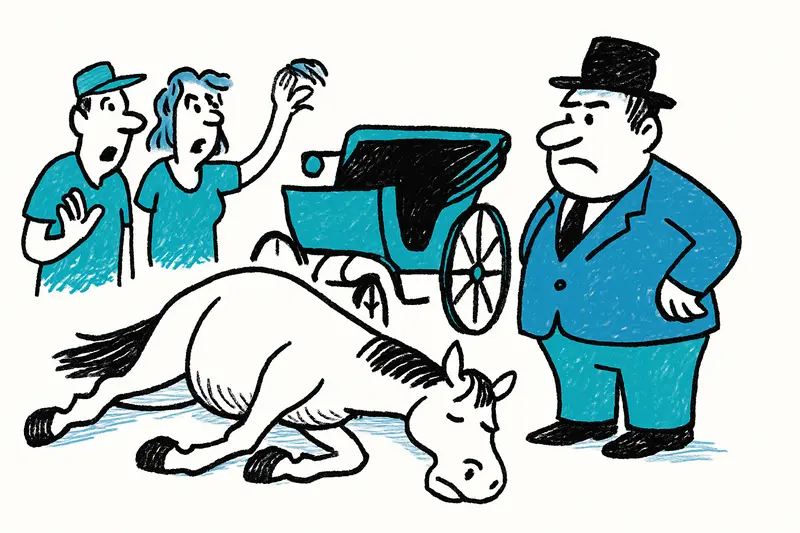
The images of the past days are vivid: Horse Falls in Palma: Do Carriages in the Old Town Need Rethinking? — right amid cruise-ship crowds, café tables and photographers. The central question is: Can traditional carriage rides still be justified here, or is this a system that needs fundamental change?
What you see and hear on site
On the Passeig, just a few steps from the cathedral, the cobblestones clatter, tourists murmur, cruise ships blow softly in the distance — and now and then you hear a horse's labored breathing when it stops. I spoke with visitors: some are horrified, others try to explain that "it has always been like this." The midday heat, the noise and the narrow streets are tangible — this is not just abstract criticism, this is everyday life for the animals, as recent incidents show in Carriage horse collapses in front of San Nicolás: Heat, animal welfare and the question of the future.
The often overlooked aspects
The public debate often lacks concrete details: How are rest breaks regulated, how often are veterinary checks carried out, who is liable in cases of overheating, and how transparent are the registers of carriage operators? According to the town hall, inspections are supposed to take place every 15 days, as outlined in Palma orders medical checks for carriage horses — turning point for horse-drawn carriages? — that sounds like control, but in practice it is a coarse interval. What happens in the days between, on the hottest weekends, in the midst of the cruise-ship boom?
Analysis: Economic dependencies versus animal welfare
The coachmen often earn their livelihood directly from the tourist flows around the cathedral. An immediate ban would affect people who rarely have other prospects. That is why political promises — a 2022 decision foresaw a ban, as discussed in Palma Struggles to End Horse-Drawn Carriages: Majority but No Final Decision — have so far been scarcely implemented. At the same time, places like Alcúdia, which are testing electric carriages, show that technical alternatives are possible. The challenge is political and economic: How can a socially acceptable transition be achieved?
What politicians and the administration say
The town hall has announced investigations and emphasized that it will step in when neglect is proven. That is necessary, but not enough. Short-term fines or occasional checks do not create a structure that protects animals in the long term. Clear thresholds are needed (e.g. no rides above 30°C, mandatory shade breaks, maximum daily kilometers), mandatory veterinary checks before the season starts and electronic documentation of all deployments.
Concrete solution approaches — act now
An untabled proposal that could work in Palma:
1. Immediate measures: clear temperature limit, mandatory drinking breaks, reduced routes during the hottest hours, immediate reporting obligation for incidents.
2. Transparency and control: digital duty logs, publicly accessible veterinary reports, CCTV at heavily frequented points, random blood and health checks.
3. Perspectives for people: retraining and support programs for coachmen (electric vehicles, tour guiding, crafts), transition funding and a fund for affected families.
4. Technical alternatives: pilot projects with electric carriages in the city center, expansion of e-infrastructure, tax incentives for switching.
5. Long term: a phased exit scenario with clear milestones and strong legal foundations — so that a ban is not just on paper but enforceable.
Opportunities that are rarely discussed
An orderly transition would be an image gain for Palma: fewer controversial posts, more modern tourism, new jobs in the field of sustainable mobility. Tourists increasingly seek ethical offers — this can become an opportunity, not just a loss.
Conclusion: Protection for animals, perspectives for people
The collapsed horses have accelerated the debate. Showing outrage alone is not enough — Palma needs clear rules, effective controls and a plan for the social transition. A ban can make sense, but only if accompanied by realistic alternatives for the people who live from the carriages. If the town hall acts honestly now, a messy incident could become a well-planned transition — otherwise only anger remains and a city that struggles to do the right thing.
In short: Two collapsed horses are a wake-up call. Technical alternatives and a social plan exist — now it comes down to enforcement and political courage.
Frequently asked questions
Are horse-drawn carriage rides in Palma still safe for the horses in hot weather?
What temperatures are considered too hot for horse-drawn carriages in Palma?
Why are horse carriage rides still allowed in Palma’s Old Town?
How often are carriage horses checked by veterinarians in Palma?
What happens to coachmen in Palma if horse-drawn carriages are phased out?
Are electric carriages a realistic alternative in Mallorca?
What practical rules could improve animal welfare for carriage horses in Palma?
Is Palma likely to ban horse-drawn carriages completely?
Similar News

Maribel: Five Decades of Service – Housekeeper from Peguera Celebrated with a Special Honor
Over 50 years in the hotel business: María Isabel “Maribel” Molinos was honored in Palma at the Nit del Turisme by Unive...
Orange Alert over Parts of Mallorca: Are We Prepared?
Dark clouds and an announced wet spell have triggered an Orange alert in parts of Mallorca. A reality check: what's miss...

Sundair & Co.: Sale speculation and what it could mean for Mallorca
Rumors about a possible sale of the airlines Sundair and Fly Air 41, which belong to Schauinsland-Reisen — and whether b...
Anne Wünsche in Mallorca: A job offer with a catch — who fits the role of personal assistant?
Influencer Anne Wünsche has left Berlin and is urgently looking for a full-time personal assistant in Mallorca. Why the ...
Daily from New York: Palma Between Boom and Strain
United will increase the Newark–Palma route to daily flights in 2027 using Boeing aircraft (231 seats). What does the in...
More to explore
Discover more interesting content

Can Cap de Bou

Townhouse Lleo 72
