
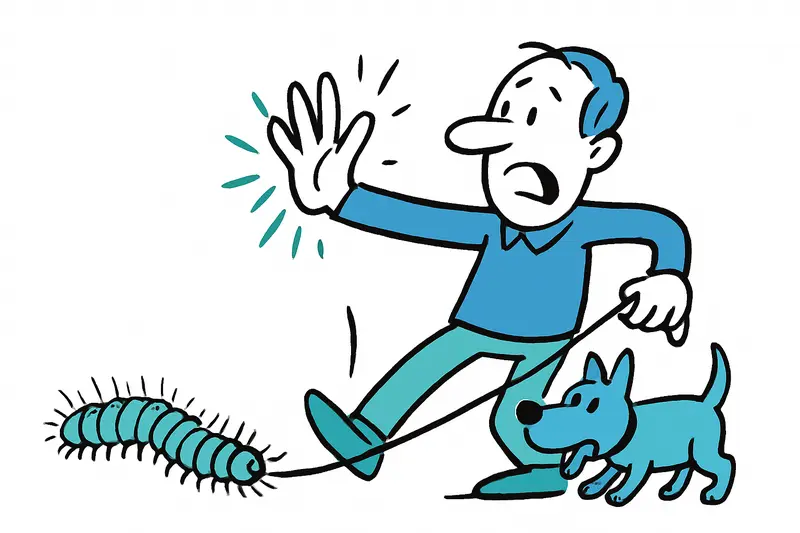
Cause inflammation on contact: How dangerous are the processionary caterpillars in Mallorca — and what needs to change now?
The caterpillars of the processionary moth are currently causing trouble in pine forests and parks. Authorities are removing nests, veterinarians warn: children and dogs are particularly at risk. A reality check with concrete measures for Palma and Calvià.
Cause inflammation on contact: How dangerous are the processionary caterpillars in Mallorca — and what needs to change now?
A guiding question, an everyday scene and clear proposals
Guiding question: How safe are our green spaces really when small, hairy caterpillars can injure children or dogs in the next gust of wind?
On a windy morning on Passeig Mallorca it smells of pine resin, the seagulls cry, and at the side of the road a mother lifts her child off the ground. She points to the pine tree where a few birds peck in the shade. Such scenes are everyday life in Palma — and right here an invisible danger lurks: the processionary moth. At the end of winter the caterpillars march in long lines from the trees to the ground to pupate. In doing so they leave behind stinging hairs that can trigger severe, sometimes dangerous inflammatory reactions when touched.
The administrations in Palma and Calvià have reacted: nests are being removed (Llucmajor expands campaign against oak processionary moth), in Palma partly burned, in Calvià controlled operations with noise cartridges are planned between February 17 and 28. The health authority also warns to be cautious in parks, gardens and other areas with pines at least until March. A local veterinarian describes vividly how dogs salivate, swell and immediately suffer significantly after contact — puppies are particularly at risk.
Critical analysis: The measures are right but incomplete. Early nest removals and targeted operations are not enough if communication is not considered. Above all, there is currently no uniform timetable: Which forests remain closed? Where exactly were nests removed and when is it safe to walk again? Many parents or dog owners do not know whether the path by the Olivar market or the trail behind Son Espases is dangerous. In addition, spatial controls are hard to enforce — a single tree can create a danger zone of dozens of metres, especially in the wind.
What is missing from the public discourse: transparent maps, clear protective notices at park entrances and exits, coordinated warnings to schools, kindergartens and dog training centers, and an easy reporting channel for citizens who discover caterpillars or nests. Also little discussed is how waste disposal in affected areas is handled — because caterpillars are often found around flower pots, playgrounds or even trash bins.
Everyday scene: A retiree with a shopping bag pauses on a bench in Parc de la Mar. Children run barefoot on the lawn. Nobody has seen a sign. No sign on the path. Then a look at her phone, a local neighborhood group reports 'Nest seen in Carrer de Sant Miquel'. That's helpful, but not a substitute for official, reliable information.
Concrete solutions — immediate and medium-term:
- Quick local maps: Municipalities publish a simple map with marked restricted areas and days of interventions. This map must be distributed via the city website, posted at park entrances and shared on social channels.
- Uniform signage: A standardized warning sign at all park entrances with brief instructions (Do not touch, keep animals away, emergency number) reduces uncertainty.
- Inform schools and daycare centers: Short letters to parents and school staff, clear rules for excursions into pine areas and an emergency plan for suspected cases.
- Veterinary emergency kits & training: Practices should know how to perform first aid. Mobile action instructions (rinse with lukewarm water, emergency care) help prevent more severe courses.
- Citizen reporting portal plus hotline: A simple report button on the municipal website and a telephone hotline for older people who do not use smartphones.
- Transparent operation protocols for removal: When were nests removed, how were they disposed of, and which protective measures did the workers wear? Citizens must know whether an area is safe again.
- Preventive tree care: Removing infested branches in the quiet season, targeted maintenance measures at playgrounds and promenades.
Some of these proposals are organizationally simple, others require resources. The crucial point: Those responsible in Palma or Calvià must act proactively in communication, not only technically. Temporary closures without information are poor consolation when parents are left with unanswered questions the next day.
Concise conclusion: The processionary caterpillar is a clear health hazard for humans and animals. The measures taken so far show that administrations are acting. But they are not sufficient as long as information gaps remain and prevention is not implemented systematically. Those who care about their neighborhood should now focus on visibility: maps, signs, involving schools and veterinarians — this must happen faster than the next procession of caterpillars.
Frequently asked questions
How dangerous are processionary caterpillars in Mallorca for people and dogs?
When are processionary caterpillars in Mallorca most active?
Can you safely walk in Mallorca parks with pine trees during caterpillar season?
What should I do if my dog touches a processionary caterpillar in Mallorca?
Are there processionary caterpillars in Palma’s parks and promenades?
Is Calvià doing anything about processionary caterpillars?
How can Mallorca residents report processionary caterpillar nests?
What information should Mallorca authorities publish during processionary caterpillar season?
Similar News

Mistaken identity with fatal consequences: Brutal assault in S'Aranjassa — what's missing in the follow-up?
At S'Aranjassa a visitor to a finca was tied up, beaten and thrown out of a van. Three men have been arrested, including...
High heel slips, car accelerates: accident on Camí de Son Hugo
A woman lost a high-heeled shoe on the forecourt of the sports facility at Camí de Son Hugo. The car accelerated, mounte...

Phone Scam: How Two Hotel Employees at Playa de Palma Lost Thousands of Euros
One morning in September, two reception employees at Playa de Palma were pressured by alleged alarm-company staff — in t...

When the Wallet Becomes a Danger: Attack in Peguera and Lessons for Mallorca
In Peguera, two women are said to have stolen the wallet from a 75-year-old German couple. When the victim intervened, t...
Plata stays Plata: Young people take over, Llonguets remain
A small bar on Carrer de l'Argenteria will continue: Tolo Serra hands the place over to young Mallorcans at the end of t...
More to explore
Discover more interesting content

Can Cap de Bou

Townhouse Lleo 72
