
Storm warning again despite spring sunshine: what Mallorca's coasts need to know now
Storm warning again despite spring sunshine: what Mallorca's coasts need to know now
Sunny days, 20+ °C – and yet the warning system beeps. AEMET reports a yellow storm warning for the night into Tuesday for almost the entire island. Why the weather flips so quickly, what is often missing in the debate, and how residents and businesses can act concretely.
Storm warning again despite spring sunshine: what Mallorca's coasts need to know now
Warm air by day, rough gusts at night – and again the question: are we prepared?
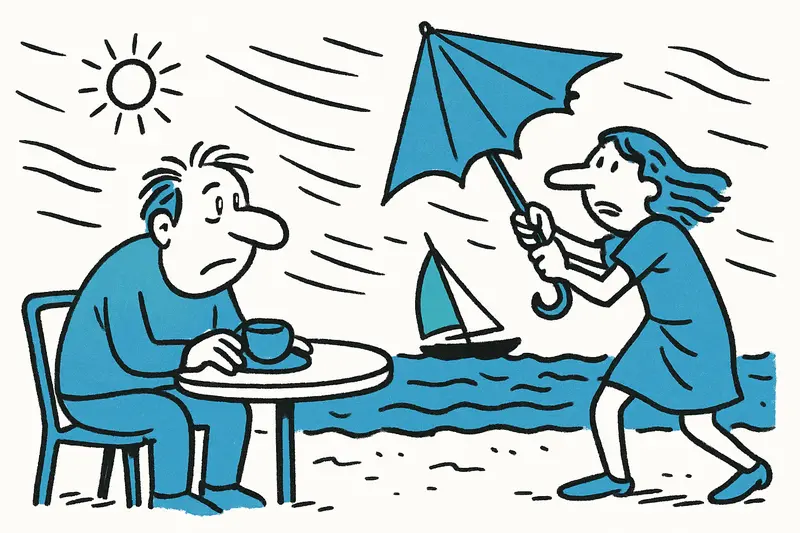
On Monday at midday the town sits half in the sun: people drink espresso at the Plaça del Mercat, and a sailing boat slowly pushes through the waves on the Paseo Marítimo. The forecast from the state weather agency AEMET turns the picture: as explained in First storm warning, then sun: How well is Mallorca prepared for this changeable weather?, for the night from midnight until about 6 a.m. there is a yellow storm warning for almost the whole island, with only the southwest excluded. Expected peak gusts are around 70 km/h. During the day it stays milder – AEMET expects daytime values around 21–22 °C, and only from Thursday will it cool down to about 16–18 °C.
Key question: why does such a sharp weather change surprise us, even though sunshine and springlike temperatures are the norm? The answer lies in the nature of the island: between the Atlantic and the mainland low-pressure systems move quickly, and mountain ranges like the Serra de Tramuntana locally amplify wind strengths. This leads to rapid shifts that are hard to prepare for on a warm afternoon.
Critical analysis: authorities and the public respond with warning levels, but in practice a gap appears. Many leisure boats are still moored, terrace owners have parasols open, market stalls are unsecured. The result of pale sunny mornings can be a small chaos at harbors and promenades – from stranded yachts and fallen trees to disrupted flights, as has already happened in recent weeks, as reported in Storm warning in Mallorca: Is the island prepared for wind and rain?.
What is often missing in public debate: a clear, locally understandable chain of actions. AEMET forecasts are available and authorities issue warnings – but how does the information reach the beach bar on the Platja, the yacht in Port d'Alcúdia marina or the family with the dog in Parc de la Mar within a few hours? The notice “Yellow warning” says caution is advised. It does not say what exactly everyone should do immediately, a point raised in Severe Weather Warning for Mallorca: Are Our Towns and Beaches Prepared?.
Everyday scene from Palma: Saturday, sun, Olivar market – between orange stalls and the clatter of shopping baskets a light westerly wind greets visitors. In the evening the mood changes: the wind freshens, trash bins rattle, older trees on Carrer de Sant Miquel creak softly. Whoever leaves their coffee on the terrace in the morning will later find wet cups and scattered napkins.
Concrete solutions that we should implement immediately: municipalities could provide standardized checklists for maritime, urban and tourist operations – for harbor operators (additional mooring lines, clear free spaces), for beach bars (roll up parasols, secure loose items), for markets (reinforce tarpaulins, anchor stalls). AEMET information should be sent by SMS or local apps targeted to operators in harbors and to the services responsible for traffic. Airports and ferry lines need transparent information chains for passengers so that changes are not communicated only at the gate the next morning.
In the medium term it is worth reviewing infrastructure: are berths sufficiently sized? Are there enough sheltered berthing areas for emergencies? How is tree maintenance on the promenades – are old, fracture-prone crowns pruned in time? And: could harbor facilities receive technical aids for short-term stabilization of yachts?
Some of these measures are simple: a central, multilingual warning page for Mallorca municipalities, visible signs at harbors, fixed procedures for shipyards and marinas on windy nights. Others require planning and money – such as retrofitting berths or regular tree inspections.
Concluding point: sunshine does not mean safety. The mild days are welcome, but we must not underestimate the feeling that the next low will strike back quickly. AEMET gives the signals – local implementation remains the responsibility of municipalities, harbor operators and people on site. If you go to the promenade in the next few hours: enjoy your coffee, but secure your bags.
Frequently asked questions
Is Mallorca expecting strong winds again despite the spring sunshine?
What should I do if I’m going to the beach or promenade in Mallorca during a wind warning?
Is it safe to go sailing or keep a boat in a marina in Mallorca during a storm warning?
Why does Mallorca’s weather change so quickly in spring?
What temperatures are expected in Mallorca before the next cooldown?
Could wind warnings in Mallorca affect flights or ferries?
What is the weather usually like on Mallorca’s west coast during a wind event?
How should towns in Mallorca prepare for sudden storm warnings?
Similar News

When the Wallet Becomes a Danger: Attack in Peguera and Lessons for Mallorca
In Peguera, two women are said to have stolen the wallet from a 75-year-old German couple. When the victim intervened, t...
Plata stays Plata: Young people take over, Llonguets remain
A small bar on Carrer de l'Argenteria will continue: Tolo Serra hands the place over to young Mallorcans at the end of t...

Unnoticed in the Luggage Compartment: How a Boy Traveled More Than 100 Kilometers in a Team Bus
A minor traveled in the undercarriage of a team bus for more than 100 kilometers until his cries for help were heard. A ...

Cap Vermell Grand: Second Michelin Key – a Gift for the East
The Cap Vermell Grand in Capdepera has been awarded its second Michelin key. For the region this elevates the luxury off...
Eurowings lets four aircraft carry names – a friendly idea that also reaches Mallorca
Eurowings is launching a campaign: four Airbus A320s are to carry the first names of people who help others in everyday ...
More to explore
Discover more interesting content

Can Cap de Bou

Townhouse Lleo 72
