
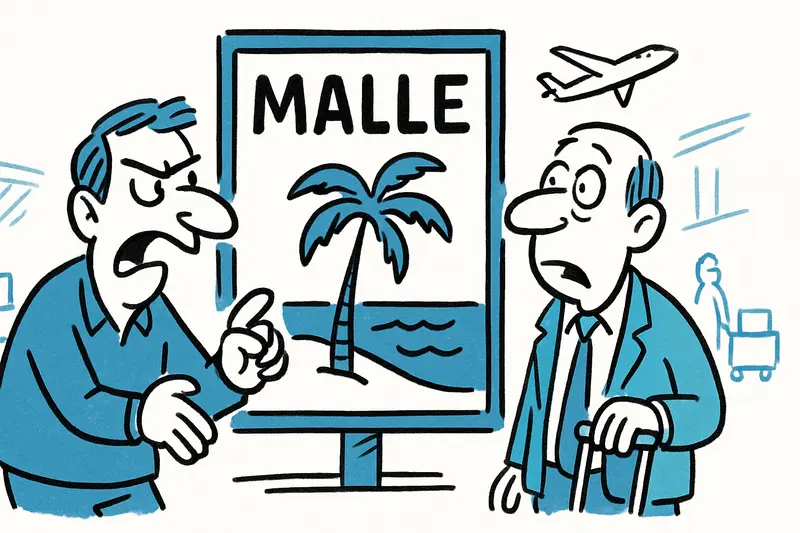
Controversy at the Airport: What the "Malle" Poster Reveals About Advertising and Respect
A large German-language advertising poster at the airport in Mallorca has sparked heated debates about language, image and how the local population is treated. A reality check with concrete solutions.
Controversy at the Airport: What the "Malle" Poster Reveals About Advertising and Respect
Key question: Are advertising campaigns at an international transport hub allowed to use provocative language that shapes the public climate of an island — or is there simply a lack of sensitivity to context and respect?
In Arrival Terminal A in Palma, where taxis honk as they pull up, suitcases clatter across the asphalt and the scent of cafés fills the concourse, a huge German-language advertising poster currently hangs. It calls Mallorca by a colloquial name and thus clearly targets a large portion of arriving guests. The ad has provoked a surprisingly strong reaction: city officials, hoteliers and many island residents feel insulted, as discussed in Poster Dispute in the Balearic Islands: How Much Provocation Can Public Space Tolerate?. The Sparkassen Finance Group has responded, saying it takes concerns seriously and will review how to proceed with the motif. Several aspects have hardly been discussed publicly — and that is exactly where this reality check begins.
Analysis: Advertising seeks attention, which is nothing new. It becomes problematic when attention is generated at the expense of understanding and respect. An airport is not merely a tourist site but a meeting place for residents, employees, suppliers and visitors from across Europe. A slogan that is humorous in one language can be perceived as derogatory or ignorant in another. On an island with its own identity and sensitive debates about mass tourism, the risk is greater.
What is often missing from the public debate is a sober inventory: What criteria apply to advertising at the airport? Who decides on language choice and tone? Was there any prior consultation with local interest groups? Such questions are rarely asked; instead, the conflict is debated on moral grounds. Another blind spot: the perspective of the airport workforce — cleaners, ground staff, small vendors in the concourse — who experience the impact of such motifs daily and are seldom heard in statements.
An everyday scene: On a late afternoon at Plaça Weyler, the sun slants, tourists roll luggage by, a bus driver laughs, an older woman puts groceries in her bag. She says she saw the poster and does not feel respected, because the language gives the impression that the island is treated as a backdrop for stereotypes. At the same time, a young waiter in front of a restaurant says advertising can also attract guests — if it doesn't provoke. These voices show that reactions are not monolithic; they are rooted in everyday life.
Concrete solutions: Instead of waiting for waves of outrage, binding rules and dialogue formats are needed. First, the airport center should publish an advertising code that explicitly considers language choice, cultural sensitivity and local consultation. Second, a short pre-check with an independent local working group would be useful: representatives from municipalities, hotels, workers and a language council could assess marketing concepts before they become widely visible. Third: a transparent complaints office with clear deadlines for reviewing ads. Fourth: advertisers should consider multilingual variants; a creative idea does not have to be equally pointed in every language. Finally: training for external agencies on the island's context and historical debates could prevent misunderstandings.
Legally, much of this sits in a gray area between freedom of expression and commercial freedom. In practice, however, airport operators and advertising space sellers decide what reaches the public eye. That is why binding award criteria are necessary — not as censorship, but as a quality standard for a place used by people from diverse backgrounds.
What is missing in public discourse is analysis of the root causes. It's not just about a word or a poster, but about how brands perceive and portray the island. As long as marketing teams operate with stereotypes without asking questions, conflicts will recur. There is also a lack of reliable data on how advertising messages affect local satisfaction and the destination's image in the mid to long term — here politics could take on an evaluative role.
Conclusion: The poster is less an isolated case than a symptom, a pattern explored in Posters, Provocation, Polarization: How Mallorca's Streets Become a Campaign Ground. In a place like the airport, advertising forms should be more carefully weighed. A pragmatic approach — transparent rules, local involvement, a clear complaints mechanism — would increase the chance to allow creative campaigns without offending the island community. Those who listen to the street know: respect pays off, one can still be loud, but with a sense of context.
In the end, it's about more than words on a banner. It's about the relationship between those who place ads and those who live here. When Palma spreads the scent of coffee and sea in the morning, the message coming from the terminal should not make the people outside roll their eyes.
Frequently asked questions
Why did the airport poster in Palma cause such a strong reaction in Mallorca?
Are provocative ads allowed at Palma airport in Mallorca?
What makes an airport ad insensitive in Mallorca?
What should tourists know when arriving at Palma airport in Mallorca?
How can Mallorca avoid conflicts over airport advertising?
Who is affected by controversial advertising at Palma airport besides tourists?
Why do Mallorca residents react strongly to tourism marketing language?
What can advertisers learn from the Mallorca airport poster controversy?
Similar News
Can Malle hits really work in Hamburg? A reality check for the premiere of "ALLE LIEBEN MALLE"
Premiere at the Großmarkt: thousands of attendees, stars from the Megapark and long beer queues. Why the concept works —...

Adrien Brody strolls through Mercat de l'Olivar – celebrity visit leading to Sa Pobla
Actor Adrien Brody was casually spotted at the Mercat de l’Olivar: tapas, fish stalls and later a stop in Sa Pobla spark...
Who can pick up whom? The complicated life of Mallorca's taxis
Three years after the inter-municipal service, empty runs are rarer — but there is a lack of equal treatment, transparen...

When the Tap Only Runs Sometimes: Why Municipalities in the Balearic Islands Are Now Rationing Water
Deià, Valldemossa, Esporles, Sóller and several places on Menorca are scaling back water supply. Who is responsible, why...

Battle for the Ramp: Why Cala Gamba Needs More Than Enforcement
The Guardia Civil intervened in Cala Gamba — residents breathed a sigh of relief, but unease remains. Key question: Are ...
More to explore
Discover more interesting content

Boat Tour with BBQ along Es Trenc Beach
Private transfer from Mallorca Airport (PMI) to Pollensa
