
Between Welcome Banner and Demonstration: Camp de Mar Makes a Statement — Is It Enough?
Between Welcome Banner and Demonstration: Camp de Mar Makes a Statement — Is It Enough?
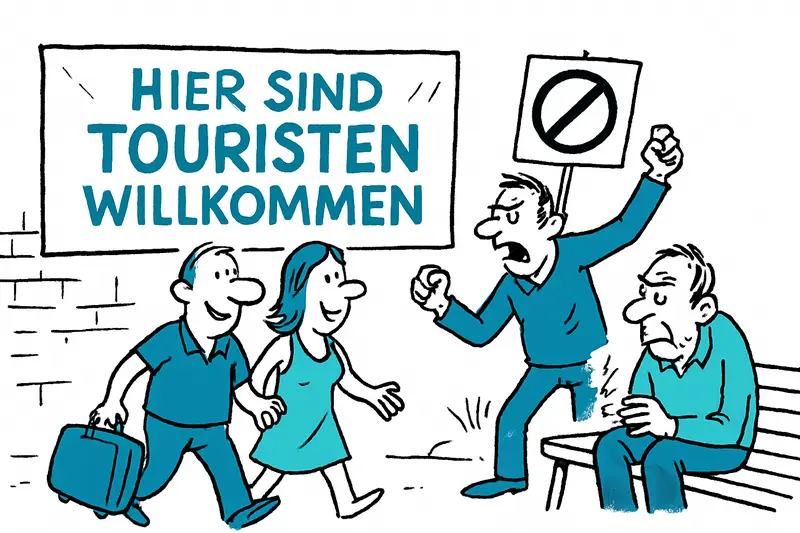
A banner at the entrance to Camp de Mar declares: "Tourists are welcome here." The gesture coincides with a large demonstration in Palma. What does this say about island politics and everyday life on the ground?
Between Welcome Banner and Demonstration: Camp de Mar Makes a Statement — Is It Enough?
Key question: Can an entrance banner bring together the deep fears and interests of an island?
In the early morning, when the sun already warms the car park in front of the beach and the church bells of Sant Joaquín still echo through the alleys, a large banner hangs at the entrance to Camp de Mar: "Tourists are welcome here." It is four-language, neatly cut, attached to the wall that leads to the small road by the beach cove. The action was organized by residents, hoteliers and shopkeepers. It coincides with a large demonstration announced for Palma; see Palma after the Protest: How Freedom of Expression and Everyday Life Can Be Balanced.
The image is simple: on one side a clear welcome message in a place that has lived from tourism for decades; on the other side the anger and concern among parts of the population about overload, noise and rising rents. Camp de Mar is not a big town. There is a shady fisherman’s restaurant, a narrow wooden jetty to the small restaurant-island and the golf course inland. Many families in the village earn their living directly or indirectly from guests. This economic interdependence explains why the banner provokes little surprise.
Critical analysis: A symbol is not enough — what is missing?
A banner is a message, not a policy package. It signals belonging and stance, but says nothing about how tourism revenue is distributed, how pressure in high season should be managed, or how familiar routes and accesses — for example the hiking paths to Cap Andritxol — can remain permanently public. In Camp de Mar there have been past conflicts over access and private interests; even prominent cases have been discussed. Such conflicts do not end with a photo at the town entrance, as shown in Posters, Provocation, Polarization: How Mallorca's Streets Become a Campaign Ground.
Public discourse often fails to distinguish between two levels: the immediate concerns of local people — jobs, accessibility, price developments — and the island-wide question of how much tourism is ecologically and socially sustainable, as explored in The Island Says No to Overcrowding: What the Survey Really Means. The debate quickly polarizes into "for" or "against." Middle-ground positions that combine fair levies, limits at critical sites and investments in infrastructure rarely come to the fore.
A scene from everyday life
On the feast day of Sant Joaquín an older man sits on the bench near the wooden jetty, smokes a cigarette and watches children run barefoot to the sea. A waitress from the restaurant-island carries trays with pa amb oli across the slightly creaking jetty. Such images show that tourism here is not abstract; it is the neighbor who closes the shop, the daughter who works as a waitress, the voice on the radio, a dynamic also examined in Between Welcome and Wariness: Germans in Mallorca — What's Really Happening.
Concrete approaches
A banner should be accompanied by measures that secure local interests. Proposals that could be discussed in municipalities like Andratx include: a) a local fund into which hotels and holiday rentals pay a share of their revenues; the funds would go to roads, waste disposal and price stabilization for residents. b) transparent building and planning procedures with binding rules for public access to coastal paths. c) seasonal tax adjustments and incentives to shift offerings into the low season so that jobs fluctuate less. d) promotion of alternative economic sectors — crafts, agriculture, small manufacturers — that create employment beyond large projects. None of these ideas is new, but they are more effective than a single welcome poster.
What is missing in public debate
Often the language is missing that turns "tourism is important" into "tourism must be organized fairly." Binding transparency rules for real estate transactions, clear regulations for coastal access rights and models for keeping revenue from luxury properties local are lacking. Without such frameworks the welcome sign remains PR — nice to see, but thin in substance.
Camp de Mar has reasons to publicly welcome guests: economic dependence, local festivals, traditions. At the same time the situation reveals the weak spot of many Balearic places: the balance between residents' quality of life and economic attractiveness is fragile. A banner can lift spirits; the solution requires decisiveness at municipal and regional levels.
Conclusion: The welcome message is a clear, human sign in a heated debate. It makes visible who in Camp de Mar currently believes they have something to lose. Those who seriously want tourism to continue to secure jobs and keep villages alive must think beyond the banner: protect access rights, ensure fair levies, invest deliberately in infrastructure and give residents real participation. Without such steps the sign will remain only a photo — and the problems will stay put.
Frequently asked questions
How can Mallorca balance tourism with residents' concerns beyond a welcome banner?
What concrete steps could help Mallorca ensure tourism benefits residents in places like Camp de Mar?
What does Camp de Mar’s entrance banner tell us about how residents view tourism?
How can Mallorca protect public access to coastal paths like those near Cap Andritxol?
Why did demonstrations in Palma coincide with a welcome banner in Mallorca?
How do feast days like Sant Joaquín show tourism’s everyday impact on Mallorca residents?
When is the best time to visit Mallorca for beach and outdoor activities?
How should travelers prepare for Mallorca’s weather and packing needs?
Similar News

More water than last year: Mallorca's reservoirs breathe easier
September rain refilled the Tramuntana's reserves: overall fill around 35 percent, Cúber at 40.42 percent, Gorg Blau at ...

Three Luxury Hotels in Banyalbufar: Lots of Money, Many Questions
A Danish investor plans three exclusive accommodations in Banyalbufar — including the historic Son Valentí. The announce...
2.1 tonnes of cocaine on sailing yacht off Spain's coast – a reality check for the coastguard
A 14-metre yacht was seized with 2.1 tonnes of cocaine. Who monitors the ports, how does the international hunt succeed ...

Heat Bonus in Mallorca: 100 Euros Extra for Outdoor Staff at MarSenses
MarSenses pays employees who worked outdoors in August an extra €100 as recognition. Lighter uniforms, reduced hours for...

Renovating in Mallorca: What You Really Can Do Without Neighbour Consent
Many think they can do whatever they want in their apartment. That's partly true — but only as long as structural elemen...
More to explore
Discover more interesting content

Can Cap de Bou

Townhouse Lleo 72
