
Twelve in Son Sardina: How a Men's Flatshare Keeps Football Alive in Mallorca
Twelve in Son Sardina: How a Men's Flatshare Keeps Football Alive in Mallorca
Eleven players, one house, six bedrooms: How FC Germania Mallorca in small Son Sardina builds cohesion, solves problems — and loudly wins on the pitch.
Twelve in Son Sardina: How a Men's Flatshare Keeps Football Alive in Mallorca
Eleven players, one house, six bedrooms — and things you have to learn along the way
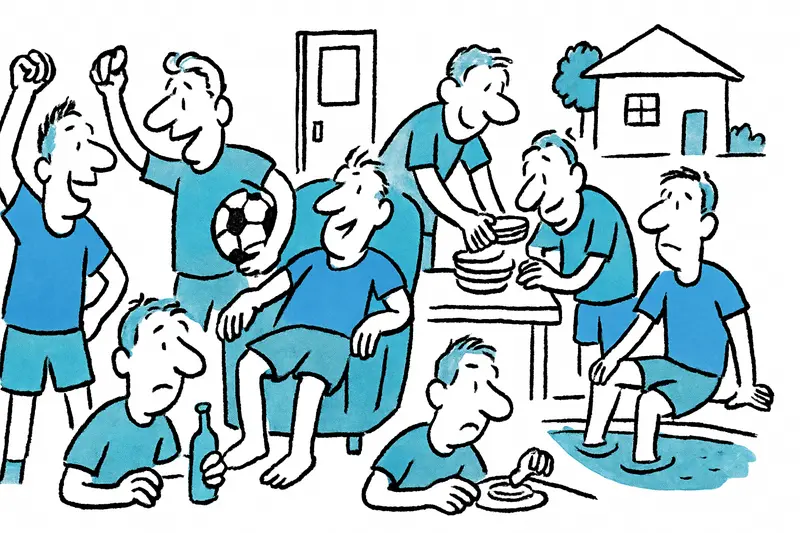
Son Sardina, a noticeable wind from the Coll d’en Rebassa, dogs barking from the street and the smell of freshly brewed café coming from a bar around the corner. In the middle of this quiet suburban scene, eleven men have come together and developed a slightly different kind of team life: a shared villa with a pool, six bedrooms and around 180 square meters of living space.
The project is simple: the team finds accommodation, players live together, training and everyday life merge. The numbers add up: eleven outfield players, six bedrooms, usually two per room, with one single room as an exception. Within the club the house is described as a practical solution — not a luxury resort, but a functional home that offers space and is close to the training ground and infrastructure.
The daily routine carries the club spirit. They train four times a week, mostly around midday, and afterwards life shifts to the villa: one person washes up, another puts things away, someone lies by the pool — sounds that suggest year-round activity. Players like the experienced striker, who has already scored several times this season, or the vice-captain are part of this shared routine during the day. The club captain and sporting director coordinates appointments, contacts and organisation, but does not live in the house; he lives nearby with his family — a setup that provides calm and leadership from outside.
Practical learning is part of it: at the beginning it wasn't easy to convince a landlord to entrust a villa to such a large, young, international group. The household also needed rules. A second fridge was bought; food is labeled with names, and occasionally they cook together. A cleaner comes, but less often than expected — because with eleven people keeping things tidy is an ongoing process.
Personal privacy is not a given. Some players miss privacy; others appreciate living together precisely because they are far from family or home, a situation described in "In Germany I was often alone": Why Sali swapped Düsseldorf for Mallorca. A Dutch player in the team compares the shared living to earlier flatshare times abroad: it is both a protective space and a workplace. Conversations, support on bad days, spontaneous training sessions in the backyard — all of this strengthens the bond.
The most recent sporting week made the cohesion visible: after a coaching change that was handled internally, the team achieved a clear win on the pitch, mirroring cup surprises such as Atletico Baleares creates cup upset – Palma dreams of a big one. Such moments of success act like glue for a young side that still needs to find itself both on the field and off it.
For Mallorca this model has a positive side: it brings young players work, entertainment and regional encounters. Clubs that deliberately bring talents to the island and provide them with housing create local variety — in Son Sardina you now hear German, Dutch and English on the street more often, and that's a small, visible enrichment, even at community events like A Football Evening for Everyone: Bavaria Meets Palma in Santa Ponça. The neighbourhood benefits from livelier squares, and small shops from errands before training.
What remains as an outlook? A men's flatshare is not a permanent state for every professional. But as a stopover, a place for settling in and team-building, the concept works surprisingly well. If rules succeed, a balance between community and retreat exists, and the club organises itself accordingly, a house like this can become fertile ground for sporting ambitions — and at the same time a bit of everyday life Mallorca can use: loud, lively, sometimes chaotic, but with heart.
Reader's perspective: Anyone strolling through Son Sardina on a quiet afternoon will notice the house with the small garden. Sometimes someone sits on the steps, eats a box of paella leftovers and laughs out loud — a perfectly normal, genuine club everyday life. And that is probably the best news for the neighbourhood.
Frequently asked questions
What is the Son Sardina football flatshare model in Mallorca?
How can a large shared house affect team cohesion for Mallorca clubs?
What are the practical challenges of housing 11 players in one home in Mallorca?
What benefits might a Mallorca neighborhood see from a club housing its talents nearby?
What does a typical training week look like for a small Mallorca club living together?
Is a men's flatshare meant to be a permanent arrangement in Mallorca clubs?
How is the living space arranged in the Son Sardina villa?
How did the flatshare model influence on-field performance in Mallorca?
Similar News
Til Schweiger in Mallorca: Calm, New Closeness and an Alcohol-Free Fresh Start at the Finca
The actor appears to have found a different life on the island: rural everyday life on the finca, a new partner and a co...
Playa de Palma: How expensive watches disappeared on the promenade – a reality check
Two apparently linked incidents at Playa de Palma — thefts of luxury watches worth a total of €34,000, one person arrest...

Ryanair to fly from Kassel-Calden to Mallorca in summer 2027 – a boost for the island
For the first time, Ryanair will offer twice-weekly connections from Kassel-Calden to Palma in summer 2027. What this me...
Cash Missing from Hotel Safe: Holiday Couple Complains in Sa Coma
A German couple reported the loss of €600 from their hotel room safe after a stay in Sa Coma. The Guardia Civil is inves...
Red Blitz goes into winter break – what it means for tourists and island residents
The historic Palma–Sóller railway will close on November 23; a reduced timetable is already in effect. We examine who is...
More to explore
Discover more interesting content

Can Cap de Bou

Townhouse Lleo 72
