
Cardiac Arrest at Cala Mesquida: What This Response Reveals About Mallorca's Beach Safety
Cardiac Arrest at Cala Mesquida: What This Response Reveals About Mallorca's Beach Safety
A 59-year-old tourist suffered a cardiac arrest at Cala Mesquida. Lifeguards resuscitated him with a defibrillator; the man is in critical condition in Palma. What is now lacking: prevention, equipment and transparency.
Cardiac Arrest at Cala Mesquida: What This Response Reveals About Mallorca's Beach Safety
Key question: Are staff, equipment and information at Mallorca's beaches sufficient to reliably handle cardiac emergencies?
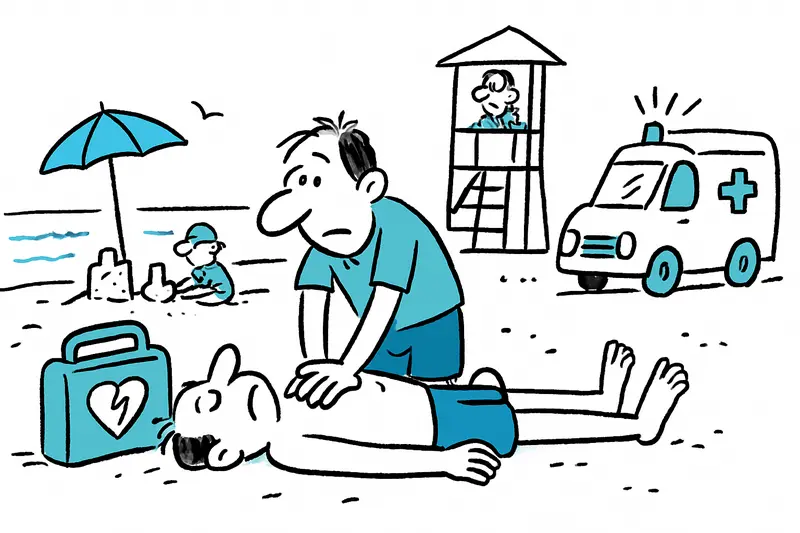
On Tuesday afternoon, in oppressive heat — the thermometer in Palma showed 35 °C — a 59-year-old holidaymaker collapsed at Cala Mesquida on the east of the island. Lifeguards on the beach began cardiopulmonary resuscitation (CPR) and used a defibrillator. The man was stabilised and taken by ambulance to an intensive care unit in Palma, but remains in critical condition.
Such reports are alarming: the images of sand, pines and waves are as familiar as the buckets of children playing at the water's edge. Yet between beach picnics and swimwear lurks the risk of sudden cardiac arrest — for locals and visitors alike. Recent cases across Mallorca — including a fatality at Playa de Palma — underscore this risk. At Cala Mesquida, where families seek shade under the pines and lifeguard towers overlook the bay, it becomes clear how quickly a holiday routine can turn into an emergency.
Critical analysis
The good news is that immediate measures worked: both laypeople and professional rescuers were able to act quickly and use a defibrillator. At the same time, the incident raises several questions. How many bathing spots actually have easily accessible automated external defibrillators (AEDs) in clearly visible locations? Are sufficiently qualified personnel present during peak times? Does the chain of survival between beach and hospital have clearly documented transmission pathways so that vital information (previous medical findings, success of resuscitation, energy levels used) can be passed on to the hospital promptly? Past incidents, such as Cardiac arrest on Can Picafort Beach, highlight the stakes and the need for systemic answers.
What is often missing from public discourse
Public reports often focus on rescue deeds and heroic stories, and less on systemic gaps: the distribution of AED devices, their regular maintenance, the availability of rescue personnel in side coves, linguistic accessibility for international guests, and binding protocols for information flow between the beach, emergency services and hospitals. Without these details, safety remains piecemeal — until another emergency exposes the weak points. Even successful resuscitations, such as the collapse on the Boulevard in Peguera, prompt questions about preparedness beyond the initial response.
Everyday scene from Mallorca
Anyone who visits Cala Mesquida on a hot afternoon knows the scene: children build a sandcastle at the water's edge, a vendor pushes a cart with cold drinks past, the wail of an ambulance suddenly mingles with the chirping of cicadas. People stop, conversation falls silent. The lifeguards, who usually exude calm, become a focused operations centre — airway checks, chest compressions, electric shock. Such moments change the beach atmosphere for hours.
Concrete solutions
1) Expand the AED network: install public AEDs at all major beaches and selected coves, with clearly visible signs and protective cabinets that function reliably in heat and sand. 2) Maintenance and registration: each device must be recorded in a regional register, with mandated maintenance intervals and functional checks. 3) Multilingual information: signs and emergency instructions in Spanish, Catalan, English and German, with guidance on how to act in cases of unconsciousness. 4) Training campaign: regular first aid and AED courses for lifeguards, beach staff, hoteliers and interested residents; including short refreshers for tourism workers during the high season. 5) Improve data transfer: a simple form or digital handover — detailing what measures were taken on the beach, how long resuscitation lasted, and how the defibrillator was used — should be standardised and transmitted to the receiving hospital. 6) Prevention for travellers: campaigns warning tourists about heat, overexertion and cardiac risks; advice on medications, hydration and resting if they have pre-existing conditions.
Concise conclusion
The successful initial response at Cala Mesquida shows: lives can be saved by quick action. At the same time, the incident reveals gaps that cannot be closed by lifeguards on site alone — as other cases, including a death at Balneario 2 in El Arenal, have shown. If Mallorca continues to combine mass tourism and hot summers, the island needs a systematic safety net: more devices, clearer rules, better information — and routine collaboration between beach and hospital. Only then will a single incident not become the next warning call.
Frequently asked questions
When is Mallorca's best time to visit for outdoor activities?
Can you swim in Mallorca year-round, or is it seasonal?
What should I pack for a Mallorca trip?
What are the top activities to do in Mallorca?
How can I get around Mallorca without a car?
Are Mallorca’s beaches family-friendly?
What safety tips should I know for Mallorca’s coastline?
Where can I find authentic Mallorcan food and local dining?
Similar News
From Deposit to Arson: How a Dispute over Jet Skis in El Molinar Escalated
After a nighttime fire in El Molinar a detainee is in pretrial detention. How could a conflict between a rental company ...
Lying Instead of Standing: How Prone Paddling Is Conquering Mallorca's Waters
On your belly across the sea — prone paddling is bringing fresh energy to Mallorca's watersports. Where to start, which ...
Housing Shortage in Mallorca: Assessment, Questions, Proposals
Over 2,000 new housing units through repurposing and special rules – sounds like a success. But do they really help peop...
Garbage, Stench, Fire Risk: What Is Really Going Wrong in Son Bauló
An apartment ensemble illegally built for years near Son Bauló is falling into disrepair, largely occupied and creating ...

Legat on Mallorca: Between Football Dreams and Political Alarm
The former pro is intervening in German politics from Mallorca – loud, emotional, without much detail. What does that br...
More to explore
Discover more interesting content

Boat Tour with BBQ along Es Trenc Beach

Private transfer from Mallorca Airport (PMI) to Pollensa
