
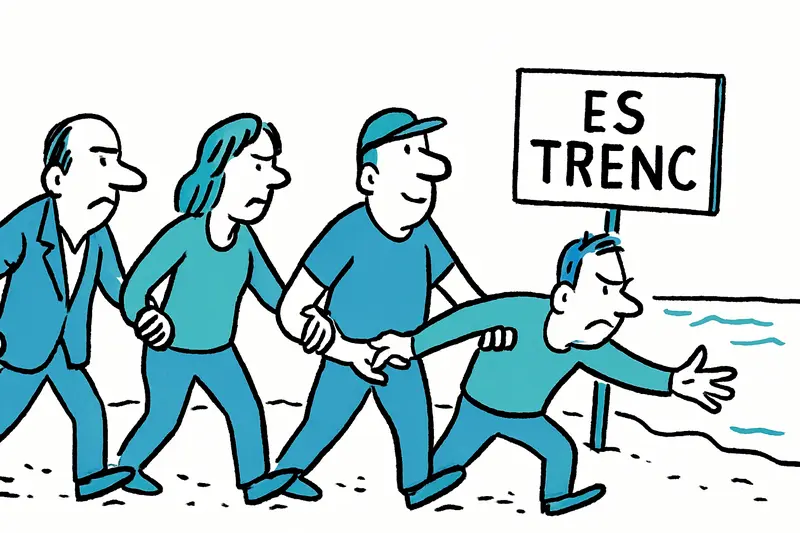
Who decides over Es Trenc? Human chain as a test for democratic nature protection
On July 5 Mallorca will form a human chain at Es Trenc beach. A controversial law allows decrees instead of parliamentary votes for nature park changes – the debate continues.
Who decides over Es Trenc? Human chain as a test for democratic nature protection
Protest on July 5, government defends decree route – and the island asks: is that enough?
In the early morning, when the first delivery van passes the salt flats of Campos and seagulls glide over the flat beach, Es Trenc still looks like a map of sand and light. On July 5 at 10 a.m. hundreds — perhaps thousands — of people want to form a chain right there. The action was organized by the local environmental groups GOB, Terraferida and the initiatives Menys Turisme and Més Vida. Their signs bear a short sentence: "Whoever loves Mallorca does not destroy it."
Key question: Does the Es Trenc–Es Salobrar nature park lose democratic oversight if decisions can in future be made by government decree?
The background is an amendment in a so-called omnibus law of the Balearic regional government. In future, adjustments to protected areas should not necessarily be decided by the regional parliament, but directly by decree of the executive. For many activists this increases the risk that protection rules will be changed more quickly and with less political debate — and that economic interests will be easier to enforce.
The government under Marga Prohens defends the move. It emphasizes that Es Trenc will not be downgraded; the decree procedure already applies to other protected areas of the islands, the government says — Cabrera is explicitly cited as a comparison. At the same time the administration announced it would take over the former school building Ca n'Estela in Campos and establish an information, research and visitor center for the park there. For citizens this sounds like additional care; for activists it is not enough as a guarantee.
Critical analysis: The debate is not only about formalities. What matters is how transparent processes, participation and scientific oversight will look in the future. A decree can act faster — that is not inherently bad, for example to address acute problems. It becomes problematic if this speed replaces democratic participation and if independent environmental assessments are lacking. It remains open which guarantees there will be for public consultations, binding environmental reports and regular monitoring statements.
What has so far been missing in the public discussion are concrete examples of how decree changes could work in practice. Who checks the basis of such decisions? Is there a deadline for objections? What role do municipalities like Campos or affected user groups — fishers, farmers, tourism businesses — play? And: How binding are the spatial planning and management plans that, according to the government, are already regulated by decree?
An everyday scene from southern Mallorca: On the MA-19 between Campos and Ses Salines, cars with license plates from half of Europe park on weekends. Recently, cameras at the Sa Barralina car park have been counting spaces in real time . Families unload coolers, locals steer their bicycles along the small paths to the dunes. In a bar opposite the salt mound, employees of a boat rental and an older woman from Campos exchange views on the news — some hope for better protection, the other fears new regulations for her small stall. The human chain shows these voices: it is not only activists who are present, but also people who make their living from the coast.
Concrete solutions that could ease the situation:
1) Clear procedural rules: Decrees should only be permissible if tied to strict deadlines, a duty to hold public consultations and to disclose the scientific basis.
2) Independent environmental assessments: Any change to the protection status needs an external, publicly accessible report with monitoring requirements.
3) Stronger involvement of municipalities: Municipalities like Campos must have a say in measures that affect their infrastructure and local economy. Building law relaxed: How Mallorca decides between housing and farmland
4) Citizens' advisory council for protected areas: An advisory body made up of residents, scientists and users could monitor in the long term whether decree decisions meet conservation objectives.
Conclusion: The human chain on July 5 will not overturn a single law. But it is a barometer test: How great is the distrust of decision-making paths that appear less public? Visitors to Es Trenc do not see political procedural issues on the beach — they see dunes, pines, salt and tourists moving between parasols. Similar disputes have arisen elsewhere: investigations into a hotel raised questions about beach access at Playa de Formentor. Politics, however, must find ways to regulate this everyday mix of nature, economy and life so that trust can emerge. That is only possible with transparency, reliable assessments and genuine participation. If these are lacking, symbolic chains will continue to be demanded — and that is a bad sign for the future of the protected area.
Frequently asked questions
Who decides Es Trenc protections in Mallorca?
Why are decree changes for protected areas controversial in Mallorca?
What safeguards are proposed to keep transparency with decree-based protections?
What is Es Trenc and Es Salobrar, and why are they important in Mallorca?
How can Campos and other locals influence Es Trenc protections?
What does the public think about governance changes for Es Trenc?
If protections are changed by decree, what could that mean for local life on Mallorca?
Where can visitors learn about Es Trenc protections and park management in Mallorca?
Similar News

Arrest at the Port: Three Suspected Pickpockets Left Mallorca After Series of Thefts
The National Police stopped three men at Palma harbour who are accused of several thefts at the airport. How could the g...

Palma's Rental Bike Boom: More Bikes, More People, More City Life
Since Bicipalma was opened to non-residents, the system has noticeably grown. Students, residents and tourists bring lif...

Palma–Lyon in Winter: Two Weekly Flights Bring Fresh Momentum
From October Transavia France will connect Palma and Lyon in winter as well: Wednesdays and Saturdays, around 17,000 sea...

Budget holidays in Mallorca: What thriftier tourists really mean
Visitors are spending less: shorter stays, fewer restaurant visits, fewer excursions. A reality check for Mallorca's eco...

Mallorca gets winter link to Lyon: Transavia France flies from October
Transavia France will launch a winter direct connection Palma–Lyon from late October: twice weekly, around 17,000 seats ...
More to explore
Discover more interesting content

Boat Tour with BBQ along Es Trenc Beach

Private transfer from Mallorca Airport (PMI) to Pollensa
