
Caught at the Gate: Why Arrest Warrants and Payments at German Airports Raise Questions
Caught at the Gate: Why Arrest Warrants and Payments at German Airports Raise Questions
A 29-year-old man was stopped during a random exit check in Düsseldorf. Two arrest warrants were outstanding; a payment apparently prevented detention. What does the case reveal about checks, justice and practice at airports?
Caught at the Gate: Why Arrest Warrants and Payments at German Airports Raise Questions
Arrest in Düsseldorf, missed flight to Palma — and a payment apparently prevented detention
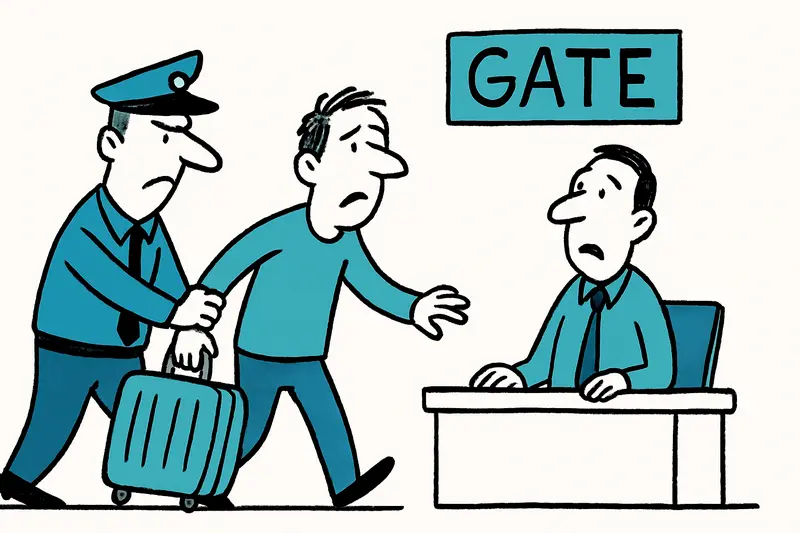
During a random exit check at Mallorca holiday ends with arrest at Düsseldorf Airport, a 29-year-old man from Syria who was traveling to Palma de Mallorca was stopped. Two outstanding arrest warrants appeared in police systems, issued in May by the Aachen public prosecutor's office. The allegations: driving without a license and fraud. The immediate consequence for the traveler was abrupt: he missed his Eurowings flight and found himself at the gate instead of on the plane.
At first glance the scenario seems unspectacular: checks are part of everyday life at airports. But the case contains several elements worth examining more closely — and a small, unusual twist: according to authorities, the man was apparently able to avert the execution of a substitute custodial sentence of 147 days by paying a fine of €8,020. A helpful acquaintance appears to have assisted in making the payment.
Key question: What does this incident reveal about the effects and limits of police checks at airports, about the handling of arrest warrants — and about the social side of penalties? These are not academic questions: they concern travelers, officers, the judiciary and the people who ultimately have to pay.
Critical analysis: Spot checks work as a security instrument because they uncover irregularities that are not visible at the counter or online. In this case they did just that. But uncovering an arrest warrant brings a series of consequences that go beyond the arrest itself: procedures for enforcement, trade-offs between custody and fines, costs for the person affected and organizational effort for the authorities. That a payment on the spot prevented detention raises the question of how transparent and consistent such practices are.
What is often missing from public discourse is the perspective of those affected and the lower levels of judicial administration. We hear the headline "arrested" or "arrest warrant" — but rarely how decisions about substitute custodial sentences are actually made, what deadlines apply and what assistance is available for people without a fixed residence or limited financial means. Equally overlooked is the role of personal networks. In this case an acquaintance apparently made the payment; what does that mean for those who have no one to step in? Cases such as an arrest in Mallorca after European arrest warrants illustrate cross-border enforcement issues.
Practical scene from everyday life in Mallorca: on Sundays, when market traders at the Mercat de l'Olivar set up their stalls, taxi drivers and young shop owners talk about passengers who arrive late or miss flights. Some are stressed, others resignedly calm. A missed flight is often merely annoying for locals; for someone stopped because of an outstanding penalty, as in an accidentally detained: when a wrong turn after returning from Mallorca becomes costly case, it can trigger a chain of existential consequences.
Concrete, practicable solutions: first, better information flows between public prosecutor's offices, courts and border authorities so that checks clearly show whether an order is enforceable or an older claim has already been settled. Second, standardized decision trees for officers on site: when is arrest necessary, when can deadlines be set or transfer/payment options offered? Third, transparent alternatives to immediate incarceration — accompanied payment plans, social counseling or short-term referral to legal assistance can prevent people from suddenly losing all options during a check.
Another issue: social inequality in enforcement. Fines can be paid — for those who can afford it. For people without savings the only option may be loss of freedom. If judicial practice effectively provides a "way out" for the better-off while others end up in custody, a question of fairness arises that is often underrepresented in public debate.
From the perspective of airport logistics, clarity is also important. Police actions at gates tie up personnel and delay operations; at the same time security interests must be preserved. A sensible solution would be to prioritize certain enforcement actions at police stations outside the departure area so as not to unduly disrupt travelers and procedures, without undermining law enforcement.
A small but relevant point: communication with the person concerned. People in the stressful situation of a missed flight and a confrontation with arrest warrants need clear, calm information about their options — not just a short announcement of "arrest warrant." Training for airport deployment officers that takes social aspects into account alongside legal steps would defuse many situations.
Conclusion: The case of a 29-year-old stopped during an exit check in Düsseldorf, whose detention was apparently averted by payment, is a small prism: it shows how security routines, law enforcement and private circumstances interact. There are practical solutions: better data coordination, transparent on-site rules and humane alternatives to immediate detention. Island everyday life — from ferries to market stalls in Palma — benefits if airports and the judiciary cooperate more precisely, fairly and comprehensibly.
In short: checks are meant to provide security. They must not become mechanisms of random inequality. Someone booking a flight home from Mallorca does not expect a court hearing at the gate. Authorities should ensure that this does not become an entry point for social injustice.
Frequently asked questions
When is Mallorca at its best for a beach holiday and outdoor activities?
Do I need a car in Mallorca or is public transport enough?
What should I pack for a Mallorca trip?
Are there family-friendly beaches in Mallorca?
What makes Sóller worth a day trip from Palma?
Is Alcúdia a good base for exploring the north coast?
What can you see in Valldemossa, and is it worth a day trip?
Is a detour to Deia worth it when exploring Mallorca's north coast?
Similar News

More water than last year: Mallorca's reservoirs breathe easier
September rain refilled the Tramuntana's reserves: overall fill around 35 percent, Cúber at 40.42 percent, Gorg Blau at ...
Three Luxury Hotels in Banyalbufar: Lots of Money, Many Questions
A Danish investor plans three exclusive accommodations in Banyalbufar — including the historic Son Valentí. The announce...
2.1 tonnes of cocaine on sailing yacht off Spain's coast – a reality check for the coastguard
A 14-metre yacht was seized with 2.1 tonnes of cocaine. Who monitors the ports, how does the international hunt succeed ...

Heat Bonus in Mallorca: 100 Euros Extra for Outdoor Staff at MarSenses
MarSenses pays employees who worked outdoors in August an extra €100 as recognition. Lighter uniforms, reduced hours for...
Renovating in Mallorca: What You Really Can Do Without Neighbour Consent
Many think they can do whatever they want in their apartment. That's partly true — but only as long as structural elemen...
More to explore
Discover more interesting content

Can Cap de Bou

Townhouse Lleo 72
