
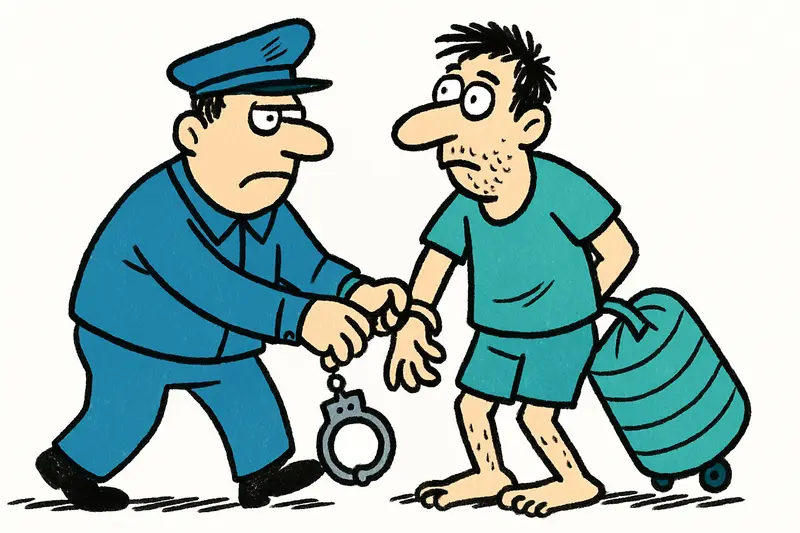
From the Beach to Handcuffs: Mallorca Holiday Ends with Arrest at Düsseldorf Airport
A 26-year-old holidaymaker was arrested after a flight from Palma at Düsseldorf Airport because an outstanding remainder of a sentence from a drug case was still pending. What does the case reveal about cross-border law enforcement, airport checks and the responsibility of travellers?
From the beach to police custody: airport check leads to arrest
You're still sitting with sand between your toes, smelling the last traces of the sea and fried fish sandwiches, maybe with a pair of flip‑flops in your carry‑on – and then the Mallorca trip suddenly ends in handcuffs. That's what happened in early September to a 26‑year‑old traveller from Poland who was arrested during a random check at Düsseldorf Airport after a return flight from Palma. It wasn't a large manhunt or a drama at the gate, but a routine inspection that uncovered an outstanding criminal case.
The guiding question: how safe are we from overlooked past liabilities?
The short version: a court had handed down a custodial sentence in 2021 for unlawful importation of narcotics; roughly 62 days remained to be served. Officers at the airport stepped in and handed the man over to the justice authorities. The pressing question, however, is another: how can it be that such cases only become visible when returning from holiday? And what role do the borders within Europe, information exchange and routine airport checks play, as explored in Arrest in Mallorca after European arrest warrants: How safe is the island as a hideout??
On Mallorca, between the roar of the waves at Playa de Palma and the little shops in Palma's old town, such a report seems almost surreal. This is holiday: people celebrate, drink cortado on Passeig del Born and listen to gulls crying above the beach kiosks. Yet the case is a reminder: legal baggage doesn't know a holiday mode, as other accounts like Handcuffed Straight from Palma: Cross‑Border Manhunts, Mistakes and Mallorca's Image show.
What does this mean for travellers and authorities?
First, praise for the control practice: random checks are indispensable to secure not only geographical borders but also the rule of law. They act as a last barrier – and, as in Düsseldorf, catch people who otherwise might have been arrested months or years later in a completely different place. On the other hand, the incident raises questions: are there sufficiently automated, EU‑wide coordinated systems that can identify travellers with outstanding sentences before they travel back? Or does much still depend on manual queries that happen to trigger at the right moment?
Practically speaking for holidaymakers: the law doesn't overtake you on the Ballermann, but often at passport control. An outstanding arrest warrant can destroy the nicest week and cause embarrassing scenes while travelling; practical advice and case studies can be found in Accidentally Detained: When a Wrong Turn After Returning from Mallorca Becomes Costly. For authorities, it means striking a balance: checks must be efficient, but they must not turn into large‑scale profiling or mass surveillance.
Less noticed aspects
From a Mallorcan perspective, it is noticeable how often responsibility is passed back and forth between countries. The execution of a sentence, whose offence may have occurred on Mallorca, takes effect in Düsseldorf. This reveals a little‑seen mechanism: how quickly and smoothly do transfers work, how are those affected informed in advance, and what role do consulates play? Such questions rarely make headlines but are central to the rule of law and the dignity of the people concerned.
Another issue is prevention. Holiday guests are often young people who know little about the legal consequences of offences abroad. Multilingual information campaigns at airports, notices when renting a car or in the online check‑in could help draw attention to outstanding cases before the plane takes off.
Concrete proposals
Four pragmatic approaches that smell less of more bureaucracy and more of clarity:
1. Better interfaces between justice databases of EU states so that outstanding arrest warrants can be recognized in time – with safeguards for data protection and proportionality.
2. Reporting obligations for authorities in cases of clear remaining sentences: inform those affected early instead of surprising them with an arrest at the destination airport.
3. Low‑threshold notices at airports and during flight bookings: reminder texts in the local language that alert travellers to possible legal baggage.
4. Stronger consular work to clarify matters before departure – quick contacts for legal questions, especially for holidaymakers returning from tourist places like Mallorca.
A quiet final chord
The case is not a crime thriller with a chase, but rather a quiet reminder: borders protect not only against goods but also from obligations. For those of us in the island world, this means that the transition between holiday idyll and real legal consequences can be shorter than you think. Between sangria glasses and sunsets at Palma's harbour the insight remains: those who bear responsibility should resolve it before the return flight – or at least expect that airports will keep their eyes open when gulls cry above the terminals.
Keywords: arrest, arrest warrant, airport, Mallorca, Düsseldorf, justice, prevention.
Frequently asked questions
Can you be arrested at the airport after returning from Mallorca?
How common are random checks at airports in Europe?
What happens if you still have a prison sentence pending when you return from holiday?
Are Mallorca holidaymakers checked more often when flying home?
What should travellers know about legal problems before flying back from Mallorca?
Why do airport arrests sometimes happen only after someone leaves Mallorca?
What role do airport checks play in cross-border cases from Mallorca?
Does Mallorca itself play any role in the arrest, or is it only the airport?
Similar News

Release after bloody attack in Palma: Why the court's decision raises questions
An 18-year-old who allegedly inflicted a serious neck injury on a man at Plaza Gomila using a wristwatch wrapped around ...
Kidnappings in Inca: Three young men forced into car trunks and abused in the forest – a reality check
In Inca, three 18-year-old men were forced into car trunks by masked assailants at the Plaça des Bestiar, taken to a for...
Spreading Massification: The Brake That Still Has Much Work to Do
Marga Prohens announces limits on volume tourism. The measures sound harsh — but are they enough to save everyday life, ...

Through the Keyhole onto the Party Yacht: How Daniela Katzenberger Is Planning Her 40th on Mallorca
Daniela Katzenberger turns 40 and wants to celebrate it on the island — likely with a boat, cake and her mother. A relax...
By Boat Instead of the Road: Palma's Water Bus — a Reality Check
The 'Bus Nàutic' launches in two stages — but questions remain over interim operations, fares and environmental requirem...
More to explore
Discover more interesting content

Can Cap de Bou

Townhouse Lleo 72
