
Two Children on a Windowsill: A Nightmare Raising Questions About Supervision Duty in Mallorca
In Palma, two minors balanced on a narrow third-floor windowsill while the grandfather responsible for supervision slept in the apartment. The police prevented a worse outcome. Who bears responsibility — and what is missing in prevention?
Two Children on a Windowsill: A Nightmare Raising Questions About Supervision Duty in Mallorca
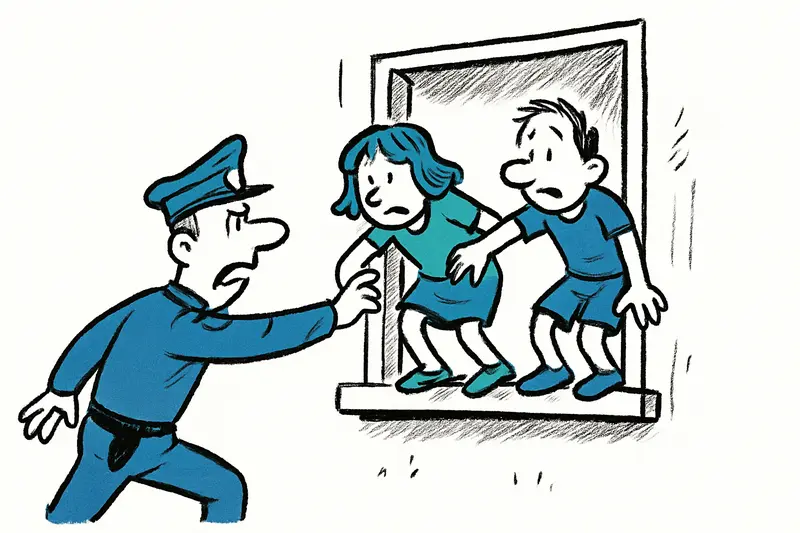
Police rescue children from a dangerous situation – but the question remains: Why did it come to this?
On a hot evening in Palma, neighbors stood in the courtyard with worried looks, repeatedly knocking on an apartment door and hearing only silence. Above, on the third floor, two children were balancing on a narrow windowsill; at times almost half of one child’s body protruded outside the facade. Only the swift intervention of the national police prevented a fall. Later, the officers found the grandfather, who was considered the responsible supervisor, sleeping and apparently intoxicated in the apartment. He was temporarily detained on suspicion of breaching his duty of supervision.
Key question: How could this life-threatening situation arise on a busy residential street in Palma – and what responsibility do families, neighbors and authorities share before an accident happens?
The immediate sequence is short: two minors stood alone at the window, neighbors knocked in vain, the police intervened, rescued the children and later handed them over to the parents. That is the sequence. But the real story lies behind it: Why were the children unsupervised? Why did apparently no one in the household respond, even though neighbors loudly reported the danger from outside? And why was the caregiving duty entrusted to a person who apparently could not respond?
We must not only see the moment, but the circumstances. In Mallorca, as elsewhere, grandparents are often informal caregivers for working parents. This is everyday life in Palma's neighborhoods: children are picked up from school in the late morning, there are few places in short-term childcare options, and the summer heat makes walks with small children rare. When alcohol comes into play and control mechanisms are missing, a risk emerges that this incident has made visible.
In public debate one uncomfortable issue often stands out: the precarious mix of informal childcare, limited social support services and homes that are not childproof. It is not only about criminal consequences for one person. It is also about prevention: windows that open several stories down without safeguards, spaces in apartments where children can reach dangers unnoticed, and the question whether older caregivers receive adequate support.
An everyday scene, as we often experience it: on the carrer — the typical street of any neighborhood — you hear the clatter of a bamboo suitcase, the smell of an evening meal, voices from a courtyard and then suddenly panic — a short cry, the sound of shoes on the stairs and a child's laughter that has turned into an unimaginable danger. Such moments show how little is often needed for an accident to happen.
Concrete solutions are possible and practical:
1. Neighborhood prevention: Campaigns in districts that explain how to act imperviously but effectively when suspecting child endangerment: inform the police, address children calmly, immediately document offers of help.
2. Securing windows and windowsills: Municipal subsidy programs for simple protective measures such as window locks, stoppers or child safety devices, especially in rental apartments and homes with families.
3. Support for caregiving grandparents: Short-term childcare offers or advisory services, especially during holiday overlap periods, as well as low-threshold information on alcohol and supervision duties.
4. Better accessibility of social services: Fast access channels for neighbors and schools to report recurring risk cases; clearly defined procedures for how cases are assessed and help organized.
5. Police protocols and training: Regular training for officers on handling child endangerment outside acute emergencies — and transparent guidelines on preventive action.
These approaches are not miracle cures. But they are practical and can reduce the risk that a momentary lapse has fatal consequences. What matters is that prevention must be thought of locally. A notice in the municipal office, an information display at the health center, a meeting in the scouts group — all of these contribute to awareness.
What counts now is not only prosecution, but learning: learning from the police action, from the neighborhood reaction, from the life circumstances that led to it. If we continue to only lament isolated cases, the real work will be left undone.
Conclusion: The police intervention prevented worse outcomes. That is reassuring, but it is not enough. In Mallorca we need a combination of practical window safety measures, low-threshold support for families and older caregivers, and stronger neighborhood responsibility. Only then can a near-tragic incident become a trigger for long-term improvement.
Frequently asked questions
What should I do if I suspect a child is unsupervised near a window in Mallorca?
What kinds of window safety devices are recommended for Mallorca homes with kids?
Is there support for caregiving grandparents who look after grandchildren in Mallorca?
How can social services be made more accessible to families at risk in Mallorca?
Should police protocols include handling child endangerment outside emergencies?
What weather-related factors affect child safety and supervision in Mallorca summers?
What practical steps can households take to reduce the risk of a child falling from a window in Mallorca?
Why is prevention important when addressing child endangerment in Mallorca?
Similar News
Lightning Strike Ignites Brush Fire Between Alaró and Consell: A Reality Check
A lightning bolt sparked a fire on Saturday afternoon near Es Putxet. 2.1 hectares burned; six aircraft and 34 personnel...
Plaza of Biniaraix: When a Party Overshadows the Village Fair
In Biniaraix a private party on the central village square during the patron saint's day substantially disrupted the off...
Chromed Jaguar on the Bow: the "Kismet" Appears off Palma
The 122-metre superyacht "Kismet" of industrialist Shahid Khan is anchored off Mallorca. A look at the technology, luxur...
Beach emergency in Portals Nous: What went wrong during the rescue?
A roughly 60-year-old woman was recovered from the beach at Portals Nous on Friday evening with cardiac arrest. This tex...
Palma as Home Port of the Super-Rich: Four Seasons' Gigayacht Brings Money — and Questions
The 207-meter "Four Seasons I" makes Palma the starting point for luxury journeys. A lot of money flows into the city — ...
More to explore
Discover more interesting content

Boat Tour with BBQ along Es Trenc Beach

Private transfer from Mallorca Airport (PMI) to Pollensa
