
How slow is this? The construction site at Playa de Palma and what is really missing
How slow is this? The construction site at Playa de Palma and what is really missing
The new seating wall at Playa de Palma is further delayed. Why is the construction dragging on, who pays the price — and what could help in the short term?
How slow is this? The construction site at Playa de Palma and what is really missing
A clear guiding question: Why is the construction of the new seating wall at Playa de Palma taking so long – and who is left to deal with the inconveniences? The wall, intended to prevent sand from blowing across the promenade, is part of a larger shoreline renovation project, including the redevelopment work at Playa de Palma and Castillo de Bellver, with EU funding and a budget of around €11 million. Still, several hundred metres of structure are missing, and beach edges from Las Maravillas up to the area around Balneario 6 remain exposed.
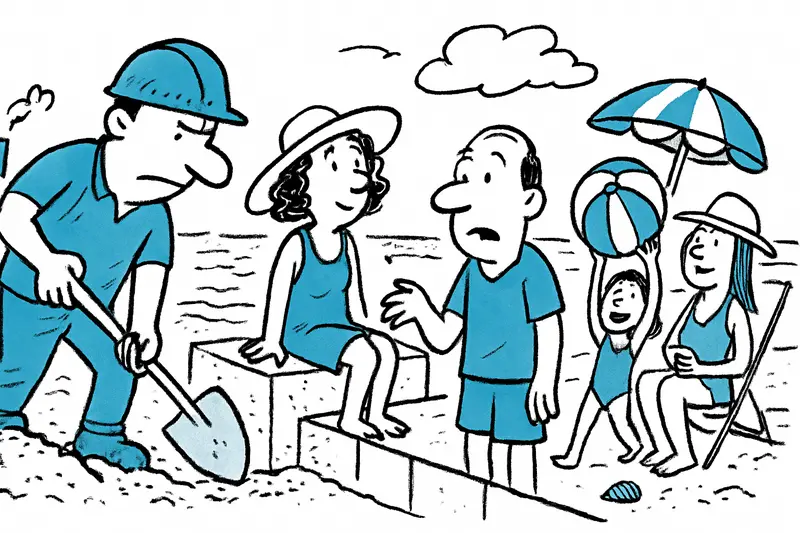
The scene on site is familiar: among sunbeds, screaming children and loud beach bars a construction machine rumbles. Vendors struggle through fine sand that is carried into shop fronts. While tourists take photos, promenade staff sweep morning and evening so entrances remain usable. You also see people using the unfinished wall as a place to put cans and bottles or to rest on when the sun is too strong — the picture says a lot about everyday life at the Playa.
Critical analysis
What is the problem? There are several usual suspects in coastal construction: changeable weather, supply chains for building materials, intermediate permitting steps, and not least the limited time windows when work can be done at night because tourism dictates the daytime schedule. It is plausible that all of this adds up and explains why about 300 metres of wall are still missing. But that is not a sufficient explanation for the unclear communication.
The official information circulating in the neighbourhood is roughly: it could take at least another month. Such formulations are vague and create uncertainty among business owners, residents and visitors. Who pays for the costs if sand keeps getting into shops — and who ultimately pays the surcharge? And what measures apply until final completion to keep the promenade safe and clean?
What is missing in the public discourse
Three things are currently missing from the debate: concrete deadlines with responsibilities, transparent interim plans for immediate protection and a reliable assessment of the technical risks. Authorities and construction companies should clearly state which sections will be finished when, what closures are necessary and what alternative solutions exist for businesses. Missing details fuel rumours – and that is frustrating in a season when every day counts.
Concrete, short-term solutions
There are practical measures that could help immediately: mobile sand barriers and additional temporary wind fences along the vulnerable stretches; coordinated night-time cleaning teams with powerful sweepers; provisional wooden planks as seating instead of the unfinished wall so that people do not further soil the construction site; and clearly visible timetables at the affected sections showing: Section A by date X, Section B by date Y. Such measures cost less than the headlines created by dissatisfaction.
Medium-term approaches
In the longer term it is important that construction contracts include tighter deadlines, penalties for delays when reliability is lacking, and incentives for night work without unduly burdening residents. Planners should also take seasonal wind patterns more into account and in future provide more modular, quickly assembled elements that can be deployed swiftly in cases of erosion. Local business associations should also be involved: those who fight sand every day have practical ideas that can help planners.
An everyday scene as a reminder
Imagine the promenade: around 9 a.m. cleaning vehicles roll by, promenade chairs are set up, behind a construction barrier a worker struggles to install a bench. Children collect shells, a waiter from Balneario 6 balances trays past, and in the background shop owners discuss lost breakfast customers over a café cortado because the entrance is too sand-blown. These small scenes show that the construction is not just about concrete but about the area's daily rhythm.
Pointed conclusion
"Maybe another month" is not enough. People at Playa de Palma demand clear deadlines, transparent accountability and pragmatic interim solutions. Politics and administration should deliver now: visible protective measures, binding construction stages and an emergency plan for local businesses. If the delay continues, the construction site will become another annoyance in a season already full of high expectations. That would be a poor start for the island and its visitors.
Frequently asked questions
When is the best time of year to visit Mallorca for warm weather and manageable crowds?
Can you swim in Mallorca year-round, and what should I know about sea conditions?
What should I pack for a trip to Mallorca?
What’s the best way to get around Mallorca?
Why is Palma de Mallorca a good base for first-time visitors?
What should I know about visiting the Serra de Tramuntana mountains?
What’s special about Cap de Formentor and the northern coast of Mallorca?
Are there family-friendly beaches near Alcúdia that are easy to reach from Palma?
Similar News
Body in the Basin of Port Adriano: Who Protects People During Crossings?
In the morning, just before noon: employees of a luxury marina discovered a floating body in the basin of Port Adriano. ...

Raised from the Sand: A Late Antique Merchant Ship Tells of the Sea off Can Pastilla
A 1,700-year-old Roman merchant ship was raised off Can Pastilla. Finds such as sail fragments and amphorae provide rare...
After the Storm: Why Many Fish Died at Riuet de s'Illot — and What's Still Missing
After the severe storm, numerous dead fish were found in the Riuet de s'Illot wetland. Who is affected, why it may have ...
Fire in Can Picafort: Family Rescued at the Last Minute – a Safety Check for the Promenade
A fire in a sports shop on the Can Picafort seafront forced the evacuation of a mother with four children. How safe are ...
Nine-year-old rescued after cliff fall at Cala Murada — How safe are Mallorca's coastal paths?
A boy fell roughly five meters down the rocks near Cala Murada. The dusk rescue was elaborate; a helper also had to be r...
More to explore
Discover more interesting content

Boat Tour with BBQ along Es Trenc Beach

Private transfer from Mallorca Airport (PMI) to Pollensa
