
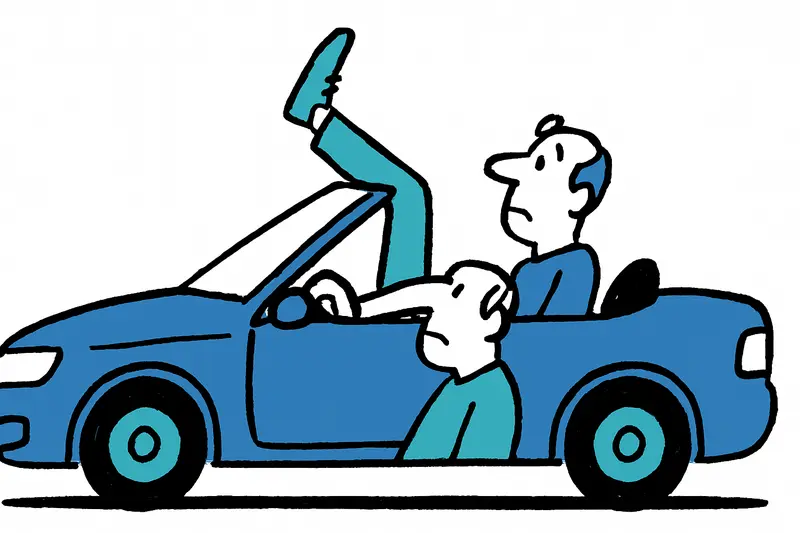
Convertible in Palma: One Leg over the Windshield — Why That's Not Just Inconsiderate but Dangerous
In Palma a police drone filmed a passenger who had placed a leg over the windshield while the car was in motion. The local police opened a fine procedure. Why this posture is so risky and what is missing in everyday practice on Mallorca.
Convertible in Palma: One Leg over the Windshield — Why That's Not Just Inconsiderate but Dangerous
A police drone incident in Palma captured an image in Palma a few days ago that quickly stuck in people's minds: a passenger in a convertible had placed a leg over the windshield while the car was moving, the foot protruding outside the vehicle's interior. The authority subsequently identified the vehicle and initiated a fine procedure. The basis for this is Article 18 of the Road Traffic Regulations, which requires vehicle occupants to adopt a proper seating position.
Key question: Why is this posture so dangerous — and is a fine enough?
At first glance it may seem harmless: a relaxed leg in the breeze, a photo for the phone. In reality the position is problematic for two reasons: first, it significantly increases the risk of injury in the event of an accident; second, it impairs the reaction capability of both driver and passenger. Airbags and seat belts are designed for seated persons in an upright position. When someone sits with an outstretched leg, the forces acting on the body in a crash change. That can lead to severe injuries to the legs and hip — sometimes permanent.
Critical analysis: What happens when the airbag deploys?
The airbag deploys in a fraction of a second and with great force. If a person is not seated correctly, the sudden movement of the airbag will hit other body parts than intended. The impact can turn what would have been a harmless broken leg into a complicated pelvic injury. Such scenarios do not only result from aggressive driving; even minor collisions or evasive maneuvers are enough. Drone videos like the one from Palma show the situation from the outside — but the consequences often occur inside: pain, hospital stays, possibly lengthy rehabilitation.
What's missing in the public debate
There is a lot of talk about parking bans, holiday rentals or noise — everyday traffic safety is discussed less. Many convertible drivers on Mallorca come from abroad, often tourists exploring the island. Yet during the rental-car check not everyone is clearly told why seating position, belts and airbag mechanics belong together. The discussion often ends with general reminders to fasten seat belts. Concrete explanations are missing: a small sign in the convertible, a note in the rental agreement or a short leaflet at the counter would change a lot.
Everyday scene from Palma
Imagine a mild June evening: the Passeig lane is still warm, scooters hum, gulls cry above the harbor, and tourists weave between street cafés. On one of the main avenues a black convertible cruises by slowly, one leg casually on the dashboard — the sun reflecting in the chrome. A few meters further a bus honks; the driver of a delivery van brakes briefly. It is precisely in such situations that a correct seating position is important. A photo may remain on the phone, a hospital stay will not.
Concrete solution approaches
The issue can be addressed practically and quickly: 1) Rental companies: clear instructions when handing over the keys, a short information sheet in the glove compartment with pictograms about seating position and airbag danger. 2) Police: targeted checks on sensitive routes in tourist areas, such as 124 km/h on Camí de Can Pastilla, combined with education rather than pure law enforcement in first cases. 3) Municipalities and airports: information posters next to rental counters, short videos in waiting areas. 4) Drivers and passengers: remember a simple rule — feet on the floor, torso upright, belt properly fastened. These measures are cheap, practical and could make many accidents less severe.
Conclusion
The photo from Palma is more than a social-media moment: it is a reminder that traffic safety is not only technology but behavior. A fine procedure is a legal reaction; however, it would make sense to take the incident as an opportunity for more education on the island. Anyone sitting in a convertible should position themselves so that airbags and belts can do what they are built to do. In Mallorca's alleys, between the scent of eucalyptus and sea breeze, it is a small effort with great benefit.
Frequently asked questions
When is the best time to visit Mallorca for warm, sunny weather?
What should I pack for a Mallorca trip in spring?
Is it easy to get around Mallorca without a car?
What are the top beaches and coast towns to visit in Mallorca?
Is swimming safe on Mallorca’s beaches?
What foods should I try when visiting Mallorca?
Are there beginner-friendly hiking options in Mallorca?
How should I dress for Mallorca’s weather?
Similar News

When the Tap Only Runs Sometimes: Why Municipalities in the Balearic Islands Are Now Rationing Water
Deià, Valldemossa, Esporles, Sóller and several places on Menorca are scaling back water supply. Who is responsible, why...
Battle for the Ramp: Why Cala Gamba Needs More Than Enforcement
The Guardia Civil intervened in Cala Gamba — residents breathed a sigh of relief, but unease remains. Key question: Are ...

He dances at the Duty-Free: How an airport employee brings a smile to Palma
A Duty-Free employee at Palma Airport created a viral TikTok with dancing breaks. Why the scene is more than just an int...
Stolen Motorcycle in Palma: Fatal Crash in Coll d'en Rabassa Shortly After Theft
A motorcycle parked on Plaza Miquel Dolç in Son Gotleu was reportedly stolen in the early hours. Hours later two men cra...
When More Guests Mean Less: Mallorca's Restaurants at the Limit
Despite record visitor numbers, the revenues of many restaurants are shrinking. Why more visitors don't automatically me...
More to explore
Discover more interesting content

Boat Tour with BBQ along Es Trenc Beach
Private transfer from Mallorca Airport (PMI) to Pollensa
