
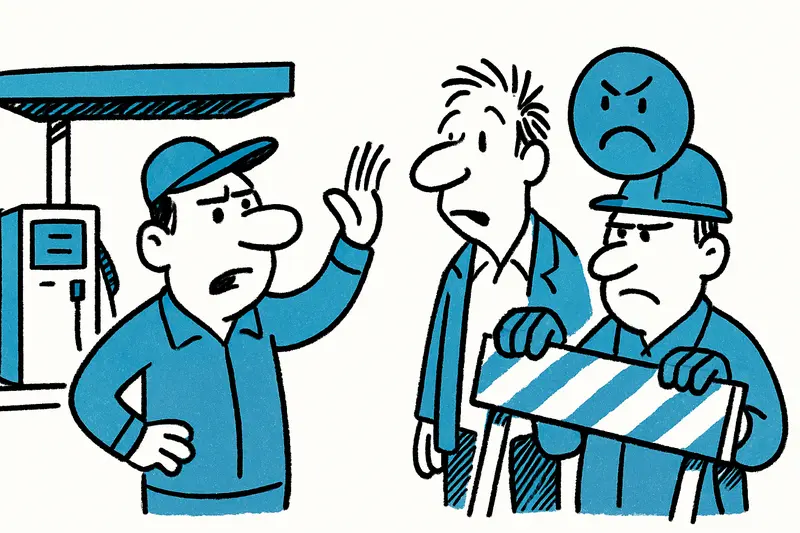
Plaça Progrés: Court clears the way — but who will the space be created for?
The Balearic High Court has ruled: the old pump at Plaça Progrés should be removed to make way for underground parking. A legal victory for the city — but the key question remains: who really benefits from the new space?
Plaça Progrés: Court clears the way — but who will the space be created for?
On an August morning the sharp smell of petrol still hung in the air around Plaça Progrés, while locals sipped their café con leche and the first buses rolled past the stop, horns blaring. That familiar aroma now appears to belong to an era soon gone: the Balearic High Court has confirmed the removal of the gas station at Plaça Progrés.
The key question: Who will benefit from the new space?
Legally the matter is clearer than its everyday consequences. The operating company lost the lawsuit, with the TSJIB ruling the gas station must be demolished; the administration can continue planning the parking project. But the central question remains: will the new surface area at the Plaça actually belong to the neighborhood — trees, wider sidewalks, benches — or will the solution primarily serve parked cars and easier access for commuters and visitors who still come by car?
What has been little discussed so far
The case focused a lot on permits from the 1950s and on whether a petrol station that has been in operation for decades can continue to exist. Less attention was paid to the practical problem: soil contamination. Where fuel has been stored for decades, pollution is often to be expected. Simply removing the tanks is not enough — clearly defined remediation measures, monitoring programs and transparency about who will bear the follow-up costs are needed.
Another point: the operators are now being charged coercive fines of nearly €3,000 every eight days. That is a lever — but unlike an immediate closure it is only a slow drip in a larger process. The facility continues to operate for now, which makes neighbors like Mariona nervous: “The hum of the pump was always there. If it gets quieter, I will be glad — but I also don't want a dust bowl in front of my door.”
Urban planning meets reality
The city has big plans: underground parking, more space for people, trees and perhaps a recovery of urban quality on the surface. On paper this sounds like a win for Palma. In practice, demolition, earthworks and construction phases mean noise from building sites, traffic restrictions and possible dust and odor nuisances — exactly the worries some residents are now raising. It is a classic dilemma: short-term burdens versus long-term promises.
Concrete opportunities — and tangible conditions
The court decision opens a door. To ensure that a seemingly good idea does not become a new conflict, the following steps should be made binding:
1. Tender and monitor soil remediation publicly: An independent assessment followed by a publicly accessible remediation plan must be mandatory. Old oil and petrol residues can otherwise cause problems for years.
2. Do not automatically maximize parking spaces: Limiting the number of parking slots and instead allocating space for bike parking, e‑carsharing charging points and wide sidewalks creates real added value for residents.
3. Regulate noise and working hours: Work in the early morning and late evening should be clearly limited — the island requires consideration, especially in residential neighborhoods like La Lonja.
4. Ensure transparency on costs and lease contracts: If the city leases underground space or cooperates with private partners, it must be clear what returns are expected — and how long the city will cover any potential losses.
5. Use interim spaces temporarily: Before the diggers arrive, the area could serve as temporary green space, a location for a weekend market or a fallback schoolyard. This builds trust and shows how the square could look later.
Looking ahead — with caution and courage
The ruling is a clear legal step toward reshaping Plaça Progrés. But plans are only as good as their implementation. An underground car park can enable genuine urban quality — or it can attract more cars to the old town and breathe new life into old problems. The balance lies in the details: environmental protection, a limited number of spaces, clear construction hours and real participation by the neighborhood.
If the city acts wisely, the Plaça will soon smell less of petrol and more of freshly planted jasmine and espresso. If it does not, the memory of the pump will be replaced only by dust, traffic and missed opportunities. The clock is ticking — and in Palma people already hear the distant sound of construction fences.
For now the pump remains in operation, but the court's signal is clear: change is coming. Now technicians, the administration and politicians decide whether the Plaça truly regains a piece of the city or simply receives another parking level.
Frequently asked questions
What is happening with the gas station at Plaça Progrés in Palma?
Will the new space at Plaça Progrés be for people or for cars?
Is there a soil pollution risk at Plaça Progrés in Mallorca?
What could construction at Plaça Progrés mean for local residents in Palma?
What does the court decision mean for underground parking at Plaça Progrés?
Why are there coercive fines at the Plaça Progrés gas station?
What would residents like to see at Plaça Progrés in Palma?
How could Plaça Progrés change the urban feel of Palma's city centre?
Similar News
The End of the Cheap Ride? Why Mallorca Is Hit Harder by the Fuel-Price Shock
Gasoline and diesel average close to two euros per liter. What this means for commuters, supply chains and renters in Ma...
Relaxed liquid rules in Munich: What Mallorca travelers will notice
At Munich Airport the 100-milliliter rule will be lifted at all checkpoint lanes — thanks to new CT scanners passengers ...
For 45 Years on Mallorca — and Then This: How a Market Visit in Santa Ponsa Became a Lesson
A woman who has lived on the island for decades lost money and important documents at the Mercat Setmanal in Santa Ponsa...
10 percent surcharge on the beach: How legal and transparent is the extra charge at Playa de Muro?
A German part-time resident noticed days after a restaurant visit in Playa de Muro that the bill included a flat ten per...

Body near the Llevant Market: What this death says about our city
A man was found dead on Sunday afternoon near the Llevant Market. Police say the death appears natural. The scene raises...
More to explore
Discover more interesting content

Can Cap de Bou

Townhouse Lleo 72
