
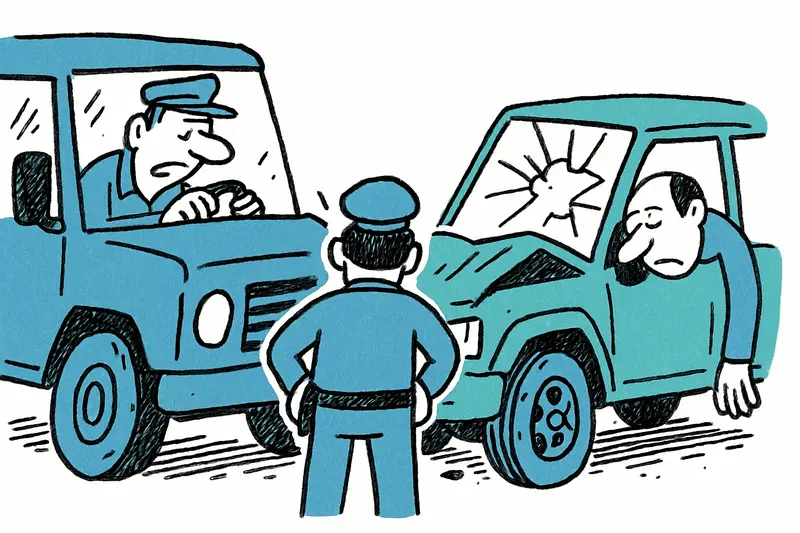
Head-on crash on MA-19 near Santanyí: Was it deliberate? Investigators probe possible motives
A Land Rover collided head-on with a lorry on the MA-19 near Santanyí. Handwritten notes found in the vehicle and a brief missing-person report raise the question: was this a suicide attempt? The Guardia Civil and the criminal police are investigating.
Severe crash near Santanyí: many questions, few answers
Early on Thursday morning a stretch of the MA-19 near kilometre 42 turned into a crash site that will occupy the town for some time. A Land Rover collided head-on with a lorry, as detailed in Choque frontal en la MA-19 cerca de Santanyí: ¿Fue intencionado? Investigadores examinan posibles motivos. The 70-year-old driver of the SUV was seriously injured and airlifted to Son Espases; the lorry driver was taken to the Juaneda clinic.
The central question: accident or intent?
The Guardia Civil found handwritten notes in the vehicle that, according to initial reports, could point to possible intent. Minutes before the collision a missing-person report had already been filed for the man; patrols searched the area — and shortly afterwards the crash occurred, as reported in Accidente grave en Santanyí: la policía investiga un posible intento de suicidio en la MA-19. The case file has been handed over to the criminal police. The guiding question now is: was this a planned act, or were private problems and a tragic accident the cause?
What is often overlooked: the reporting and search chain
In such cases it is worth looking behind the scenes. How quickly and in what form are missing-person reports passed on to patrols? Was there clear information about health status, medications or suicide risk? The police work routinely, but also within rigid bureaucracy: an anonymous report, incomplete data or communication gaps between Policía Local, Guardia Civil and emergency call centres can cost time and chances. That affects not only the search but also the possibilities of helping a person in danger in time.
Rescue under the most difficult conditions
Fire brigades from Felanitx and Llucmajor used hydraulic rescue equipment to free the lorry driver. Emergency doctors from PAC Santanyí, two ambulances and units of SAMU 061 were on site. The road brigade of the Consell cleared the carriageway. One detail that gives neighbours pause: the man in the Land Rover was not wearing a seat belt. Small lapses can make the difference between life and death in such moments.
Pastoral care, prevention, local responsibility
Near the crash site, in a bar in Santanyí, I heard the soft beeping of the emergency monitors and the word "unbelievable." Days like this change the neighbourhood; conversations revolve around care but also around questions of blame. What role do neighbours, friends, pharmacists or bar owners play when someone suddenly disappears or behaves conspicuously? Often it is the local people who could see early signals — if they know whom to inform and how.
What is important now: concrete improvements
The investigation must clarify exactly what happened. In addition, concrete precautions are needed on several levels:
1) Faster, clearer reporting channels: Standardised, prioritised coordination between Policía Local, Guardia Civil and emergency call centres could shorten response times. Digital checklists for missing-person reports (medications, suicide risk, last known route) would be helpful.
2) Training for first-contact persons: Pharmacists, municipal employees, bar owners and bus drivers should recognise basic signs of a mental health crisis and know whom to notify immediately.
3) Expansion of low-threshold support: More visible crisis intervention services on Mallorca, quick phone and chat options in multiple languages and mobile crisis teams that can be dispatched for acute reports.
4) Traffic and safety campaigns: Reminders of simple protective measures such as wearing a seat belt — often underestimated on quiet side roads and on the way to work.
Help and contacts
If you are in crisis yourself or know someone at risk, help is available: on Mallorca there is the anonymous emergency number 024, the general emergency number 112, Balearic pastoral care 971 461 112, suicide prevention 900 925 555 and support for minors 900 202 010. For German speakers the German pastoral care hotline is available at 0049 800 1110 111.
The authorities are working meticulously, but investigations can take time. In the meantime the most important task for the community is to look closely, speak up and act when someone seems at risk. An espresso at the bar, a short conversation with a neighbour, a phone call — sometimes a small sign of care is enough to prevent worse.
The editorial team will follow up and report as soon as the authorities release new information.
Frequently asked questions
What happened on the MA-19 near Santanyí?
Was the crash near Santanyí on Mallorca deliberate?
What happens when someone is reported missing in Mallorca?
Who rescued the drivers after the crash near Santanyí?
Why do police investigations into serious crashes in Mallorca take time?
What should you do in Mallorca if someone seems to be in crisis?
Why is wearing a seat belt still important on Mallorca roads?
What support lines are available in Mallorca for mental health emergencies?
Similar News
First Day, First Consequences: What Palma's Rent Freeze Really Means
A new decree stops a planned eviction in Palma — but what really changes for tenants and landlords? A reality check with...
When Housing Becomes a Matter of Survival: Mallorca Between Rental Frenzy and Everyday Life
The case of 87-year-old Maricarmen showed that on Mallorca many people's lives are poised between affordable and uninhab...
Autumn in Mallorca: When Melancholy Gets a Window
Why autumn quietly tightens here — and how to make use of the mood: walks, culture, candles and the light from Palma to ...
Near-miss on Lanzarote: Landing Ryanair Jet and Iberia Takeoff — what really went wrong
On Lanzarote there was a dangerous incident: A Ryanair flight (FR5910) from Dublin landed on runway 03 while an Iberia E...
Eurowings introduces new Premium Business seats on Mallorca routes
From December 1, selected Eurowings flights to Palma and other destinations will feature eight particularly generous sea...
More to explore
Discover more interesting content

Can Cap de Bou

Townhouse Lleo 72
