
Death near Son Banya: Lead points to possible heroin overdose
Death near Son Banya: Lead points to possible heroin overdose
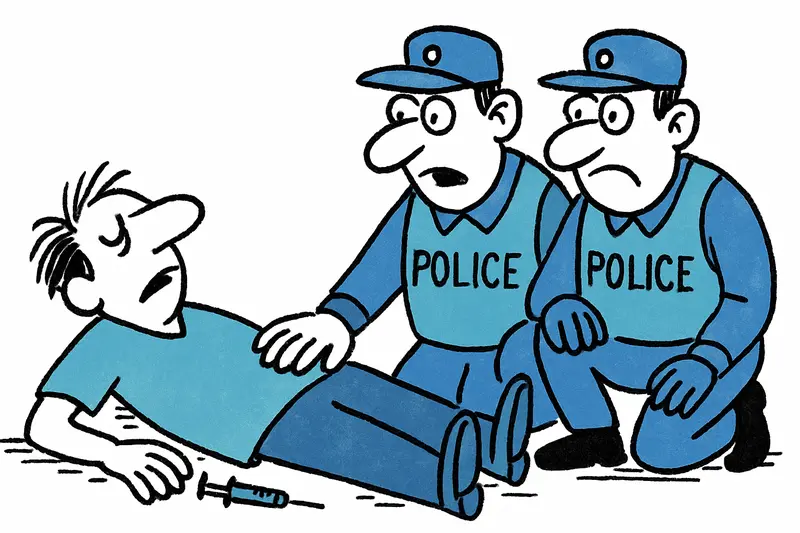
A 58-year-old man was found dead on Saturday evening a few metres from the entrance to the Son Banya settlement. Evidence points to an injection mark and thus a possible heroin overdose; investigations are ongoing.
Death near Son Banya: Lead points to possible heroin overdose
Key question: How does the constant makeshift fixing of a problem that no one wants to properly solve end?
On Saturday at around 6 p.m., an e-bike rider discovered a motionless man only a few metres from the entrance to the Son Banya settlement (the site of a recent major raid in Son Banya). Two officers from a nearby deployed special unit (GOR) were in the area because they were securing an assembly; they provided first aid and quickly found that help had come too late. The deceased could be identified by carried identity documents as a 58-year-old Spanish man. A syringe in the man's arm is a visible detail, which is why a possible heroin overdose is currently being investigated as the cause of death. The case was reported to the competent court, and a funeral company took charge of removing the body.
In short: The discovery site is not a remote finca in the mountains but the dusty driveway near Son Banya, where voices, engine noises and the distant clatter of dishes often merge in the evening. Anyone who lives here or passes by every day knows the routine: police officers in yellow vests, residents with shopping bags, and the occasional siren when something escalates, such as a fatal collision in Son Banya. That does not normalize it; it only dulls the view.
Critical analysis
The concrete sequence — discovery by a passerby, presence of a special unit, identification by ID, visible needle — is a thin thread of information that investigators will pull on. Law enforcement will clarify whether there was third-party involvement or whether it was an isolated overdose. For an outsider, questions remain: Why did a man of this age die alone on an open street? Who supplies the substances, who provides acute help? Authorities can provide forensic results, but they do not answer the deeper questions about care, prevention and social integration.
One area of concern: Repressive measures against dealers may affect supply but not the need behind addiction. Outpatient addiction services, low-threshold offers and consensus-oriented approaches are unevenly distributed on Mallorca. In places like Son Banya, police operations and cleanup actions run on a weekly cycle; this has a methodological character: visible, brief, but without lasting bridges for those affected, as shown by episodes when police stop new drug shacks in Son Banya — residents briefly breathe a sigh of relief.
What is missing from the public discourse
There is much talk about deployment statistics, raids and arrests, and rarely about what people like the 58-year-old would have immediately needed: a dry place, medical emergency care without stigma, clean syringe exchange programmes or low-threshold drug counselling in the evenings. Also little present is the perspective of neighbours who live with fear and shame — and whose everyday life is shaped by finding remnants of needle packs while jogging or whispering about assaults at the kiosk.
Everyday scene from Mallorca
Imagine Calle Aragó in Palma on a Friday evening: the smell of tapas, voices in different languages, scooters honking. Two streets away, near Son Banya, older women sit on a bench and speak quietly; a delivery van is parked with its loading area open. The scene shows how closely normality and crisis lie here. People go shopping, hear the police, argue about loud music — and yet the question remains who takes care of the lost.
Concrete solutions
1) Expand emergency medicine precisely: mobile teams equipped with naloxone as standard gear could reach what currently takes minutes more quickly. 2) Fixed needle and syringe exchange points at set places and times, linked to low-threshold counselling, to reduce acute risks. 3) Aftercare and housing options: short-term intake places with medical support can pull people out of the street spiral. 4) Community involvement: local initiatives, neighbourhood meetings and anonymous counselling offers reduce stigma and build trust. 5) Data-driven deployments: instead of one-off raids, coordinated long-term programmes would be helpful — with clear evaluation criteria rather than symbolic actions.
Why this matters
Because this man's death is more than a case number. It is a symptom: of inadequate care, political short-termism, of a society that prefers to hide problems rather than treat them. Son Banya stands as a representative of other hotspots; if we don't start here, similar stories will continue to occur.
Conclusion
Investigations must determine whether this was an overdose. In parallel, Mallorca needs pragmatic, results-oriented measures — even if uncomfortable, but effective. The key question remains: Will we continue to watch people slip away on the margins, or will we build pathways to catch them? On the streets around Son Banya you can hear scooters rattling in the evening and the occasional laughter from bars. You should also be able to hear the sound of help.
Frequently asked questions
What is the latest known cause of death in the Son Banya case in Mallorca?
What should you do if you find an unresponsive person in Mallorca?
Is it safe to walk or cycle near Son Banya in Palma?
How do police operations in Son Banya affect everyday life in Mallorca?
What help is available for drug addiction in Mallorca?
Why do people talk about harm reduction around Son Banya in Palma?
What is Son Banya in Mallorca known for?
When is the best time of year to visit Mallorca for a quieter trip?
Similar News
More Electric Cars in the Balearic Islands: Sales Rise Sharply
Between January and August, 14,185 vehicles without petrol or diesel propulsion were sold — an increase of more than 40 ...
Autumn in Mallorca: What Truly Remains of Summer
The days grow shorter, the evenings cool — and yet more of summer lingers than you might think: sounds, recipes, people,...
Rescue operation at Tolleric: Why nighttime cliff parties become dangerous
A British holidaymaker fell about ten meters at the cliffs of Tolleric during the night, later climbed back up and was r...
Car accident on the MA-1: Mother and daughter on a bicycle struck by a fellow countryman – Who protects cyclists here?
On the MA-1 between Portopí and the Cala Major exit, a mother and her daughter on a bicycle were struck by a car. A para...
Smoke over the UIB: Who is responsible for the fire on the roof?
On Saturday afternoon a fire broke out on the roof of the Arxiduc Lluís Salvador building at the University of the Balea...
More to explore
Discover more interesting content

Can Cap de Bou

Townhouse Lleo 72
