
Detours on the Paseo Marítimo: How Palma Can Ease Access to the Ferry Port
Due to renovation work, access roads to the ferry port in Palma have been rerouted. What commuters need to know now — and which solutions could mitigate the impact for residents, travelers and delivery traffic.
Renovation at the port: New route, old problems — and the question of better solutions
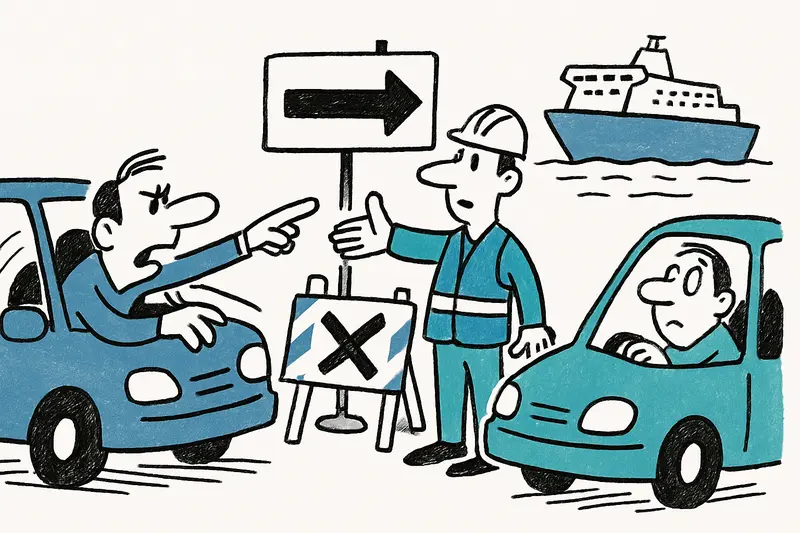
From today, everyone heading to Palma's ferry port faces one thing: a detour. Access roads at the Paseo Marítimo: More boulevard, more questions — will Palma make the new waterfront part of everyday life? are being repaired and the port authority has set up a temporary traffic routing. Short answer for those in a hurry: enter via Portopí, exit further along the Paseo Marítimo. The works are scheduled to last until mid-September, weather permitting and barring further surprises.
Key question: Why does a short-term detour immediately cause so much chaos?
The answer is simple and multifaceted. Port traffic is not like normal city traffic. Ferries with thousands of passengers, scheduled buses, taxis, delivery trucks and residents all meet in a confined space. Between 7 and 9 a.m. you hear engine noise, taxi horns and the squeal of tail lifts more than the sound of the sea. When potholes and sunken curbs must also be fixed, a single wrongly placed sign can bring the whole chain to a standstill.
What is happening on site — and what often stays under the radar
The current detour runs via the Portopí entrance past Terminals 3 and 2. The signage is visible, but that is not always enough. What is rarely discussed is the chain reaction when a truck stops to load or unload. Such a stop narrows the roadway so much that buses cannot turn and taxis end up double-parked. Pedestrians and cyclists suffer too, because temporary paths are often narrower or poorly lit. Example Moll Vell: Anyone walking with heavy luggage to the temporary EMT stop quickly notices that five minutes on foot in the heat with a suitcase is much harder than a dry traffic announcement suggests — a situation similar to those covered in Paseo Marítimo in Palma closed on Sunday: How to avoid stress at the harbor.
Concrete problems that could quickly be solved
1. Unclear prioritization: During construction there is often no clear priority for scheduled buses and pedestrians. A reserved bus lane or a temporary loading ban for delivery vehicles during peak times would relieve pressure significantly.
2. Communication: Relying on signs alone is not enough. Real-time information in apps, SMS to registered travelers or loudspeaker announcements at busy points reduce uncertainty; consult the EMT Palma official website for bus updates.
3. Taxi and truck management: A temporary park-and-shuttle system outside the port area with a shuttle to the terminal would reduce traffic looking for parking.
4. Lighting and protection for footpaths: Mobile lights and protective barriers make temporary walking routes safer — especially in the early morning hours and around evening ferry departures.
Practical tips for travelers and commuters
• Allow extra time, especially on departure days — a lesson underlined by past events such as Sunday in Palma: Paseo Marítimo largely closed on 16 November — tips for residents and visitors.
• Use parking garages further out and walk the last stretch — often faster than sitting in a jam.
• If you have luggage: taxis or ride-hailing services are more expensive but save nerves. Hauling heavy suitcases up stairs? Better not.
• Cyclists and pedestrians: stick to the temporary routes. Some sections are noticeably narrower than usual.
Opportunities the construction period offers
At least: a well-planned repair can provide greater safety in the long term. Once curbs and pavement are renewed, not only drivers but also cyclists, pedestrians and bus services will benefit. It is up to the port authority and the city to turn this measure into an opportunity now: better signage, coordinated delivery windows, night work during low-traffic times or temporary shuttle services would show that they want to turn a short-term inconvenience into lasting gain, a debate echoed in Who is Palma's new waterfront boulevard really for?.
My conclusion — with a little local tip
Yes, construction sites are annoying. But they are necessary: the past months with loose surfaces and sunken curbs have been dangerous for some drivers. The port authority should now think beyond the bare minimum and set clear priorities. More staff for traffic management, better communication and simple measures like reserved bus lanes could significantly reduce the burden.
And one practical Mallorca-magic tip: If you must go to Moll Vell — treat yourself to an espresso after parking. The smell of fresh coffee and the shriek of seagulls are the best remedy for traffic frustration. Those who start relaxed usually arrive more relaxed.
Frequently asked questions
How do I reach Palma ferry port during the current roadworks?
Why does traffic around Palma port get so slow during construction?
How much extra time should I plan for when going to the ferry port in Palma?
Is it better to go to Palma port by taxi, bus, or car while the roads are affected?
Are the walking routes to Palma ferry port safe during the detour?
How long will the Palma port roadworks last?
What should I know about getting from Moll Vell to the temporary EMT stop in Palma?
What is the best way to avoid stress at Palma ferry port during the works?
Similar News

Release after bloody attack in Palma: Why the court's decision raises questions
An 18-year-old who allegedly inflicted a serious neck injury on a man at Plaza Gomila using a wristwatch wrapped around ...
Kidnappings in Inca: Three young men forced into car trunks and abused in the forest – a reality check
In Inca, three 18-year-old men were forced into car trunks by masked assailants at the Plaça des Bestiar, taken to a for...
Spreading Massification: The Brake That Still Has Much Work to Do
Marga Prohens announces limits on volume tourism. The measures sound harsh — but are they enough to save everyday life, ...

Through the Keyhole onto the Party Yacht: How Daniela Katzenberger Is Planning Her 40th on Mallorca
Daniela Katzenberger turns 40 and wants to celebrate it on the island — likely with a boat, cake and her mother. A relax...
By Boat Instead of the Road: Palma's Water Bus — a Reality Check
The 'Bus Nàutic' launches in two stages — but questions remain over interim operations, fares and environmental requirem...
More to explore
Discover more interesting content

Can Cap de Bou

Townhouse Lleo 72
