
Alcohol at the Wheel in Palma: Why This Frontal Crash Tells Us More Than a 'Serious Mistake'
Alcohol at the Wheel in Palma: Why This Frontal Crash Tells Us More Than a 'Serious Mistake'
On the Camí Vell de Bunyola a Mazda crashed head-on into another car. The 43-year-old driver and later her husband were under the influence of alcohol. A police report reveals gaps in enforcement and prevention — and raises the question: How do we especially protect the children in the car?
Alcohol at the Wheel in Palma: Why This Frontal Crash Tells Us More Than a 'Serious Mistake'
An accident on the Camí Vell de Bunyola exposes gaps in dealing with drunk drivers — and in caring for the children.
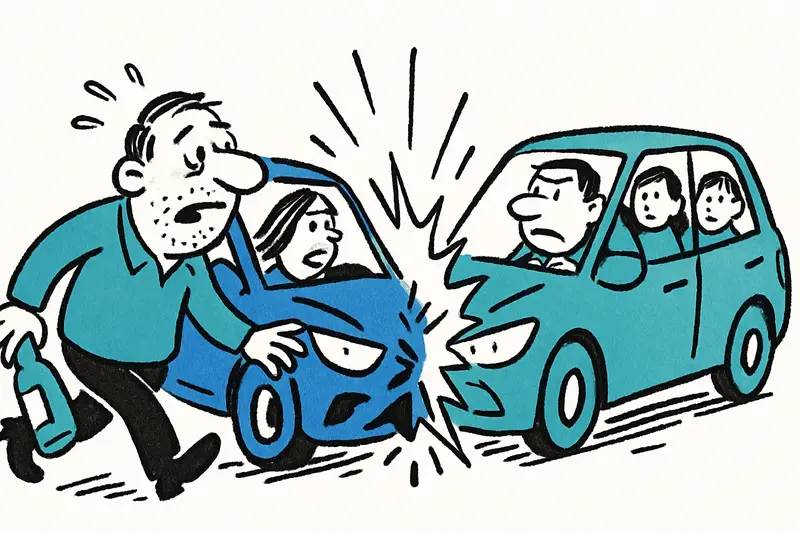
On the afternoon of December 20, a serious collision occurred on the Camí Vell de Bunyola in Palma: a Mazda CX-5 apparently drove completely into the oncoming lane, crossed the double solid line and collided head-on with a Hyundai i20. The 48-year-old driver of the Hyundai was thrown back by the impact; the vehicle finally ended up on the sidewalk. The driver, 43 years old, tested positive for alcohol at the scene; the result was 0.63 mg/l, a pattern also seen in Palma: Accident involving a drunk female driver — despite a license previously revoked.
Strange and at the same time disturbing: shortly after the accident the woman's husband arrived in another car in which the couple's two children were sitting. He also showed signs of alcohol consumption and likewise tested positive. The local police initiated investigations for endangering road safety, a dynamic explored in Alcúdia: Who Was Really at the Wheel? A Reality Check on Alcohol, Responsibility and Investigations; additionally the woman has a prior conviction and had apparently not completed a mandated traffic education course.
Key question: Why do such cases occur repeatedly despite existing rules — and how can we prevent children from being put in situations where adults are no longer fit to drive?
Reconstructing the course of the accident is one thing; another is looking at the background. Several problems collide here: alcohol consumption and mobility, repeat offenders versus resocialization, and the poor state of our routines when it comes to protecting children. Anyone who looks at the Camí Vell de Bunyola from an everyday perspective knows: commuters, school traffic, delivery vans and pedestrians share the route. Driving under the influence can quickly be fatal there, as seen in incidents like Nighttime Accident in Son Oliva: More Than Just a Drunk Driver.
Critical analysis: the case shows that mere sanctions often are not enough. A fine or a driving ban are imposed, but if a convicted person does not fulfil required obligations such as a sensitization course, the system does not enforce consequences consistently. The recurrence of drunk driving is not purely a question of will, but also the result of insufficient controls, limited follow-up of obligations and a lack of intervention offers — especially for households with children.
Three things are missing in public discourse: first, the concrete debate about technical protective mechanisms such as ignition interlocks (alcohol interlocks) for repeat offenders; second, binding practices on how emergency services should handle intoxicated guardians and children present at the scene; third, a clear offer of locally available counselling and support services so families are not only sanctioned but also accompanied.
A scene many on the island can picture: residents hear sirens, go outside and look at the accident scene — dogs bark, trash containers rattle. While police secure the scene, two children stand at the roadside, tense, freezing, perhaps protected by a grandmother. These images linger and are more powerful than any statistic.
Concrete solutions that would be practicable on Mallorca:
- Ignition interlocks for repeat offenders: Court orders requiring that vehicles may only start with an installed interlock until obligations are met.
- Tighter follow-up of obligations: Electronic reporting and verification procedures so that convicted persons must prove they have attended required courses; feedback to courts in case of non-compliance.
- Operational guidelines for police and rescue services: Standardised procedures when intoxicated caregivers with children are at the scene — for example immediate activation of child protection and provisional care by specialised agencies.
- Control priorities and prevention work: More visible checks on known accident stretches, combined with local information campaigns in schools, neighbourhoods and workplaces.
- Infrastructure measures: Where possible, physical separations, better markings and additional stopping or deceleration lanes in critical sections — not all problems can be solved technically, but some accidents could be mitigated.
These proposals are not a panacea, but they are practical steps between routine fines and real prevention. It is also important that politicians, police and social services work together; a car accident should not end with a case number without the family receiving support.
Pointed conclusion: the crash on the Camí Vell de Bunyola is more than a sad news item. It is a wake-up call for an island community that wants to better protect its roads and its children. Those who cross the line of responsibility must not simply fall out of sight — neither legally nor socially.
Frequently asked questions
What happens after a drunk driving accident in Mallorca?
How dangerous is driving under the influence on Mallorca roads like the Camí Vell de Bunyola?
Can police in Mallorca charge a driver even if nobody is seriously injured?
What should happen if children are found with an intoxicated parent after an accident in Mallorca?
Are repeat drunk drivers in Mallorca given extra penalties or controls?
Would alcohol interlocks help prevent drunk driving in Mallorca?
What help is available in Mallorca for families affected by alcohol-related driving problems?
How can Mallorca reduce drunk driving on roads with a history of crashes?
Similar News
Injured captain, big plans: Germania Mallorca before the away match in Consell
The newly founded FC Germania Mallorca travels to Consell on Saturday. Captain Bastian Müller is out injured, but coach ...
Palma, Palma de Mallorca, Palma‑Mallorca: What is it really about?
The debate over the city's name is more than grammar: it concerns identity, law and branding policy. A sober reality che...
Warning to Bathers: Nipping Fish in Cala Major and Other Coves — a Reality Check
In Cala Major and several beaches around Mallorca, bathers report painful “nips”. Who are the animals, why are they gett...

Rental Car Theft in El Arenal: What This Incident Reveals About Our Gaps
A teenager steals a running rental car in El Arenal, flees on foot, climbs over walls and is caught by the Guardia Civil...

Red Rope in Palma's Library: What Helps Against Selfie Tourism — and What's Missing
Palma's city library cordoned off an area with a red rope to keep selfie tourism away from reading and working activitie...
More to explore
Discover more interesting content

Can Cap de Bou

Townhouse Lleo 72
