
Citizens intervene: Drunk man without driving licence crashes on Camí de la Vileta — and shows a Nazi tattoo
A 46-year-old man damages several vehicles and traffic signs in Palma and tries to flee — passersby intervene. Police investigate hit-and-run; a Nazi tattoo aggravates the case. An assessment and clear questions for authorities and society.
Citizens intervene: Drunk man without driving licence crashes on Camí de la Vileta — and shows a Nazi tattoo
Leading question: How well does our city protect the public and its streets when a drunk driver without a valid licence causes an accident, attempts to flee and openly displays right-wing extremist symbols?
What happened
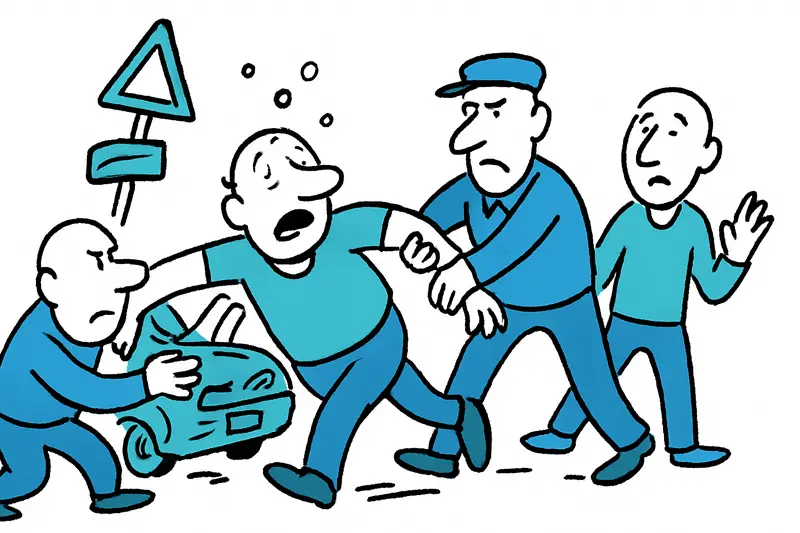
On the evening of 8 May at around 18:10, an incident occurred on the Camí de la Vileta in Palma that is more than just a traffic disruption. A 46-year-old man rear-ended a car waiting at a traffic light, drove on, lost control and damaged a roundabout: kerbstone, traffic island and a traffic sign were affected. Residents and other road users intervened, seized the man’s key and held him until the Policia Local arrived, reminiscent of Nighttime Accident in Sóller: Alcohol, No Driver's License — How the Situation Escalated. The officers of the so-called Equipo Comunitario de Proximidad took over the situation. During questioning the man stated that he did not possess a category B driving licence; investigations by the accident vehicle unit (UVAC) revealed that his moped licence had already been revoked in 2014 due to loss of points, a pattern seen previously in Palma: Accident involving a drunk female driver — despite a license previously revoked. He also exceeded the legal blood alcohol limit, insulted the officers and displayed a Nazi tattoo.
Critical analysis
The individual facts are troubling enough: driving under the influence, no driving licence, hit-and-run and property damage. Taken together they raise questions about traffic monitoring, prevention and the authorities’ response. Why was a vehicle operator without a B licence able to repeatedly participate in road traffic? How often are licence revocations and point losses effectively translated into everyday enforcement, for example through spot checks or vehicle embargoes?
Another issue is the intersection between traffic offences and politically motivated right-wing symbolism. Displaying a Nazi tattoo is not a trivial matter; it increases the risk of conflict in an already volatile situation. Authorities and society must respond in a nuanced way: on the one hand, criminal prosecution must not overlook that this was a dangerous traffic situation; on the other hand, the visibility of extremist symbols belongs in the criminal police assessment.
What is missing from the public discourse
The public debate often focuses only on the sensational elements — an accident, a tattoo, citizens’ intervention. Less present are structural questions: targeted breathalyser checks at hotspots at peak times, digital tracking of licence suspensions, cooperation between traffic authorities and municipal enforcement. There is also a lack of clear discussion on how to handle politically extremist symbolism without falling into hasty appeasement or overreaction.
Everyday scene from Palma
Imagine the evening: the air on the Camí de la Vileta is still mild, children shout from the schoolyard, a scooter rumbles past, a supermarket delivers crates. A dull crash, then outrage, loud voices, footsteps on the pavement. Within minutes neighbours hold the man — no heroism, more practical solidarity. This is how Mallorca works: people step in when authorities are still on their way, as when Paseo Marítimo: Taxi drivers stop drunk driver — a wake-up call for Palma's nightlife.
Concrete solutions
- Targeted traffic checks at peak times in known accident hotspots and residential areas, complemented by breath tests at critical departure times.
- Better networking: when a licence has been revoked, suspensions should be systematically cross-checked with vehicle owner data, for example during vehicle registration or checks by the Policia Local.
- Mobile technology: municipal apps that allow witnesses to quickly report accidents and dangerous drivers (with photo/video upload and GPS timestamp) would speed up intervention.
- Neighbourhood prevention: information campaigns about the legal consequences of driving without a licence and the risks of alcohol consumption in road traffic.
- Sensitive handling of extremist symbols: documentation by the police, notification to the competent public prosecutor and, where criminally relevant, consistent prosecution.
Pointed conclusion
The incident on the Camí de la Vileta is not an isolated phenomenon but a series of avoidable failures: lack of enforcement, drunk driving, the absence of immediate measures against driving without a valid licence — and an additional alarm signal in the form of a Nazi tattoo. What is needed is not rhetorical fireworks but pragmatic measures: better controls, faster administrative processes and greater neighbourhood engagement. The people on site reacted correctly this time. It is now up to the institutions to ensure it does not come so close again.
Frequently asked questions
What is the weather usually like in Mallorca in spring?
Can you still swim in Mallorca in autumn?
What should I pack for a trip to Mallorca in spring?
Is Mallorca a good place to visit outside the main summer season?
What is Palma de Mallorca like to explore on foot?
What is Sóller in Mallorca known for?
When is the best time to walk in the Tramuntana mountains in Mallorca?
Are beach clubs in Mallorca open all year?
Similar News
Smoke over the UIB: Who is responsible for the fire on the roof?
On Saturday afternoon a fire broke out on the roof of the Arxiduc Lluís Salvador building at the University of the Balea...
Short Getaway with Sea View: Inmood Aucanada among Spain's Top Hotels for Dinner Breaks
A small hotel on the coast of Alcúdia was highlighted by a Spanish experience platform as particularly suitable for shor...
Cala Pi crowned Mallorca's most beautiful beach: A morning at the rocky cove
The travel portal Holidaycheck praises Cala Pi as Mallorca's most beautiful beach: a narrow, romantic cove, clear water,...
Injured captain, big plans: Germania Mallorca before the away match in Consell
The newly founded FC Germania Mallorca travels to Consell on Saturday. Captain Bastian Müller is out injured, but coach ...
Palma, Palma de Mallorca, Palma‑Mallorca: What is it really about?
The debate over the city's name is more than grammar: it concerns identity, law and branding policy. A sober reality che...
More to explore
Discover more interesting content

Can Cap de Bou

Townhouse Lleo 72
