
El Terreno: Ongoing construction exhausts residents — When will it end?
El Terreno: Ongoing construction exhausts residents — When will it end?
For years, construction machines, dust and road closures have shaped the image of El Terreno. The announced completion of the pool offers little comfort when transparency and protection for residents are lacking.
El Terreno: Ongoing construction exhausts residents — When will it end?
Gentrification, technical problems and poor coordination are turning a once-quiet neighborhood into a construction zone
Key question: How much strain must residents of an urban neighborhood endure before the administration and construction industry enforce clear rules?
Anyone who walks along Carrer s’Aigo Dolça in the morning recognizes the pattern: a crew whipping up dust, a delivery van double-parked to unload materials, and the constant whine of drills that doesn't stop even on windless days. The street between the Paseo Marítimo and Plaça Gomila has been the focal point of several construction projects for years — foremost among them the new s’Aigo Dolça sports and swimming facility, and the broader upgrade package is outlined in Palma Invests More in El Terreno: What the Renovation Will Actually Deliver. Residents report recurring closures, interruptions to electricity and gas supplies, and periods that have simply become unbearable.
The facts are known: after contracts were awarded, unforeseen issues like groundwater layers and cavities surfaced, leading to design changes and delays. At the same time the neighborhood is attracting new buyers — many villas have been purchased and modernized, and hotels, bars, a bakery, a florist and even a new Tedi store have opened, a trend that coincides with municipal funding described in Palma bets on El Terreno: Three million for a neighborhood meant to come alive again. That makes the area attractive but increases pressure on local infrastructure and raises the number of simultaneous interventions in public space.
Critical analysis: it is not only that individual sites are getting out of hand, but the interaction of many factors. First: uncoordinated schedules. When several projects claim the same traffic space at once, bottlenecks, prolonged closures and additional noise peaks occur. Second: technical surprises such as groundwater require restarts and more expensive solutions — that explains rising costs, but does not justify the lack of clear information policy toward residents. Third: social consequences. Long-term residents see their quality of life — sometimes their health and neighborhood structures — suffer; some moved away temporarily because ongoing noise and dirt became everyday life.
What is often missing from the public discourse is the perspective of everyday organization: How are delivery flows managed? Who takes responsibility when supply interruptions happen repeatedly? Is there a binding plan for noise and dust mitigation? And last but not least: how are vulnerable residents — the elderly, families with small children — actively supported?
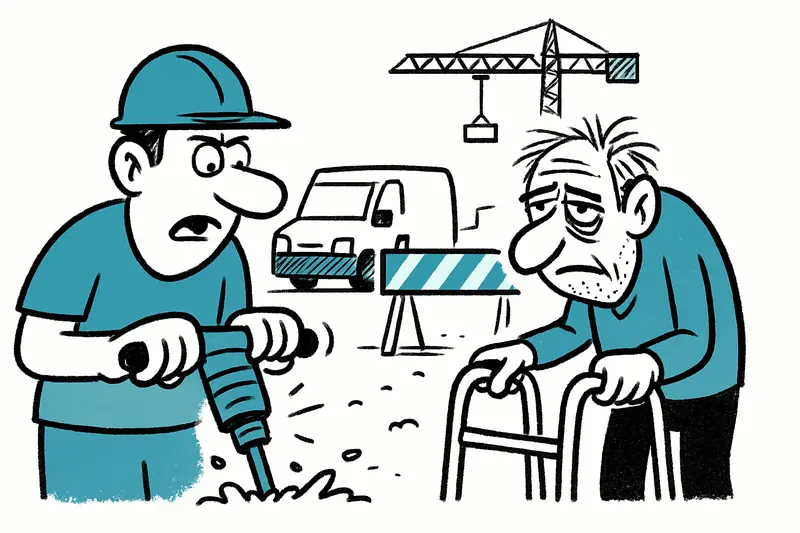
An everyday scene from the neighborhood: it is mid-morning, the sun has just risen above the sea line, yet a fine layer of dust hangs on the pavement, flowers and shop windows. The corner bakery that used to display fresh croissants is often closed now because staff cannot reach it due to the construction measures. An older man pushes his walker past a makeshift barrier, followed by a delivery bicycle squeezing through narrow gaps. Children who used to play in the small park on sunny days must stay indoors because fine particles linger in the air.
Concrete solutions that could be implemented immediately: first, a central construction management office for El Terreno to coordinate all upcoming works in time and bundle closures instead of stretching them out over years. Second, binding work hours and rest periods and a quota system for noisy work — no loud drilling in the early morning or late Saturday afternoon. Third, mandatory dust control measures: regular watering, mobile air filters at sensitive locations and closed transport for fine materials. Fourth, a utility providers' plan to minimize interruptions and to timely compensate affected households or provide temporary solutions. Fifth, an independent technical audit of construction progress and cost changes by a municipal monitoring team so that later corrections do not burden the neighborhood.
In addition, the city should establish a local contact point in El Terreno — an office that accepts complaints, offers appointments for information meetings and acts as a mediator between residents, architects and companies. Transparency is not a luxury: realistic completion dates, published daily and weekly work schedules and an emergency hotline would avoid a lot of frustration.
Legal steps should be a last resort, but pressure tools such as citizen objections to night or Sunday work, fines for non-compliance with environmental regulations and mandatory social compensation could have an effect. Furthermore, future contracts should place greater emphasis on penalties and guarantees so that financial surprises do not automatically extend delays.
Conclusion: the renovation of s’Aigo Dolça and other projects can bring real benefits to the neighborhood — a functioning pool, a small park, new shops. But not at the price of people living for months or years in a semi-public construction zone. If the administration and construction industry do not finally cooperate on a binding basis, the end result will be a finished project and a worn-out neighborhood. Those who know this part of Palma understand: El Terreno has tested its residents' patience, and local access measures such as an elevator have been proposed in El Terreno Gets an Elevator — a Small Step with Big Impact. It's time for clear rules and tangible compensation, not just promises of better times.
Frequently asked questions
Why has construction in El Terreno Mallorca been going on for so long?
How does construction in El Terreno affect daily life for residents?
What can be done to reduce construction noise and dust in Mallorca neighborhoods like El Terreno?
Who is responsible when construction work in Palma interrupts gas or electricity?
Is El Terreno in Mallorca still worth visiting while construction is ongoing?
What is happening around Carrer s’Aigo Dolça in El Terreno?
What is the new sports and swimming facility in El Terreno supposed to bring to the area?
What should residents in El Terreno do if construction is affecting their health or home life?
Similar News
Car on MA-13 near Inca in flames – a safety check for the island
A vehicle caught fire on the MA-13 towards Alcúdia on Tuesday afternoon. The driver was uninjured, the car was destroyed...
Real Estate in Mallorca: Fewer Buyers, Higher Prices — What's Behind It?
Sales on Mallorca are falling, yet prices continue to climb. Why fewer transactions do not equal relief — and what shoul...
Just Bought — Already Trouble: Water Damage in the Heiters' Villa and What Owners in Mallorca Should Know Now
A newly purchased sea-view property — and within days a water damage. What risks lurk in new properties in Mallorca, and...

Rich, Richer, Mallorca? A critical look at the growing super-rich bubble
Numbers: Around 3,600 millionaires in the Balearic Islands hold a combined €27.6 billion. What this concentration of wea...
Chain reaction on the MA-1: Eight injured in rear-end collision near Portopí
On Tuesday morning there was a crash at the Andratx exit to the MA-1 towards Palma: a rear-end collision between a car a...
More to explore
Discover more interesting content

Can Cap de Bou

Townhouse Lleo 72
