
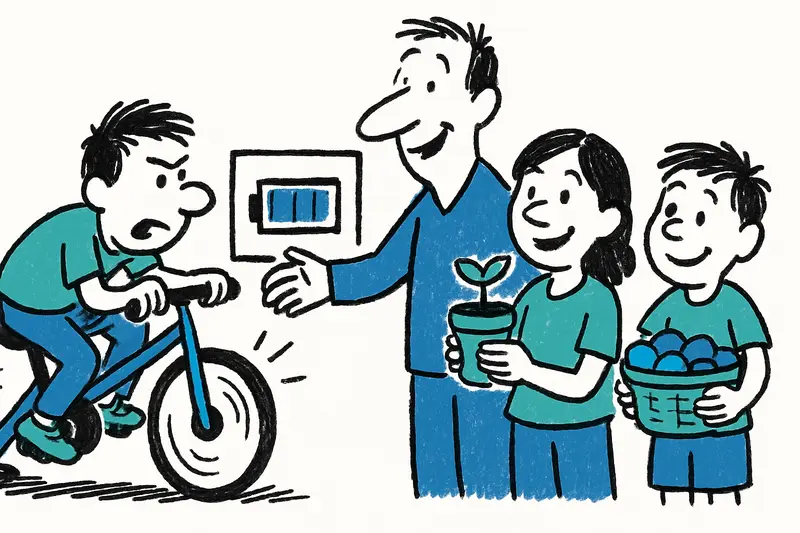
Energy BYD Challenge in Santa Margalida: Children pedal for clean energy
Energy BYD Challenge in Santa Margalida: Children pedal for clean energy
Around 120 fourth- and fifth-graders from CEIP Eleonor Bosch learned on the Plaça de la Vila, through play, how electricity, recycling and mobility are connected. A hands-on day that leaves a lasting impression.
Energy BYD Challenge in Santa Margalida: Children pedal for clean energy
Hands-on learning on the Plaça de la Vila – bike ergometers, quiz and a tomato seedling to take home
In the morning the voices of children filled the Plaça de la Vila in Santa Margalida. Around 120 pupils from the fourth and fifth grades of CEIP Eleonor Bosch gathered there to experience for themselves, as part of the project "Energy", what sustainability means in everyday life. Between the clicking of bicycle chains, laughter and the distant chime of the town hall bells, you could see curiosity and movement come together.
The centerpiece of the event was bike ergometers that generated electricity while pedaled. On screens the groups could follow in real time how much energy they produced – an immediate, tangible result of their own effort. The children not only competed against each other but also learned that energy is not an abstract concept, but something linked to effort and responsibility.
In addition to cycling there was a small cinema showing a film about electromobility, reflecting local debates such as Palma's balancing act: More parking — more e-bikes — can they coexist?, and an interactive quiz that challenged the pupils and encouraged reflection. Mobility tools were on display, and the children could see electric vehicles up close for maintenance demonstrations. In a workshop they designed posters – with planets, solar panels and electric cars as motifs – showing how creatively environmental topics can be conveyed.
Movement and waste sorting were combined in a relay game: teams sorted litter correctly into bins while a giant memory game reinforced terms related to sustainable consumption. Teachers accompanying the day observed that such playful situations often anchor knowledge better than pure theory and praised the activities as a meaningful complement to classroom teaching.
Between stations the children refreshed themselves with fresh fruit and water. Each child also received a small seedling of a Mallorcan tomato variety to take home. A piece of everyday care that continues at home and preserves the connection to nature: watering, watching it grow, perhaps even harvesting – simple steps that make sustainability tangible.
Representatives of the municipality were on site; the participation of the town hall leadership underlined that such projects are supported by the administration. Also on board were the Ministry of Economy, Employment and Energy of the Balearic Islands and the companies and organizations BYD Quadis Dream, Qwello, TBC, Fundació Saica, Viveros Can Juanito, GRAM and Scoobic. The involvement of local nurseries like Viveros Can Juanito shows how well practice and region fit together.
What does this day mean for Mallorca? It is an example of how environmental education can work locally: practical, communal and visible. When children plant their tomatoes on the paving stones of the square and talk about it at home, a network of small behavioral changes is created that can have long-term effects. Schools, municipalities and companies work hand in hand here – a model that can be easily adapted elsewhere.
The Energy BYD Challenge has already had stops in Llucmajor, Pollença and Inca and will soon continue in Alaró, Campos and s'Alqueria Blanca. Such tours create awareness across municipalities and bring the topic of sustainability directly into neighborhoods; other island events with very different impacts are covered in 550 Challenge in Mallorca: A Treat for Petrolheads, a Burden on Everyday Life. For parents, teachers and local politicians it is an invitation: with small, practical actions awareness grows.
A warm spring day, children with baskets of fruit and tomato seedlings on their way home – the image stays. Anyone driving around the island in the coming weeks could stop by the next station and see for themselves: taking part is easier than it sounds, and the impact often begins at home, on the balcony or in the classroom.
Summary: An experiential, local approach to environmental education that unites practice and community and works well in Mallorca. The project shows: sustainability is best learned with your own hands – and sometimes with muscle power.
Frequently asked questions
What is the Energy BYD Challenge in Mallorca?
How do children learn about clean energy in Santa Margalida?
Is the Energy BYD Challenge suitable for younger schoolchildren in Mallorca?
What do children get to take home from the Mallorca sustainability workshop?
Which Mallorca towns have hosted the Energy BYD Challenge?
Why is environmental education in Mallorca often taught through games and activities?
What did children learn about mobility at the event in Santa Margalida?
How can families in Mallorca support sustainability at home after these school activities?
Similar News
Rescue operation at Tolleric: Why nighttime cliff parties become dangerous
A British holidaymaker fell about ten meters at the cliffs of Tolleric during the night, later climbed back up and was r...
Car accident on the MA-1: Mother and daughter on a bicycle struck by a fellow countryman – Who protects cyclists here?
On the MA-1 between Portopí and the Cala Major exit, a mother and her daughter on a bicycle were struck by a car. A para...
Smoke over the UIB: Who is responsible for the fire on the roof?
On Saturday afternoon a fire broke out on the roof of the Arxiduc Lluís Salvador building at the University of the Balea...
Short Getaway with Sea View: Inmood Aucanada among Spain's Top Hotels for Dinner Breaks
A small hotel on the coast of Alcúdia was highlighted by a Spanish experience platform as particularly suitable for shor...
Cala Pi crowned Mallorca's most beautiful beach: A morning at the rocky cove
The travel portal Holidaycheck praises Cala Pi as Mallorca's most beautiful beach: a narrow, romantic cove, clear water,...
More to explore
Discover more interesting content

Can Cap de Bou

Townhouse Lleo 72
