
Can an 1890s house be renovated in a socially responsible way? The guesthouse on Calle Can Martí Feliu
Can an 1890s house be renovated in a socially responsible way? The guesthouse on Calle Can Martí Feliu
A four-storey house from 1890 in Palma's Old Town — once a guesthouse, now vacated and offered for sale. Is affordable housing for ordinary earners threatened by a shift to luxury?
Can an 1890s house be renovated in a socially responsible way? The guesthouse on Calle Can Martí Feliu
Key question: How much of a city's history may the market turn into luxury — and who is left out?
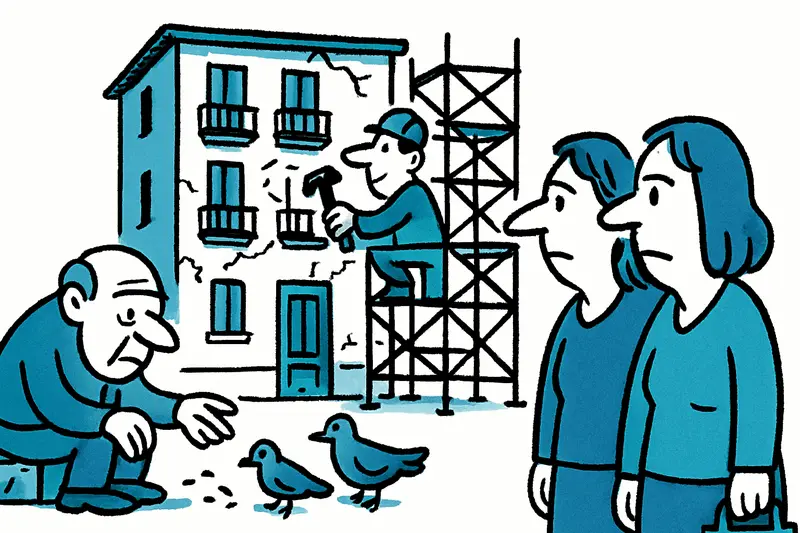
In Palma's Old Town, just a few steps from the Mercado de Olivar and the shopping street Sindicat, stands a house that has seen more than most modern new builds: Can Martí Feliu 16, built in 1890, long used as a guesthouse and recently vacated. Four storeys, just under 736 square metres, around 20 rooms — many with shared bathrooms. According to the listing, the starting price was about €3,400 per square metre, which would be roughly €2.5 million plus renovation costs. Residents report that a Spanish architect bought the building and now plans an extensive renovation with luxury apartments.
The scene is familiar: in the morning the vegetable carts roll by the Mercado de Olivar, a fisherman drops off fresh fish, and a nearby bar smells of café con leche and ensaimada. On Calle Can Martí Feliu neighbours whisper, some with shopping bags, about the change — not out of curiosity but because they know what such projects mean for the neighbourhood.
Critical analysis: conversion instead of preservation — for whom?
The building is historic: built in 1890 with a small-room layout and shared bathrooms — features that used to provide simple accommodation or affordable housing. The planned conversion into expensive apartments is economically understandable: location, square metre prices and the scarcity of attractive old-town stock point in that direction. However, this calculation has losers. Long-term guests or cheap short-term tenants lose an affordable place to stay, neighbourhoods lose mix and social diversity, and the city loses affordable housing in a central location.
One must not forget: a house is more than steel and stone. In narrow alleys, small shops, workshops, flats and guesthouses sit side by side. Once the interior rooms become exclusive units, the microclimate changes: shops become more expensive, craftsmen can no longer find affordable workshops, and the people who enliven Palma year-round are pushed further to the suburbs, as seen in Between Promenade and Cardboard Shacks: Can Pastilla on the Brink of a Social Crisis.
What is often missing from the public debate
The discussion usually focuses on investment sums and demolition in Palma. The voices of those who so far found a home in such houses — seasonal workers, pensioners on small budgets, small hospitality workers — are rarely heard. Also lacking is a cost–benefit analysis that prices social externalities: loss of affordable housing, rising rents in the surrounding area, changed local services.
Moreover, the question of mandatory requirements for renovations is hardly discussed: Are there binding rules that require a mix of affordable housing and high-quality units? Government renovation funds and which subsidies are tied to social conditions? These points are missing from the public conversation, although they are central to quality of life on the island.
Concrete local solutions
A few practical approaches the city administration and owners could consider:
1. Social conditionality of subsidies: Renovation grants only if a share of affordable housing is guaranteed.
2. Obligation for mixed-use concepts: Preserve ground-floor uses (small shops, workshops) and require a portion of affordable housing within the building.
3. Time-limited tenant protection models: Transitional arrangements for existing residents to make relocations predictable.
4. Community models: Cooperatives or community land trusts as alternatives to pure profit sales — especially interesting for buildings with local significance.
5. Transparency in sales and conversion projects: Duty to inform neighbours, early participation and public impact assessments on social consequences.
Everyday scenes as warning and motivation
An older man sits every morning on a wall opposite the house, feeds pigeons and watches the delivery workers. He knows the names of owners from previous decades and shakes his head at terms like 'luxury apartment': 'What I want is for my niece to still be able to stay nearby,' he says, without a mayor's office confirming it. Such small stories shape the Old Town more than any real estate report.
The question is therefore not only economic: it is about the soul of a neighbourhood. If the renovation succeeds and creates space for different incomes, the upgrade can have positive effects. But if planning is driven solely by profit, Palma will lose substance — and that is not noticed immediately but through small shifts: a closed artisan shop, a new café with prices only tourists can afford.
Conclusion
The guesthouse on Calle Can Martí Feliu is a typical case for a city caught between protecting the old and market appetites. The guiding question remains: can urban policy steer such conversions so that not only a few benefit? If action is taken now — with clear conditions, transparency and neighbourhood participation — a balance can be found. If not, the Old Town will continue to lose its mix, rooms for ordinary earners will disappear and Palma will lose a piece of its everyday identity.
Frequently asked questions
What is the weather like in Mallorca in spring?
Can you swim in Mallorca during spring?
What should I pack for a trip to Mallorca in spring?
Is spring a good time to visit Mallorca?
What can you do in Mallorca in spring?
Is Mallorca busy in spring?
Is Palma de Mallorca a good place to visit in spring?
Is the weather in Sóller pleasant in spring?
Similar News

Smoke over the UIB: Who is responsible for the fire on the roof?
On Saturday afternoon a fire broke out on the roof of the Arxiduc Lluís Salvador building at the University of the Balea...
Short Getaway with Sea View: Inmood Aucanada among Spain's Top Hotels for Dinner Breaks
A small hotel on the coast of Alcúdia was highlighted by a Spanish experience platform as particularly suitable for shor...
Cala Pi crowned Mallorca's most beautiful beach: A morning at the rocky cove
The travel portal Holidaycheck praises Cala Pi as Mallorca's most beautiful beach: a narrow, romantic cove, clear water,...
Injured captain, big plans: Germania Mallorca before the away match in Consell
The newly founded FC Germania Mallorca travels to Consell on Saturday. Captain Bastian Müller is out injured, but coach ...
Palma, Palma de Mallorca, Palma‑Mallorca: What is it really about?
The debate over the city's name is more than grammar: it concerns identity, law and branding policy. A sober reality che...
More to explore
Discover more interesting content

Can Cap de Bou

Townhouse Lleo 72
