
Cliff fall on Ibiza: Why a coastal cliff accident becomes a community problem
Cliff fall on Ibiza: Why a coastal cliff accident becomes a community problem
A roughly 40-year-old man of Irish origin died after a fall at a cliff near Sant Joan on Ibiza. The lengthy, complex rescue operation raises questions about coastal-edge safety and prevention.
Cliff fall on Ibiza: Why a coastal cliff accident becomes a community problem
Key question: What is missing so that a single fall does not immediately turn into a large nighttime rescue operation with air support?
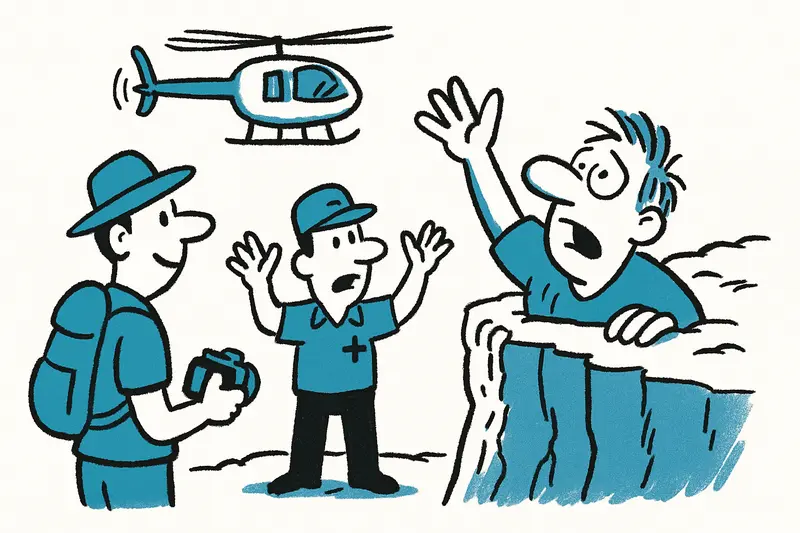
Late in the afternoon, around 5:30 p.m., a severely injured man was found in a remote cliff area near Sant Joan on Ibiza; shortly afterwards rescue personnel pronounced him dead. The victim was a roughly 40-year-old man of Irish origin. A woman who found him on the slope alerted the emergency dispatch center. Ground units, the fire brigade, the 061 emergency service, the Guardia Civil and the Policía Local were mobilized; the difficult access conditions made a helicopter recovery necessary. The operation lasted several hours and was concluded around 8:20 p.m.
It sounds like a single tragedy, but the story repeats along Mallorca's coasts and on the neighboring islands, as reporting such as When Dares Turn Deadly: Examining Cliff Jumps on Mallorca's East Coast documents: one life, one emergency call, a complicated technical access. Such missions tie up personnel, equipment and air resources that could be urgently needed elsewhere – think of summer wildfires or a heart attack in Palma.
Critical analysis: the facts are sparse, but some patterns emerge clearly. First: many cliff areas are steep, crumbly and hard to traverse. Second: people go alone to dangerous spots — whether to take photos, fish or seek solitude. Third: the alarm chain works, but the logistics become costly and complex when helicopter access is required. Fourth: the timing of the discovery (late afternoon) is no coincidence — accident rates rise when shadows mislead or orientation becomes more difficult; similar delays in discovery have been reported in other incidents, for example Bendinat accident: Unnoticed under the cliffs for hours — jetski rescue at midday.
What is often missing in public debate: responsibility is too often shifted onto rescue services. There is a lack of honest discussion about prevention, the limits of personal responsibility for visitors, and the role of municipalities and the tourism industry. It is also seldom asked how many of these missions would be avoidable if simple measures were more widely implemented, a point highlighted after cases like Tragic Fall in Cala Sant Vicenç: A Wake-Up Call for Greater Coastal Safety.
An everyday scene from Mallorca that explains the picture: a spring day in Palma, the market halls are full of voices, ferries stack cars, and cyclists push their bikes by. Tourists rent cars, follow a map without local warnings and end up at secluded coves because the photo looks better. Locals have long lowered their hoods when they see the narrow paths to cliffs; they know where the rock crumbles. But this local knowledge is rarely passed on.
Concrete approaches that could act quickly and pragmatically:
1) Mapping and signage: Municipalities should systematically map danger points along coastal paths and mark them with standardized, multilingual signs. Not just "Enter at your own risk," but specific warnings: "No descent possible," "Risk of collapse when wet," "No mobile reception."
2) Preventive information at check-in: Hotels, holiday rentals and car hire companies can provide mandatory information sheets listing risky locations — supplemented by a recommendation to avoid solitary excursions to remote cliff areas.
3) Emergency and location technology: Mobile emergency trackers, simple SOS devices or promoting emergency apps with offline maps for hikers and beachgoers would lead rescuers faster to the exact location.
4) Local patrols and volunteer networks: In municipalities with many cliffs, violations of clearly defined restricted zones could be more strictly monitored. At the same time, establishing and promoting volunteer coastal watchers who can speak to and inform visitors is worthwhile.
5) Cooperation between islands: Resources like helicopters are limited. Coordinated, cross-island planning for high season and critical time windows reduces bottlenecks; common standards for risk information create clarity for visitors.
Financial aspects must not be taboo: who pays for complex recoveries? Some EU regions are discussing models in which repatriations and search-intensive operations are partially chargeable when grossly negligent behavior is proven. That is legally sensitive and politically difficult, but a debate about costs and prevention is necessary.
What can happen immediately: better warning signs, voluntary info sheets at booking and a small public awareness campaign in several languages showing typical risks at coves and cliffs. These measures cost little but could prevent many missions.
Concise conclusion: the death of a person at a coastal cliff is always tragic. The question is whether we will do more in the future to prevent the recurrence of such missions. Rescue services will remain, but with smarter prevention, clear information and local networking the frequency of these large-scale operations can be reduced. In Mallorca, Port de Sóller or the coves of El Trenc it is often only small things — a sign, a note at the counter, a friend who doesn't go alone — that could save lives.
Frequently asked questions
Are Mallorca cliff paths safe to visit alone?
When is the best time to visit Mallorca coves and cliffs safely?
What should I pack for a walk near the Mallorca coast?
Why do cliff accidents in Mallorca often require helicopter rescue?
What can hotels and rental companies in Mallorca do to prevent cliff accidents?
Which coastal areas in Mallorca need extra caution?
How can Mallorca improve warning signs at dangerous cliffs?
Should people use emergency apps when hiking in Mallorca?
Similar News
Smoke over the UIB: Who is responsible for the fire on the roof?
On Saturday afternoon a fire broke out on the roof of the Arxiduc Lluís Salvador building at the University of the Balea...
Short Getaway with Sea View: Inmood Aucanada among Spain's Top Hotels for Dinner Breaks
A small hotel on the coast of Alcúdia was highlighted by a Spanish experience platform as particularly suitable for shor...
Cala Pi crowned Mallorca's most beautiful beach: A morning at the rocky cove
The travel portal Holidaycheck praises Cala Pi as Mallorca's most beautiful beach: a narrow, romantic cove, clear water,...
Injured captain, big plans: Germania Mallorca before the away match in Consell
The newly founded FC Germania Mallorca travels to Consell on Saturday. Captain Bastian Müller is out injured, but coach ...
Palma, Palma de Mallorca, Palma‑Mallorca: What is it really about?
The debate over the city's name is more than grammar: it concerns identity, law and branding policy. A sober reality che...
More to explore
Discover more interesting content

Can Cap de Bou

Townhouse Lleo 72
