
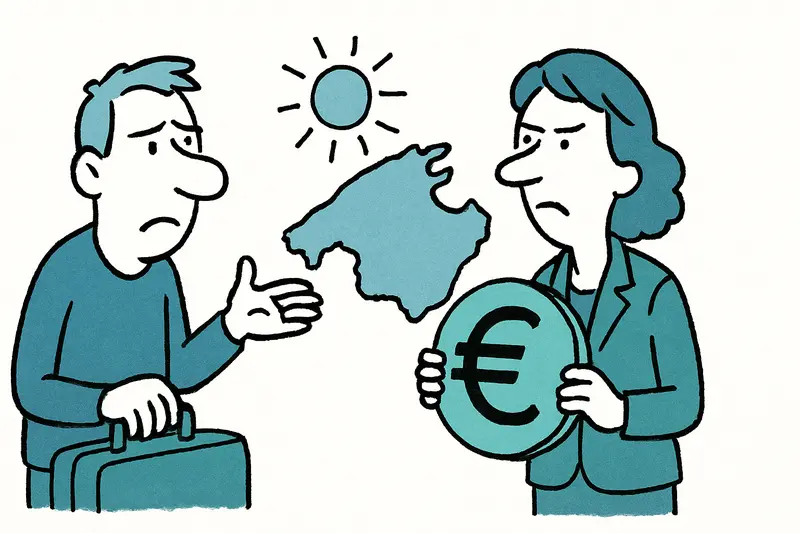
EU Tourism Funding in Mallorca: Sustainable, but Without a Brake?
An analysis of 296 tourism projects in the Balearic Islands shows that only a small share of the EU funding examined went to measures explicitly aimed at reducing tourism intensity. What the figures say—and what they don’t.
Where is the money going—and what is it actually meant to change in Mallorca?
Anyone who has walked through central Palma on a warm day knows the scene: A bus pulls up, a group gets off, and the pavement grows crowded. In the café next door, locals order their cortado while another group gathers outside. This is not proof of any particular policy. But it shows why one question keeps coming up in Mallorca: Are public investments being used only to organise tourism more effectively—or also to ease its pressure on the island and everyday life?
An analysis of 296 tourism-related projects in the Balearic Islands offers a concrete point of reference for this debate. The projects examined had a combined budget of around €238.41 million. That represented about 90 percent of the tourism funding allocated to the islands through Spain’s Recovery and Resilience Plan. The analysis groups the projects according to different ideas of sustainability. Its most striking finding: on average, almost 80 percent of the budget examined went to measures the researchers classify as “green growth.”
This refers to projects that aim to maintain economic activity while reducing or better managing its environmental impact. They may include energy efficiency, infrastructure, environmental restoration and digital systems. Such measures are not automatically pointless or merely cosmetic. More efficient equipment can save resources; better management can make problems visible. But these improvements do not, by themselves, answer the question of how much tourist activity a place can sustain over the long term.
The small figure with major political significance
Measures assigned to a post-growth approach in the study accounted for an average of 3.25 percent. According to the analysis, these include the long-term protection of land, ecological restoration and reducing tourism intensity. Around 17 percent went to projects that, according to the study, follow a more conventional growth model—for example, advertising, diversifying tourism offerings or improving transport links.
The figures are a snapshot of how the funding examined was allocated, not a verdict on every individual project. The categories are also the researchers’ analytical framework. It would be going too far to conclude from them that four-fifths of the funding had “nothing to do with sustainability.” By the same token, it would be too easy to present every more energy-efficient light or digital platform as a solution to overcrowding. Lower consumption per visitor is not the same as less pressure if visitor numbers rise at the same time, or if tourism spreads to more places and across more months.
This is the critical point: The word sustainability can mean many things. It can refer to protecting a habitat, but also to making tourism more efficient while allowing it to keep growing. The study shows that the latter interpretation was much more prominent in the funding examined than measures explicitly aimed at limiting tourism intensity. On its own, however, the study does not prove that any particular project in Mallorca failed, or that EU funding could have directly reduced visitor numbers. To establish that, the conditions attached to individual grants, project objectives and outcomes would need to be examined in greater detail.
What often gets overlooked in the debate
A budget total does not tell us whether a project works. How much water was actually saved? Was a sensitive natural area relieved of pressure? Did traffic conditions improve—and for whom? Did new capacity get created that later attracted even more demand? These questions belong alongside the amount of funding approved and the number of facilities completed. Otherwise, the public record mainly counts what was built or bought, not what changed in everyday life.
How funding is distributed across the islands also matters. A measure that makes sense in Palma will not necessarily have the same effect in a small coastal town or in the Tramuntana mountains. And a project that eases an urgent problem in one place may increase the burden elsewhere. The published averages show the broad direction of funding, but they cannot replace local scrutiny: Where is the project located, what limits apply there, and who bears the long-term costs?
What could change in practice
First, a clear public report should be available for every tourism project receiving funding, covering its cost, location, objective, measurable baseline and results after completion. Not just “energy efficiency improved,” but, for example: how much was saved compared with which previous year? Second, binding criteria are needed that take local limits into account—for example, those relating to water, traffic or the protection of sensitive areas. A project should not be considered sustainable simply because it uses newer technology.
Third, calls for proposals could give greater weight to projects that measurably reduce pressure or reverse damage, rather than simply optimising further tourism offerings. This includes protecting and restoring habitats, as well as making better use of existing infrastructure without quietly building in the goal of generating new demand. Fourth, results should be monitored over several years. A newly funded facility can be opened quickly; the more important question is whether it is still saving water or protecting a natural area after three summers.
For people in Mallorca, this may sound dry—like spreadsheets and funding applications. But this is exactly where it is decided whether “sustainable tourism” is more than a friendly label. When the queue at the bus stop gets longer or pressure on water and roads rises in August, the programme’s headline is not what matters. What matters is whether the change can be felt locally.
The study offers no simple culprit, but it does provide an uncomfortable test: By far the largest share of the funding examined was intended to make tourism more environmentally sustainable, while approaches to reducing its intensity accounted for only a small proportion. Mallorca needs both more efficient systems and clear limits. Funding only the former may simply make the existing model run more smoothly—not necessarily make life easier for the island.
Frequently asked questions
How is EU tourism funding being used in Mallorca?
What does “green growth” mean for tourism in Mallorca?
Does sustainable tourism funding reduce overcrowding in Mallorca?
How much tourism funding went to reducing tourism intensity in the Balearic Islands?
Does the funding study prove that EU tourism projects in Mallorca failed?
How can people tell whether a tourism project in Mallorca is genuinely sustainable?
Why do the local effects of tourism funding vary across Mallorca?
What could make tourism funding more accountable in Mallorca?
Similar News

Luggage at Palma Airport: How to Make Your Suitcase Easier to Spot
Black and dark blue suitcases can look remarkably alike on the carousel. A distinctive marker makes yours easier to find...
The Ferreret on Mallorca: Why This Little Toad Is More Than a Natural Wonder
The Ferreret toad lives only on Mallorca. Its protection depends not on grand promises, but on quiet water sources, inta...
Luxury Hotel Renovation in Port de Sóller: What Will It Mean for the Town?
A hotel renovation can refresh rooms and facilities. The harder question for Port de Sóller is how employees, local busi...
Mallorca and EU Funding: Sustainability Also Needs Limits
Funding can make hotels and municipalities more efficient. But using less water per guest still does not answer how much...

Free Buses in Mallorca: Relief with No Clear End in Sight
Madrid wants to extend free travel on season passes and multi-journey tickets through 2027. Before parliamentary approva...
More to explore
Discover more interesting content

Can Cap de Bou

Townhouse Lleo 72
