
The Ferreret on Mallorca: Why This Little Toad Is More Than a Natural Wonder
The Ferreret toad lives only on Mallorca. Its protection depends not on grand promises, but on quiet water sources, intact gorges and the actions of local people.
An Island Species Is Not a Souvenir
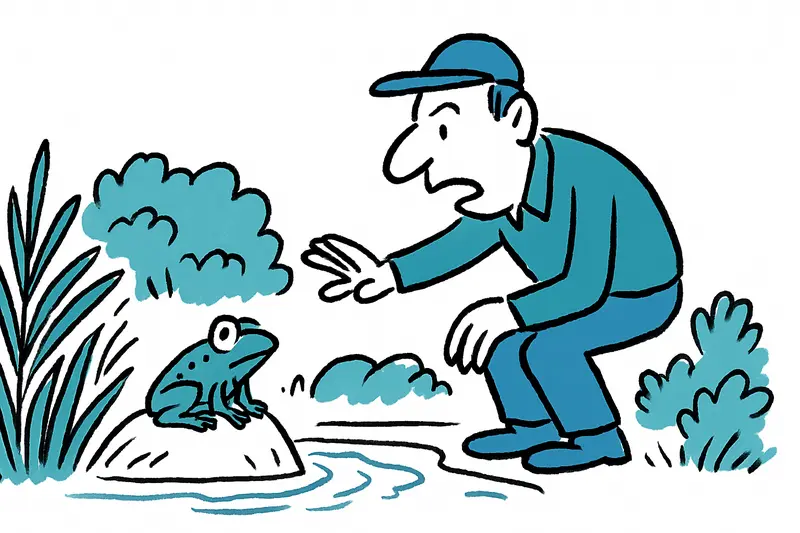
In the Tramuntana, a streambed can look almost unremarkable from the road: pale rock, a few shaded channels, water gathering between stones. These small, damp refuges are exactly what the Ferreret needs. The Mallorcan midwife toad, scientifically known as Alytes muletensis, occurs naturally only on Mallorca. Its habitat lies in the mountains of the Serra de Tramuntana. That makes it special—and vulnerable.
“A frog found only here” may sound like a charming island curiosity. But uniqueness is no trophy for a natural history cabinet. It means that if conditions deteriorate on Mallorca, there is nowhere else in the world for the species to retreat to. Its story is therefore less an exotic footnote than a question of how carefully the island looks after its smallest habitats.
The Toad Doesn’t Need a Grand Stage
The Ferreret is not an animal you can count on seeing during a walk. It lives in rocky, hard-to-reach places near small water sources. In midwife toads, the males carry strings of eggs around their hind legs until the larvae hatch. It is a remarkable strategy—but no invitation to go searching for them. Where animals need to be left undisturbed, not seeing them can be the best kind of observation.
On Mallorca, water is never just scenery. In summer, gardens, fields and villagers feel its importance; in the mountains, a small spring or a pool that holds water only seasonally can be vital to wildlife. Longer dry spells and heavy rainfall put these habitats under pressure: one can shrink water sources, while the other can wash away sediment and larvae. The impact on individual populations cannot be judged from a car park. That is precisely why ongoing monitoring is needed instead of reassuring assumptions.
What Can Get Lost in the Public Debate
Conservation discussions quickly turn to large protected areas, rare animals and beautiful images. The painstaking work in between is less visible: checking water sources, recording changes, limiting disturbance and responding quickly to new threats. The links between habitats matter too. A single stream is not an isolated miniature world, but part of a delicate system of rock, water, vegetation and quiet.
Visitors usually see only the trail passing a ravine. They may not know whether a pool holds water year-round or whether a population there is under pressure. This is not a criticism. Rather, it shows why signs and clear local rules matter. People who are unaware of sensitive areas may accidentally enter them, move stones or pollute the water. A photo takes only a moment; the effects of disturbance are harder to see.
Preventive measures must also account for introduced animals and pathogens. A new threat can be especially serious for small, isolated amphibian populations. Experts and the relevant authorities need to decide which measures are appropriate in each location. For everyday visitors, the rule is simple: do not touch or relocate animals, do not release non-native animals, and follow notices about closed or particularly sensitive areas. If you are near a stream, do not throw anything into it or use soap or other products in the water.
Protection Starts with the Unremarkable Things
Some practical steps would make sense for Mallorca. Where necessary, sensitive breeding and water sites should be more clearly marked or temporarily protected from visitor traffic. Monitoring needs to be consistent: not just counting animals, but considering water levels, habitat conditions and possible changes together. Before work is carried out in the mountains, it should be assessed at an early stage whether small bodies of water or tributaries could be affected. Information must also be easy to understand—in Mallorcan, Spanish and the languages hikers actually speak.
This sounds less spectacular than putting a rare species on a cover. It is, too. But conservation rarely consists of one grand moment. It lies in choosing not to leave the trail, leaving a stone where it is and not treating a water source like a paddling pool. Explaining these practices, rather than simply issuing prohibitions, makes it easier for visitors and residents alike to act considerately.
Life goes on at the edge of the Tramuntana: a delivery van on the country road, voices from a village, the smell of damp earth after a shower of rain. The toad usually remains unseen. That should not make it seem unimportant. Mallorca can be proud of a species found nowhere else. But the best proof of that pride is not how often its name is mentioned—it is whether its small water habitats remain quiet enough for it to live there in the future.
Frequently asked questions
What is the Ferreret, Mallorca’s native midwife toad?
Where does the Ferreret live on Mallorca?
Can you see Ferrerets while hiking in Mallorca?
How do male Ferrerets care for their eggs?
How do drought and heavy rain affect Ferrerets in Mallorca?
What should visitors do near mountain streams in Mallorca?
What are the main threats to the Ferreret on Mallorca?
How is the Ferreret protected in Mallorca?
Similar News

Luggage at Palma Airport: How to Make Your Suitcase Easier to Spot
Black and dark blue suitcases can look remarkably alike on the carousel. A distinctive marker makes yours easier to find...
EU Tourism Funding in Mallorca: Sustainable, but Without a Brake?
An analysis of 296 tourism projects in the Balearic Islands shows that only a small share of the EU funding examined wen...
Luxury Hotel Renovation in Port de Sóller: What Will It Mean for the Town?
A hotel renovation can refresh rooms and facilities. The harder question for Port de Sóller is how employees, local busi...

Mallorca and EU Funding: Sustainability Also Needs Limits
Funding can make hotels and municipalities more efficient. But using less water per guest still does not answer how much...

Free Buses in Mallorca: Relief with No Clear End in Sight
Madrid wants to extend free travel on season passes and multi-journey tickets through 2027. Before parliamentary approva...
More to explore
Discover more interesting content

Can Cap de Bou

Townhouse Lleo 72
