
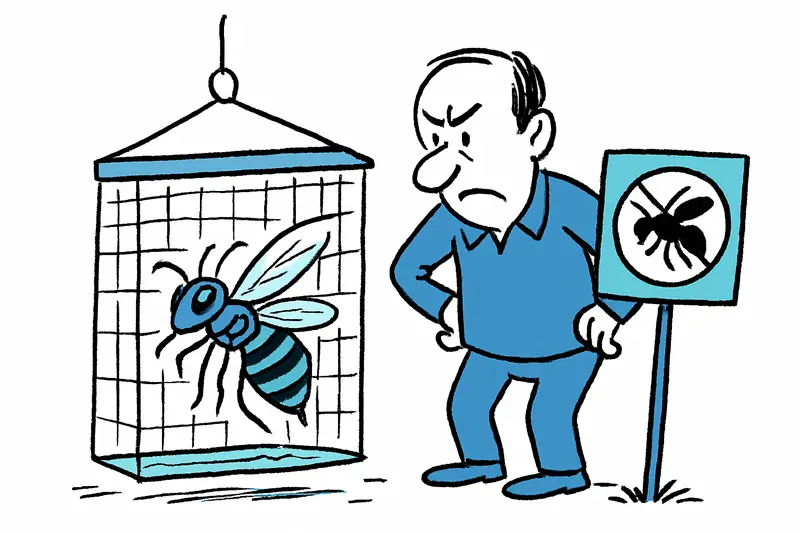
Fighting the Asian hornet: Is this enough on Mallorca?
Fighting the Asian hornet: Is this enough on Mallorca?
The Balearic government has set up 380 traps and caught 22 hornets; a nest in Palma was removed. Our reality check: How effective are the measures, what's missing in the public debate, and how can residents, beekeepers and authorities work together better?
Fighting the Asian hornet: Is this enough on Mallorca?
Key question: Can 380 traps and 22 captured individuals stop the new invader — or does the island needs a plan B?
On the Passeig des Born an old woman sits on a bench, a bee hums next to a flower tub. Not a loud drama, but the buzzing has become quieter in recent years, and that makes people here nervous. The Balearic government has now set up around 380 traps and reports 22 captured Asian hornets between March and May (GOV.UK guidance on the Asian hornet (Vespa velutina)); a nest was found and removed in Palma. Good news, clearly — but is it enough?
Critical analysis: Traps are tools, not a solution. A catch of 22 individuals shows that monitoring works; at the same time the number tells us nothing about population dynamics. It is not known where the traps are located exactly, which baits are used, how many non-target species were caught, or how quickly new nests reappear. A removed nest in Palma is a visible success, but a nest is only the tip of the iceberg: Vespa velutina often builds well-hidden nests in vegetation and building crevices — and the species multiplies within months (Wikipedia's page on Vespa velutina).
What is missing in the public discourse: transparency and context. The number of traps sounds impressive, but maps of trap locations, regular updates on catch numbers, data on breeding cycles and reports on bycatch are missing. The role of ports and airports as entry points is usually only mentioned in passing. And: there is little discussion about how affected Mallorca's beekeepers really are — not in numbers, not with firsthand accounts.
Everyday scene in Mallorca: At the weekly market in front of the Mercat de l'Olivar a beekeeper buys honey and casually explains that he has already seen foreign hornets at the apiary several times this year. He has a close network of neighbours who send alerts via WhatsApp, but no official reporting app. Such local informants are often the first to discover nests — yet they act voluntarily and without clear guidance.
Concrete solutions that would make sense now: First, more targeted trap placement instead of mass deployment: traps at known flight routes, near ports and apiaries, combined with different lures to increase effectiveness and reduce bycatch. Second, a public dashboard with maps and catch statistics so beekeepers, scientists and the public can identify patterns. Third, regular training for municipal workers, firefighters and volunteers — anyone who finds a nest needs safe protocols, protective equipment and disposal instructions. Fourth, funding research into early warning: nest-detection dogs, drones with thermal cameras and genetic tests can help detect nest density and origin pathways.
Further: Better exchange with beekeepers and agricultural businesses. Some farms need guidance on which plants to sow along roadsides; flowering hedges can protect bees but also attract hornets. Information leaflets in town halls, flyers at markets and a hotline or app for reporting — the Balearic conservation authority COFIB already has a WhatsApp account at 606 875 244; that's practical, but alongside reporting there should be clear follow-up: who responds, how fast, what is documented?
What authorities should do: Provide funds for long-term monitoring, finance cooperation with universities and set clear priorities: protect pollinators, minimise bycatch, and quickly remove nests in inhabited areas. Border controls for plant imports and transport of wood and garden waste also deserve attention — invasive species often travel with goods.
Objections and risks: Every measure has side effects. More traps increase the risk of catching beneficial insects. Chemical baits are problematic. Volunteer programmes can be useful but need oversight. And of course everything costs money — but the equation is simple: loss of bees hits agriculture, tourism with honey and nature offerings, and small-scale farming on the island.
Punchy conclusion: The discovery of the nest in Palma and the 22 captured animals are not an all-clear but a warning: the island is accessible to an invasive species, and the current approach feels more reactive than strategic. People in Mallorca may be pragmatic — that's not enough now. We need more data, clearer procedures, stronger links with beekeepers and researchers and communication that doesn't just soothe with numbers but explains what comes next. The traps are a start. The real fight takes place on the meadows, in the ports and in the minds of decision-makers.
Frequently asked questions
What is the weather usually like in Mallorca in late spring?
Can you swim in the sea in Mallorca in spring?
Is late spring a good time to visit Mallorca?
What should I pack for Mallorca in the spring?
What is Palma like in late spring?
Are Mallorca beaches busy in late spring?
What is the weather like in Sóller in spring?
Is it worth visiting Mallorca for outdoor activities in late spring?
Similar News

"Fifth Season" in Port d'Andratx: A glass-bottom pool that makes passersby stop
An unusual superyacht with a dark hull and a partially glazed infinity pool is currently at the Yacht Club of Port d'And...

Newark–Ibiza: What the new direct flights mean for Mallorca
United will operate four weekly direct flights from New York–Newark to Ibiza with the A321XLR from May 2027. For Mallorc...

Body in the Basin of Port Adriano: Who Protects People During Crossings?
In the morning, just before noon: employees of a luxury marina discovered a floating body in the basin of Port Adriano. ...

Raised from the Sand: A Late Antique Merchant Ship Tells of the Sea off Can Pastilla
A 1,700-year-old Roman merchant ship was raised off Can Pastilla. Finds such as sail fragments and amphorae provide rare...
After the Storm: Why Many Fish Died at Riuet de s'Illot — and What's Still Missing
After the severe storm, numerous dead fish were found in the Riuet de s'Illot wetland. Who is affected, why it may have ...
More to explore
Discover more interesting content

Boat Tour with BBQ along Es Trenc Beach

Private transfer from Mallorca Airport (PMI) to Pollensa
