
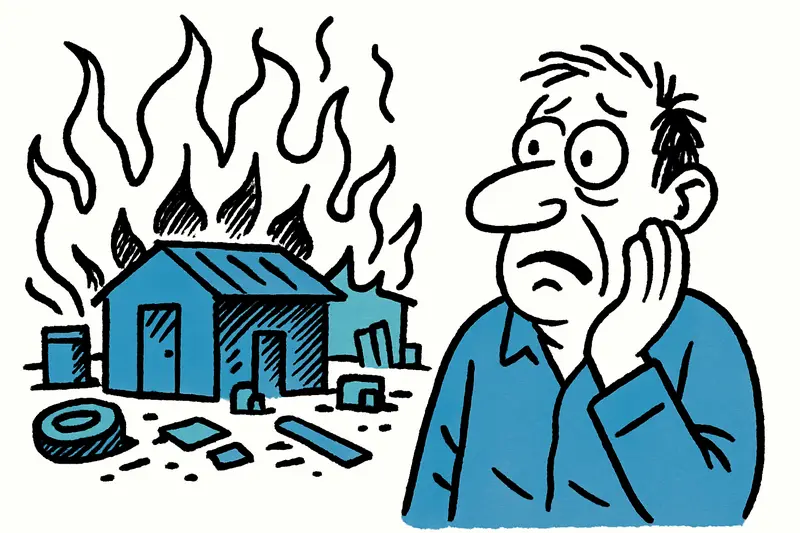
Fire on the outskirts of Palma: When improvised settlements become a ticking time bomb
Plumes of smoke on Palma's edge, burning shacks near Ca'n Pastilla: why the city needs more than fire engines — and which measures could really help.
Smoke in the evening — and nobody feels responsible
When the sun sets behind the airport and the last buses creak into the suburbs, the smell of smoke rises into the streets in some corners of Palma. Last week, around 10:30 p.m., improvised shacks burned again near Ca'n Pastilla; two nights earlier residents on Calle Aragón were jolted awake by crackling in the dark. Similar incidents have occurred elsewhere in Palma, as reported in Fire in Can Morro near Porto Pi: A Wake-Up Call for Mallorca's Fire Safety. This time people were uninjured — luck that can easily run out.
What the settlements really look like
These are not organized emergency shelters; they are makeshift constructions of wood, sheet metal and tarpaulins: pallets as floors, seemingly clamped-together solar panels, exposed electrical cables, piles of furniture and cardboard — all dry and waiting like accelerants. At night the wind carries the creaking of the structures, along with the distant roar of airplanes and sometimes loud voices from the nightlife. A resident who asked not to be named says quietly: 'You live with the smell, with the fear that something will spark.'
Ignition sources and gaps in responsibility
Fire department and police see a bundle of causes: improperly installed or defective solar systems, carelessly discarded cigarettes, and in isolated cases arson. Added to this is a factor that rarely makes the front pages: batteries from solar kits and tractors left unsecured that can react dangerously in heat, a known issue described in lithium-ion battery fire hazards. These storages are often located in immediate proximity to residential buildings, petrol stations or businesses. The result: a local incident can become a citywide crisis within minutes, a risk highlighted in Spain is Burning: Fire Traces as Far as Mallorca – Is the Country Really Prepared?.
The social dimension that is too often overlooked
Behind the shacks are people with stories — lost jobs, broken relationships, addiction problems. Some are only there temporarily, others stay for years. Support services reach them only patchily, and local reporting on recent fires shows how responses can fall short, as in Fire near Porto Pi: What the blaze reveals about safety in Palma. Social workers report difficult accessibility, no fixed contacts at night and that many residents distrust official agencies. So much remains improvised: provisional power connections, solar modules, batteries — built out of necessity, but dangerously flammable.
Why simple clean-up is not enough
There are repeated clean-up actions — tidy, brief, incomplete. Afterwards the problem often reappears elsewhere. That is not only due to a lack of resources, but to the logic of life on the street: without safe alternatives people return. A resident at a bus stop puts it calmly: 'We don't just want them to clear things away, we want people to be able to live without fear.'
Concrete steps: What must be done now and what requires long-term action
The equation is simple, the implementation more complicated. In the short term the city must neutralize the hazards: regular waste removal, secure collection points for batteries, EU guidance on battery waste and recycling, mobile fire protection units, fire inspections and a clear action plan for hot summers. Also important are targeted deployments of social-pedagogical teams together with the fire department — people should not just be driven away, but accompanied.
In the medium term there is a need for secure energy provision: central charging and power points with professional installation, the use of certified solar systems and a program to replace dangerous batteries. This should include mandatory registration of temporary accommodations so that help can arrive quickly.
In the long term there is no way around housing policy solutions: affordable housing, transitional apartments, supported housing projects and reintegration programs. Hotels and local businesses nearby are affected — a coordinated municipal response, financed through central funds and EU programs, would be more sensible than fragmented emergency measures.
A city must act — not just extinguish
The fires on the outskirts are warning shots: they mark technical risks, social imbalances and a failure in prevention. Palma can and must work harder on the problem — less with flash actions, more with sustainable structures. Otherwise the fear at night will remain, the crackling of the fences and the knowledge that there may be less luck the next time a blaze occurs.
Frequently asked questions
Why are there fires in improvised settlements on the outskirts of Palma?
Are the fires near Palma dangerous for nearby residents and businesses?
What should I do if I smell smoke in Palma at night?
What causes fires in Mallorca’s improvised settlements?
Why is clean-up alone not enough in Palma’s informal settlements?
What longer-term solutions could reduce fire risk in Palma?
Is Mallorca prepared for fires linked to temporary housing and batteries?
What makes the areas around Ca'n Pastilla and Calle Aragón vulnerable to fires?
Similar News
Release after bloody attack in Palma: Why the court's decision raises questions
An 18-year-old who allegedly inflicted a serious neck injury on a man at Plaza Gomila using a wristwatch wrapped around ...
Kidnappings in Inca: Three young men forced into car trunks and abused in the forest – a reality check
In Inca, three 18-year-old men were forced into car trunks by masked assailants at the Plaça des Bestiar, taken to a for...
Spreading Massification: The Brake That Still Has Much Work to Do
Marga Prohens announces limits on volume tourism. The measures sound harsh — but are they enough to save everyday life, ...
Through the Keyhole onto the Party Yacht: How Daniela Katzenberger Is Planning Her 40th on Mallorca
Daniela Katzenberger turns 40 and wants to celebrate it on the island — likely with a boat, cake and her mother. A relax...
By Boat Instead of the Road: Palma's Water Bus — a Reality Check
The 'Bus Nàutic' launches in two stages — but questions remain over interim operations, fares and environmental requirem...
More to explore
Discover more interesting content

Can Cap de Bou

Townhouse Lleo 72
