
Fort San Carlos: Museum, Harbor Dispute — and a Conflict That Demands Answers
Fort San Carlos: Museum, Harbor Dispute — and a Conflict That Demands Answers
The military museum at Fort San Carlos sits right on Palma's harbor, with unexpectedly quiet rooms filled with cannons and a rooftop view of the city. The dispute over the use of the surrounding port area makes clear that heritage conservation, environmental protection and port economics are clashing.
Fort San Carlos: Museum, Harbor Dispute — and a Conflict That Demands Answers
When you reach Fort San Carlos at the entrance to Palma's harbor, you first hear the seagulls, then the distant horn of ships and finally the creaking of old cannon carriages. The structure dates from the early 17th century; the fort itself is a distinctive point on the Passeig Marítim and has housed Palma's Military Museum since 1981, and nearby Under the Seu: Palma's Maritime Museum Reopens After Renovation.
Inside there is more than photographs: rows of cannons, display cases with infantry equipment and even a collection of hand grenades in one of the rooms, labeled with names like 'Courage' or 'Perseverance'. Admission is modest: residents pay about four euros, tourists around five euros. From the roof there is an unobstructed view over the harbor basin, cruise ships and the city's rooftops — a reason many locals value the site.
The museum recounts chapters of Spanish military history, including events such as the Battle of Bailén in 1808 and the conflicts at the end of the 19th century when Spain lost colonies like Cuba. The exhibition also addresses figures like Valeriano Weyler; historically his campaigns in Cuba and the Philippines are controversial episodes.
But the place is not just an archive. Right next to the fort there are currently sand drifts, remnants of boats and the weathered remains of a former beach bar that was closed for lacking a permit. The port authority has plans to use the area for marine repair and service facilities, not unlike the discussions around Portocolom renews its harbor: Between tradition and rooftop promenade. Conservation groups such as Arca and GOB propose the opposite: Portixol to Become Greener – How Much of the Harbor Will Remain?, a plan for generous green space as a buffer between the city and the port.
Key question: does the area around the fort primarily belong to the port economy — or to the city community together with heritage and environmental protection? The answer is not only aesthetic. It concerns noise, traffic, clean water, tourism quality and how Palma manages its coastline economically.
Critical analysis: the ongoing debate seems to be conducted in a piecemeal way. Concrete environmental impact data, noise studies and comparisons of alternative locations for shipyards are missing from the public record. Planning documents are not presented in a form easily accessible to citizens. This creates distrust. Economic arguments for repair facilities are often stated in general terms — jobs, added value — without numbers showing how many real positions would be created and at what cost to the neighborhood.
What is missing from the public discourse: an honest cost-benefit calculation, serious alternatives and the perspective of those who pass the fort every morning. The voices of port residents, fishermen, museum staff and the small cafés whose customers enjoy the castle roof view and mix the smell of sea salt with the aroma of coffee are absent.
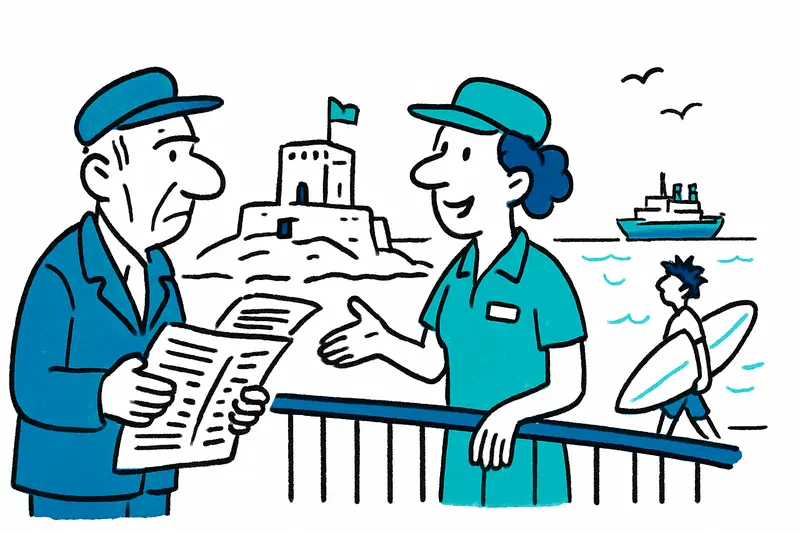
Everyday scene from Palma: a retiree in a uniform jacket who often visits the museum takes his newspaper from his pocket, greets the museum attendant and stops at the railing to watch the harbor bustle. On the promenade cyclists turn, a delivery van honks, and two young people unpack surfboards. This routine would be severely disrupted if heavy workshops with running diesel engines replaced the sand hills.
Concrete solutions: firstly, an independent environmental study assessing noise, soil and water quality and light emissions. Secondly, a comparative examination of alternative locations for marine services, including costs for connections and infrastructure. Thirdly, the establishment of a protection zone around the fort with clear building and use rules providing a buffer band of green and recreational space. Fourthly, participation formats for the neighborhood: public workshops, digital information portals, clearly dated decision phases. Fifthly: temporary cleanup measures so that access to the museum does not give the impression of a derelict lot.
Concise conclusion: Fort San Carlos is more than a museum with a beautiful view. It is a place where memory, urban life and port use meet. A 'business as usual' approach favoring unfiltered port industry would tip the balance. If the authorities genuinely want to create jobs, they should do so without sacrificing daily quality of life in Palma. A solution with green strips, clear limits for craft businesses and transparent participation would be a compromise that protects port pride and preserves quality of life.
Frequently asked questions
What is the best time of year to visit Mallorca for warm weather and sunny days?
What should I pack for a beach trip to Mallorca?
Is it safe to swim in Mallorca’s sea, and what should I watch for?
What are good ways to get around Mallorca without a car?
What are some must-see places for a first visit to Mallorca?
How does Mallorca's weather vary with the seasons?
Are there family-friendly activities in Mallorca suitable for kids?
What should I know about sun protection and beach safety on Mallorca’s coast?
Similar News

Rental Car Theft in El Arenal: What This Incident Reveals About Our Gaps
A teenager steals a running rental car in El Arenal, flees on foot, climbs over walls and is caught by the Guardia Civil...

Red Rope in Palma's Library: What Helps Against Selfie Tourism — and What's Missing
Palma's city library cordoned off an area with a red rope to keep selfie tourism away from reading and working activitie...
Old Town Under Pressure: When a Doorway Becomes a Sleeping and Shower Place
For months a woman has been living with a parasol, a clothes rack and personal belongings next to the social welfare off...

When Shopping Weighs Heavier: Mallorca Demands a Tax Pause on Food and Fuel
Rising prices are putting pressure on households and agriculture. The Balearic Islands are calling for temporary tax rel...
Almost 70 Euros for Just Under Three Hours of Parking: The Trap at Son Sant Joan
A short work errand at the airport ended with a surprisingly high parking bill. Why the two-hour tariff limit raises so ...
More to explore
Discover more interesting content

Can Cap de Bou

Townhouse Lleo 72
