
From the Reading Chair to the Patrol Car: How an Adopted Porreres Resident Continues to Accompany His Village
From the Reading Chair to the Patrol Car: How an Adopted Porreres Resident Continues to Accompany His Village
Richard Nightingale Goss, who moved to Porreres in 2001, left the village not only books but now also his car — which will be used by the local police. A small story about gratitude, everyday life, and how memories become practical.
From the Reading Chair to the Patrol Car: How an Adopted Porreres Resident Continues to Accompany His Village
A British newcomer remains visible in Porreres years after his death
Anyone strolling through Porreres on a market day hears the clatter of the stalls, sees the seniors gathered on the Plaça, and sometimes notices the soft hum of a Volkswagen now driven by the local police, a quieter counterpart to episodes like Brave Police Trainee Stops Fleeing Driver — Neighbors Lend a Hand. The car once belonged to Richard Nightingale Goss, a man who moved from Britain to Mallorca in 2001 and soon made the small village his home, a journey similar to My Heart Pulled Me to Palma – How a German‑Austrian Couple Is Putting Down Roots Here.
Goss, who died in 2023 at the age of 83, was no casual acquaintance of the village. After health setbacks in his professional life he sought connection and found it: he helped with civil protection, drummed with the batucada, attended rehearsals of the Gregorian school, and often stood with a camera on festival days to document the parades of the giant figures. Those who drink coffee in the bar next to the town hall remember him as one of those always ready to lend a hand.
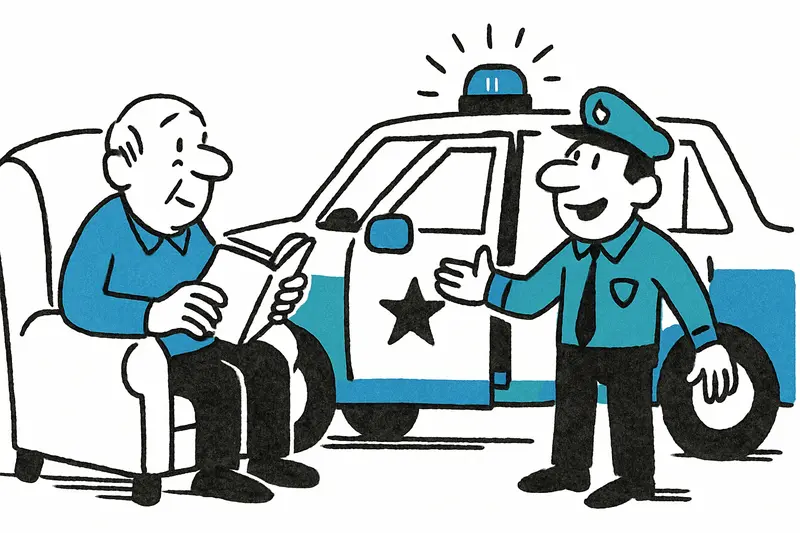
Some time ago Goss had already handed over his extensive private book collection to the municipality. The books did not end up on a dusty shelf but were used in loan projects and reading hours for children; the municipal office mentioned the step on World Book Day in early April, a reminder of stories like From 'Tolerated' to Author: Emina, the Library and a New Life in Marratxí. Now another visible sign of his connection followed: his family handed over the car to the municipality — a used car that, after completion of the necessary formalities, was taken into service by the local police.
A vehicle changing ownership is not in itself a headline. But this example reveals something else: how in villages on Mallorca assets and memories often directly flow into municipal uses. The car now patrols the traffic-calmed streets, brings officers to events, and is used in the countryside when needed, where a sturdy car achieves more than a symbolic monument.
For many people in Porreres it is a fitting continuation. Goss never made much fuss about himself; his wish was to use things practically. The relatives' decision to hand over the car corresponds to this pragmatism. At the same time, the case offers a small lesson about how legacies can look different: books, photos, a car — each contributes in its own way to preserving everyday village life.
On the Plaça in the afternoon you notice passersby who, when the VW with the blue light rolls by, briefly look up. Some smile because they knew the owner, others only recognize that the vehicle now officially performs tasks. Among the members of the brass band, a woman says she finds it nice that something of his continues to help; an older civil protection man nods in agreement and recounts a trip in which the car transported materials to a municipal event, among other things.
Such small, concrete uses are often more sustainable than grand gestures. The car saves the municipal budget rental costs, is ready for immediate use, and daily reminds people of someone who decided to share the village — with his time, his books, and in the end also with his vehicle.
What can other communities learn from this? Anyone who leaves their property for public benefit should clearly stipulate what it is intended for; families and municipalities benefit when transfers are transparent and the purpose remains practical. In Mallorca, where neighbourhood is more than a word, such transfers can ease the work of volunteer groups and strengthen municipal resources.
In the end remains the memory of a man who stayed out of curiosity and affection. In Porreres he will be found not only in old photos or excerpts from books, but also in a car that makes its rounds. This is not a big monument — but probably exactly what he would have wished: to be useful without much fuss.
And so life goes on: the accordion still sounds on the square, a Gregorian tone drifts from the church, and a Volkswagen slowly drives down the Carrer Major. A small, familiar circle of things that hold a village together.
Frequently asked questions
What is Porreres like for someone who wants to settle in a small village in Mallorca?
How do community donations and legacies help towns in Mallorca?
Why are former private cars sometimes used by local police in Mallorca villages?
What kind of activities are common during village festivals in Mallorca?
How important are books and reading projects for children in Mallorca towns?
What is the Plaça in Porreres used for?
What should families in Mallorca consider when donating property or belongings to a municipality?
How do small villages in Mallorca keep everyday life running smoothly?
Similar News
Mueller continues expanding in Mallorca: Artà in 2026, Can Picafort in early summer 2027
The drugstore chain Mueller is opening two new stores in Mallorca: a 1,400 m² shop in Artà on 5 November 2026 and a bran...
The Painter Who Lived Mallorca: Franz Taussig and His Century-Old Secret
A hundred years ago a young Viennese arrived in El Terreno, sketched the island and called himself Francis Caron. Today ...
Airport dispute: Bridge, forecasts and the question of responsibility
A video by the Spanish transport minister has ignited the dispute over DORA figures, capacities and local governance pow...

The Painter Who Invented Himself: How a Young Viennese Drew Mallorca
A hundred years ago a 19-year-old draftsman arrived in El Terreno. His diary and sheets, long known under the pseudonym ...
Released with Conditions: The Plus Ultra Suspicion and a Mallorcan Finca as Residence
A Dutch entrepreneur, sought in connection with the Plus Ultra case, was extradited to Spain after his arrest in Germany...
More to explore
Discover more interesting content

Can Cap de Bou

Townhouse Lleo 72
