
From the Stadium to a Park Bench: Why a Former Player in Palma Now Lives on the Street
From the Stadium to a Park Bench: Why a Former Player in Palma Now Lives on the Street
Former Real Mallorca striker Jordi Morey Vich (b. 1959) is currently sleeping on a park bench near s’Escorxador. A reality check on responsibility, gaps and solutions.
From the Stadium to a Park Bench: Why a Former Player in Palma Now Lives on the Street
Key question
How can it be that a man who in the early 1980s was part of the team that brought Real Mallorca back to the top division now spends his nights on a park bench near s’Escorxador — and what responsibility does the city society bear?
Critical analysis
The bare facts are brief: Jordi Morey Vich, born in Palma in 1959, was a professional striker, later played for clubs such as Poblense, Levante and Córdoba, and subsequently worked in marketing and in social roles for his former club. Today he says he is homeless; he sleeps outdoors near the former slaughterhouse s’Escorxador, claims to suffer from gout and osteoarthritis and cannot afford medication. His mobile phone usually has no credit, he uses public facilities like the library and public restrooms, and he describes his situation as dramatic.
The overall picture is symptomatic: a structured career path, networks in the local football and club environment, then a break that pushed him to the margins. The gaps in care become clear — medical treatment, low‑threshold counselling services, permanent accommodation and real reintegration are missing from his everyday life.
What is missing from the public discourse
We often talk about numbers — how many homeless people are registered in Palma — and less about the individual paths that lead people there. In Morey’s case the discussion about the transition from paid work to precarious conditions is absent, as is the debate about bureaucratic hurdles to accessing social benefits, the role of sports clubs in long‑term support for former employees, and medical aftercare for people with chronic conditions. Also rarely addressed is how local neighborhoods and small initiatives could provide practical support when public authorities do not respond quickly enough.
Everyday scene from Palma
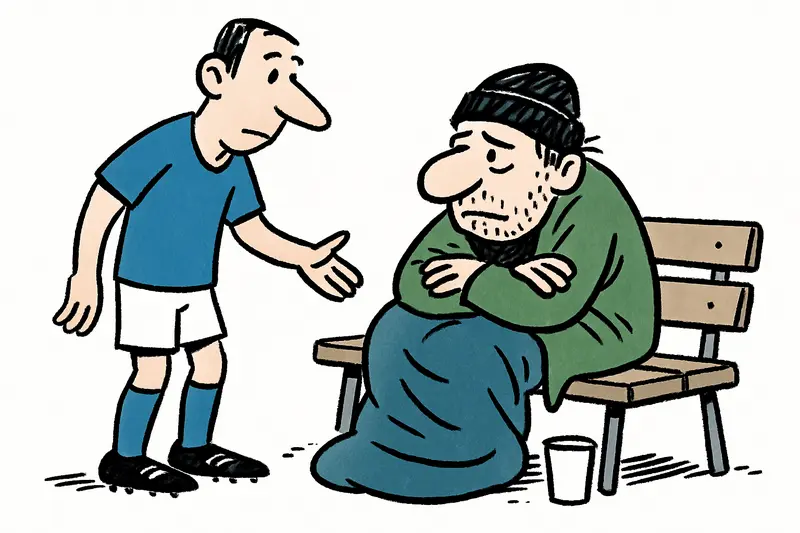
Early in the morning in front of the library on the square — the seagulls’ calls in the wind, the rumble of the garbage truck on the Passeig Mallorca, the bakery already taking loaves out of the oven — Morey sits on his bench near s’Escorxador. A bottle of water, a cold coffee in a paper cup, a thin sleeping bag: that is his daily inventory. Passersby turn a corner, some look away, an older man stops, remembers matches at the Sitjar stadium, leaves a coin and walks on. Such small moments show how visible and yet invisible a person in Palma can be.
Concrete solutions
1) Expand mobile social teams: teams that regularly visit targeted locations like s’Escorxador to provide, alongside emergency aid, help with applications and to arrange medical care. This work must be funded on an ongoing basis, not just through one‑off actions.
2) Transitional housing with personal support: small housing units linked to accompanying social work and medical aftercare. For people with physical ailments such as gout, short distances to therapies are crucial.
3) Strengthen club responsibility: sports clubs should consider binding aftercare programmes for former employees — not only for image reasons, but as locally rooted networks that can facilitate access.
4) Bureaucracy guides: volunteers or paid advisers who help with paperwork, pension or social benefit applications. Many affected people do not know which benefits they are entitled to or are afraid of complex procedures.
5) Promote neighborhood networks: small initiatives such as washing and shower services, clothing distribution or community meals in community centres ease acute need and create connections.
Pointed conclusion
The story of Jordi Morey Vich is not an isolated case, but it hits harder because it has a face: a once‑known footballer from Palma who now lies on a bench. Expressing pity is not enough. We need coordinated, lasting measures — medical, social and organisational — and a rethink by institutions and clubs: those who built a career here should not simply be written off when life goes wrong. And at the bench by s’Escorxador the city’s morning concert does not stop; it is up to us to ensure that within those sounds a hand is also offered.
Frequently asked questions
Why do some former footballers in Mallorca end up homeless?
What support is available for homeless people in Palma?
Is s’Escorxador in Palma a known place for homelessness?
How serious is homelessness in Palma right now?
What kind of help do homeless people with illness need in Mallorca?
What can football clubs in Mallorca do for former employees who fall into hardship?
Can you use public libraries and restrooms if you are homeless in Palma?
What are realistic ways to help a homeless person in Palma?
Similar News
Bendinat as a meeting place: Padel Cup brings together nearly 120 players
Three days of padel at the Bendinat Urban Country Club: organized by El Económico and Borbalán, with around 120 particip...
Large-scale Anti-Tourism Graffiti at Cala Mendia: Protest or Vandalism?
On the morning walkers discovered an approximately 50-meter-long slogan against tourism on the wall above Cala Mendia. W...
Bomb threat before Jet2 flight in Tenerife: A reality check for security protocols
A passenger reported a bomb in luggage shortly before departure in Tenerife. Evacuation, baggage checks, delays — and ma...
Who is stripping Mallorca's coast bare? Why entire slopes are being removed for villas
On Mallorca steep slopes are again being removed to make way for luxury construction sites. Who bears the responsibility...

Robber Falls While Fleeing in Sant Agustí: Who Takes Responsibility?
During a purse-snatching in Sant Agustí, a non-commissioned officer chased the suspect; the man jumped from a bridge and...
More to explore
Discover more interesting content

Can Cap de Bou

Townhouse Lleo 72
