
When Fruit Becomes a Luxury: Why Prices in Mallorca Are Rising So Painfully
When Fruit Becomes a Luxury: Why Prices in Mallorca Are Rising So Painfully
Figures from the INE show: Fresh food in the Balearic Islands has become significantly more expensive year-on-year. What this means for buyers, markets and producers in Mallorca — a critical look with concrete solutions.
When Fruit Becomes a Luxury: Why Prices in Mallorca Are Rising So Painfully
Key question: What happens on the island when everyday fruit becomes unaffordable for many households?
The latest figures from Spain's National Statistics Institute (INE) are clear: fresh food in the Balearic Islands has risen by about 15.3 percent year-on-year, as highlighted in Why Food Is So Much More Expensive in the Balearic Islands — A Reality Check. You don't only see this in tables; you feel it at the checkout and at the weekly markets, as detailed in When the supermarket bill hurts: How expensive the weekly shop on Mallorca has become. Grapes, persimmons, peaches — prices are climbing; tomatoes are already being sold for around five euros per kilogram, seedless grapes for about six euros, Calanda peaches at seven euros. Numbers like these change shopping habits.
Critical analysis: Several interlinked causes lie behind the price jump. The island is heavily dependent on transport: fuel costs, freight prices and the electricity consumption in cold chains play a larger role than on the mainland. Rising oil prices feed directly into transport and production. At the same time, general inflation dynamics increase operating costs for producers and retailers, and Inflation Falls, Costs Remain: Who Pays the Price in Mallorca? notes many residents feel little relief. When eggs rise by 8.4 percent and beef by 6.1 percent, these are not isolated incidents but symptoms of a system with little buffer.
What is missing in public debate: three points. First: the local production side is often treated as a side note. Small farmers and cooperatives face higher energy costs and sometimes outdated infrastructure — this drives up costs. Second: the distribution chains are fragmented. Between producer and end consumer there are several intermediaries who add margins and logistics costs. Third: the social consequences are underestimated. If people start buying less fruit, it affects not only nutrition but long-term health — especially for families with tight budgets, an issue explored in Rising Cost of Living in Mallorca: Who Pays the Price?.
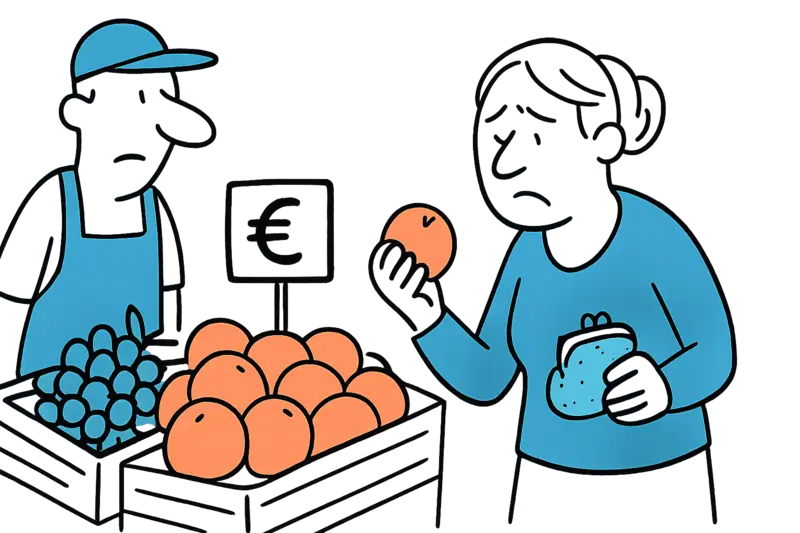
Everyday scene in Mallorca: a Saturday morning at Mercat de Pere Garau. The sun is low, vendors are stacking wooden crates, somewhere a delivery van honks, and the scent of oranges mixes with fried fish from the neighboring stall. A señora at a stall looks at the price tags, counts coins, puts a peach back. “I buy less now, it's only enough for the children,” she says, without much fuss but with fatigue in her voice. Moments like these are no longer isolated incidents.
Concrete approaches — no miracle cures, but effective measures:
1) Short term: Targeted subsidies for low-income households to keep essential fresh goods accessible. Emergency programs could provide seasonal food vouchers for markets.
2) Medium term: Investments in local cooling and storage infrastructure: if producers suffer fewer losses to spoilage, costs fall along the chain. Supporting cooperative distribution models reduces intermediaries and thus margin mark-ups.
3) Energy and transport strategies: Group contracts for renewable energy in agricultural businesses, subsidized upgrades to more efficient cooling technology and coordinated consolidated transport instead of many small deliveries. That reduces the direct impact of oil price swings.
4) Steering demand: Publicly funded information campaigns can help consumers shop seasonally and cost-consciously. Hotels and restaurants can be encouraged to source regionally — volume brings predictability for producers.
5) Long term: Strengthening local production through variety selection, more resilient cultivation methods and water management. Advisory services and microloans for farms to enable modernization.
What is often missing politically: clear, integrated approaches that bring together agricultural policy, energy policy and social policy. It's not enough to talk only about import costs or oil; coordinated support for producers and for the households most affected is needed.
A realistic, local example: a cooperative in a market municipality could operate a shared cold storage facility with municipal support, while hotels in the region commit to fixed purchase volumes. That creates planning security and lowers individual transport costs. Such bundled models don't work overnight but are practicable and cost-effective.
Pointed conclusion: These figures are not an abstract topic for economic talk shows — they appear on the neighbor's receipt, at the fruit stand in the market and in children's daily diets. Mallorca has resources and know-how, but it lacks coordinated action that links short- and medium-term relief with long-term resilience. Otherwise, fruit will remain a piece of luxury for some households instead of daily normality.
Frequently asked questions
When is the best time to visit Mallorca for pleasant weather and fewer crowds?
Can I swim in Mallorca year-round?
What should I pack for a trip to Mallorca?
What are the best ways to get around Mallorca without a car?
What family-friendly activities can I find in Mallorca?
What language and customs should I know when visiting Mallorca?
Are there safety considerations or common scams travelers should know in Mallorca?
Where is a good base in Mallorca for a first visit?
Similar News
Cala Bona: New residents' parking — who really benefits?
The municipality of Son Servera has completed a parking lot with 50 spaces (plus two disabled spaces) behind the Hotel C...

Defy off Mallorca: A beautiful facade on the high seas?
The 94-meter superyacht "Defy" of US billionaire Ken Griffin lies off the coast — luxury, technology and questions: Who ...

Palmanova: Bathers rescue unconscious man — but questions remain
In the morning, an approximately 65-year-old man was pulled unconscious from the water off the coast of Palmanova. Rescu...
Arrests after Beach Thefts: How Safe Are Mallorca's Beaches Really?
After a large-scale operation, 19 suspects were arrested. The case raises questions: why were thieves able to strike for...
No more tap water in Cala Millor – what happens when the tap runs dry?
Sant Llorenç del Cardassar has cut fresh water services at beaches due to the drought and issued further usage bans. Who...
More to explore
Discover more interesting content

Can Cap de Bou

Townhouse Lleo 72
