
Gate drama at Palma Airport: Why one incident raises more questions than answers
Gate drama at Palma Airport: Why one incident raises more questions than answers
Two men advanced to a gate, refused to leave the aircraft, and were arrested by the Guardia Civil. This incident at Palma Airport raises questions about security, communication and de-escalation.
Gate drama at Palma Airport: Why one incident raises more questions than answers
Key question: How can Palma Airport prevent situations in which people forcibly enter aircraft and law enforcement at the gate must use physical measures?
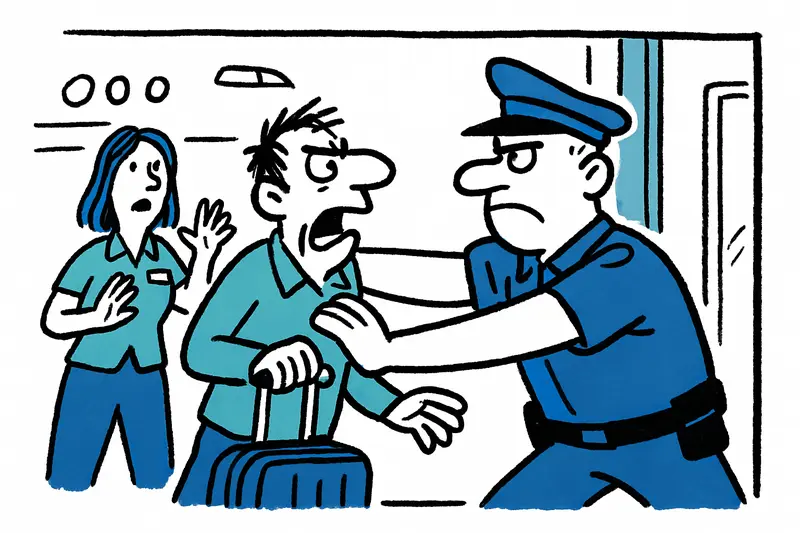
On Sunday afternoon, somewhere in the maze of gates at Palma Airport, the routine hum of announcements and the rolling of suitcases suddenly turned into a full-blown scuffle. Two men managed to get to an aircraft bound for Barcelona, even though access had apparently been denied to them. Airline and ground handling staff tried to turn them away; when they refused to leave, the Guardia Civil intervened and arrested the two 27-year-olds.
I often stand in the terminal and notice the same small things that hardly anyone pays attention to: the mix of espresso aroma and worn seat cushions, the monotone beeping of baggage carts, the brief moments when people frantically stare at their phones. It is in these in-between spaces that conflict can grow: misunderstanding, language barriers, exhaustion after travel — and then a decision that leads to confrontation.
Critical analysis
The scene at the gate reveals several problems. First: Why was access denied? There are many legitimate reasons — missing travel documents, security concerns, overbooking, or medical issues. There is often a lack of public clarity about which criteria can be applied immediately and how transparently staff explain them. Second: the escalation chain. It is normal for gate staff to call the Guardia Civil. It becomes problematic when the situation escalates to the point that physical measures seem unavoidable. Are there enough employees trained in de-escalation, interpreters, or mediators before force becomes necessary? Similar questions about responses and arrests were raised after an emergency landing in Palma, documented in Emergency Landing at Son Sant Joan: Questions Over Arrests and Procedures.
Third: perception and stigmatization. In reports and everyday life, airport incidents are quickly framed as "tourist excesses" or attributed to someone's origin. That makes it easy to reduce complex events to simple blame — and prevents asking which structural gaps made the incident possible. Coverage of other Palma Airport disruptions, such as Turmoil on Palma's Runway: What to Know About the Air‑Arabia Incident, has similarly shown how narratives can shape public reaction.
What is missing in the public discourse
Rarely is there talk about the routine procedures that take place directly in front of a gate: Who makes the final decision about access, according to which rules, and in what language is that explained? Also rarely discussed is the role of time pressure and flight schedules, which can lead to decisions that affected people perceive as unfair. Finally, there is a lack of open debate about training: How often are airport staff trained in conflict management? Are there standardized intervention guidelines that also take cultural misunderstandings into account? Other disruptions, notably a drone incident that briefly shut down the airport, underline how quickly confusion spreads, as reported in Drone in the Sky over Palma: Why 35 Minutes of Chaos Aren't the Whole Story.
Concrete solutions
A few practical measures that could have an immediate effect:
- Multilingual, short information sheets at gates and check-in that briefly explain why access can be denied and what the next steps are. Often a clear "why" is calming enough.
- De-escalation training for ground staff, with realistic role plays and a focus on nonverbal signals. Those who know the right tone can defuse a conflict earlier.
- Holding areas next to gates: small spaces where disputed cases can be calmly resolved instead of directly at the aircraft, where the atmosphere is already heated.
- Documentation and transparency: short incident reports published anonymously so patterns become visible (time, trigger, outcome). This helps identify recurring gaps.
- Interpreters or digital translation stations available immediately — some misunderstandings arise in seconds.
A slice of everyday life from Palma
Imagine walking to the gate: the sun throws warm streaks through the large windows, taxi drivers take their first breaks outside, and the departures board flashes "Boarding" in several languages. An older man with a rolling suitcase and a group of young travelers stand close together; the gate staff speak quickly, apologetically, someone rolls their eyes. It is exactly there that a small spark can start a bigger fire — and rarely is it only one party's fault.
Punchy conclusion
The incident at the gate was not an isolated spectacle but a symptom: at airports, time pressure, communication failures, and human fatigue meet. Seeing the interplay of these factors shifts the debate away from simple blame toward practical improvements. Less escalation begins with clear communication, better training, and uncomplicated ways to resolve issues calmly. If we as a society expect airports to remain safe, we must also explain how we enable that in everyday practice — not only once people are already struggling over an armrest.
Frequently asked questions
Why can passengers be denied boarding at Palma Airport?
What should happen if there is a conflict at the gate in Mallorca?
Is it common for language barriers to cause problems at Palma Airport?
What can airlines do to prevent gate incidents at Mallorca airports?
What is the best time of year to visit Mallorca for calm airport travel?
What should I pack for a flight through Palma Airport in Mallorca?
How can passengers avoid misunderstandings at Palma Airport?
Why do airport incidents in Palma often lead to bigger public debates?
Similar News
More water than last year: Mallorca's reservoirs breathe easier
September rain refilled the Tramuntana's reserves: overall fill around 35 percent, Cúber at 40.42 percent, Gorg Blau at ...
Three Luxury Hotels in Banyalbufar: Lots of Money, Many Questions
A Danish investor plans three exclusive accommodations in Banyalbufar — including the historic Son Valentí. The announce...
2.1 tonnes of cocaine on sailing yacht off Spain's coast – a reality check for the coastguard
A 14-metre yacht was seized with 2.1 tonnes of cocaine. Who monitors the ports, how does the international hunt succeed ...

Heat Bonus in Mallorca: 100 Euros Extra for Outdoor Staff at MarSenses
MarSenses pays employees who worked outdoors in August an extra €100 as recognition. Lighter uniforms, reduced hours for...
Renovating in Mallorca: What You Really Can Do Without Neighbour Consent
Many think they can do whatever they want in their apartment. That's partly true — but only as long as structural elemen...
More to explore
Discover more interesting content

Can Cap de Bou

Townhouse Lleo 72
