
Surprising — why German visitors fell in July and Mallorca still isn't collapsing
Surprising — why German visitors fell in July and Mallorca still isn't collapsing
In July about 597,889 German visitors arrived in the Balearics, 4.06% fewer than the previous year. What do falling arrivals alongside significantly higher spending mean for the island? A reality check with a look at everyday life at Palma airport and concrete proposals.
Leading question: Does a July decline in German guests mean the beginning of the end for Mallorca's summer season — or just a shift in patterns?
The raw numbers show contradictions: In July 2026 around 597,889 people from Germany landed on the Balearic Islands — 4.06 percent fewer than in the same month in 2025. On a year-to-date basis (January–July), the German market is about 1.5 percent below the previous year. At the same time, German visitors spent around 4.15 billion euros in July on the Balearics, an increase of 8.3 percent; average daily spending rose to 259 euros (Spanish average: 218 euros).
Critical analysis
First the compression: fewer heads, but more money per head. That is not an unambiguous alarm signal, but an indicator of changed travel behaviour, as discussed in More revenue, fewer Germans: Who really benefits from the Balearic boom?. Operators and municipalities see two effects running in parallel: shorter-term bookings and a higher willingness to pay among the remaining guests. Both change the market mechanics: hotels and restaurants must be more flexible with prices and staffing, and average occupancy fluctuates more strongly.
Spatial shift is also important: Mallorca recorded around 1.98 million visitors in July and was slightly below the previous year, while Ibiza, Formentera and Menorca gained, a pattern detailed in Balearic Islands on the Rise – More Visitors, Fewer Germans: How Mallorca Can Manage the Transition. This suggests that offers and experiences are valued differently — not all islands suffer equally.
What is missing from public debate
The debate often sticks to percentage figures, a point highlighted in When the Germans Stay Away: Opportunity or Risk for Mallorca?. Too rarely is it asked: who are the departing guests — e-mobility and climate skeptics, price-conscious families, or simply early-bookers who now move into the autumn window? The dynamic between arrival numbers and spending is also insufficiently considered: higher average spending can stabilise municipal revenues, while at the same time raising local price levels and making everyday life more expensive.
Another blind spot: the adaptability of small businesses. A finca owner in Sencelles, a café on the Passeig del Born or a beach kiosk on Playa de Palma do not all react the same way to short-term booking waves. The social consequences (uncertainty for seasonal workers, fluctuating supply chains) hardly make the headlines.
Everyday scene from the island
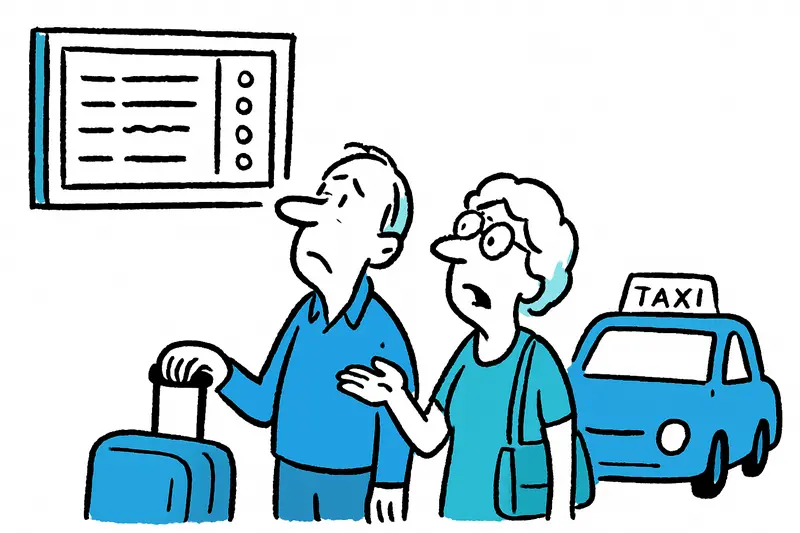
Early in the morning at Terminal E of Palma airport: a taxi waits, two suitcases are rolled onto the pavement, an older German couple looks puzzled at the departures board — their connecting flight is later than planned. At the bus station shortly afterwards, the young server of a café on Plaça Major talks to colleagues about the strange booking behaviour: "Last week full, this week quieter — and those who come, order different things." Small observations like these shape how the decline is felt on the ground.
Concrete solutions
1) Make marketing more flexible: put more focus on last-minute channels in Germany, while at the same time offering targeted incentives for early-bookers in the shoulder season (event packages, culture weeks), an approach recommended in Why fewer Germans are coming to Mallorca this summer - and what the island should do now.
2) Promote regional diversification: strengthen municipalities away from the hotspots so Mallorca is not perceived only as a beach destination. Investments in local events, cycling tours, high-quality gastronomy and sustainable excursions attract different guest types.
3) Dynamic pricing and staffing strategies: hotels should respond to variable booking situations with flexible rates and staffing plans. Short-term cooperation with employment agencies could cushion seasonal workers.
4) Cooperation with tour operators: tour operators and the destination should gradually develop package products that make higher spending per guest attractive and tangible — for example gastronomy vouchers, exclusive tours or sustainable mobility offers.
5) Data and transparency: better, timely analysis of booking and spending data helps adapt pricing strategies and municipal services precisely. None of this needs a political seal of approval, but cooperation between hotels, tourism associations and municipalities.
Pointed conclusion
A decline in German arrivals in July is unpleasant, but not a financial collapse: fewer guests but higher spending point to a market change, not a catastrophe. What will matter is how quickly the island economy adapts to short-term bookings and changed spending habits. If hotels, operators and municipalities now do more than lament and take concrete steps — more flexible offers, stronger regional concepts, better data — Mallorca still has good prospects. Otherwise the island risks sliding into an uncomfortable equilibrium between higher prices and fluctuating occupancy.
Frequently asked questions
Why did German visitors to the Balearic Islands fall in July 2026 even though spending rose?
Is Mallorca still a viable summer destination despite a drop in German arrivals?
What does July performance reveal about Mallorca versus the other Balearic Islands?
What practical steps should Mallorca hotels and local authorities take to cope with short-term booking waves?
How should a finca in Sencelles respond to changing booking waves?
What are Passeig del Born cafés noticing about booking patterns?
How are Playa de Palma beach kiosks adapting to variable bookings?
What does the scene at Palma airport Terminal E reveal about evolving visitor patterns?
Similar News
Why the Paseo Marítimo is deserted at night — and what Palma could do now
After the redesign the Paseo Marítimo often feels quieter in the evening than before. Relaxing rules alone won't solve t...

One Year of Construction on the SOUTH Taxiway: Will Chaos and Delays Threaten Palma Airport?
Starting in November, the renovation of the SOUTH taxiway at Palma Airport begins. One year of construction, €22 million...
One Year of Construction on the South Taxiway: How Well Is Palma's Airport Prepared?
The South taxiway will be refurbished from November for around twelve months. The works cost about €22 million and could...

Serious canyoning accident in Sóller: What the fall in the Torrent de ses Llemes reveals about safety on the island
A 51-year-old man fell about seven meters in the Torrent de ses Llemes. Helicopter rescue, handover to an advanced emerg...

When the tradesman crosses the line: An assault in Palma and what's missing now
A woman reports a sexual assault by a plumber in Palma. The National Police arrested a suspect who was later released. W...
More to explore
Discover more interesting content

Boat Tour with BBQ along Es Trenc Beach
Private transfer from Mallorca Airport (PMI) to Pollensa
