
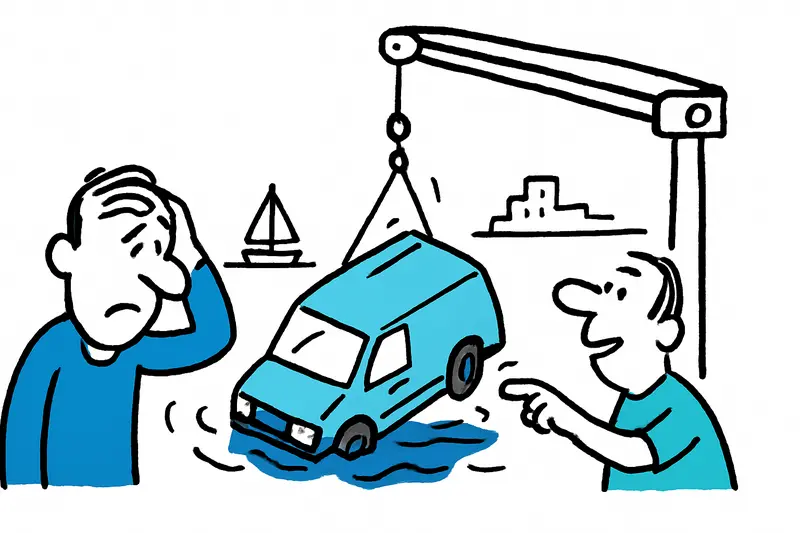
Handbrake forgotten: Van rolls into the harbour basin at Club de Mar
On Tuesday at midday a delivery van rolled unbraked into the harbour basin at Club de Mar and sank completely. Recovery teams lifted the vehicle out of the water with a crane. This article asks why such accidents on Passeig Mallorca are not only curious but also risky.
Handbrake forgotten: Van rolls into the harbour basin at Club de Mar
Key question: How can such an accident be prevented in a busy harbour area in the future?
At around noon on Tuesday something happened in Palma that made many onlookers first stare, then smile, and finally shake their heads: a delivery van, apparently not secured against rolling, started moving on its own at the edge of Club de Mar and disappeared completely beneath the surface of the harbour basin. The salvage operation drew numerous curious onlookers; eventually a crane had to be brought in to get the vehicle back onto land. (See Car Plunges into Ciutadella Harbor Basin: Who Could Have Prevented It?.)
At first glance such images are amusing, but on second thought problematic. A rolling vehicle at the quayside is more than a curious incident: it poses environmental risks from fuel or oil leakage, dangers for passers-by and boat traffic, and effort for emergency services who have to spend time and resources.
The immediate cause seems simple: insufficient securing when parking. But the analysis must not stop at individual blame. On Palma promenades like Passeig Mallorca craftsmen, delivery services and other providers park there daily for short intervals. Time pressure, narrow spaces and lack of alternatives increase the likelihood that people routinely skip safety checks.
What often gets too little attention in public debate is the structural side of the problem. Who bears the pressure on delivery drivers? Are there sufficient designated loading zones near the quay edge, or does practice force risky stopping positions? How well maintained are older vans technically — for example brakes and handbrakes — and how often do companies check their fleets? And not least: what measures does the port authority have to keep vehicles physically away from the water? (Related concerns were highlighted in When a Dispute in Portopí Ended Up in the Harbor: Crash Without Driver's License Raises Questions.)
A small everyday sketch: On a mild Tuesday you first hear the coffee machines in the street cafés at Club de Mar, then the rustle of palm leaves in the wind and the distant whirr of a crane. People stop on the promenade, push shopping bags, photograph the boats. In this soundscape an unsecured van can easily be overlooked — until it moves. Such scenes are typical for Palma: beautiful, lively — and sometimes dangerously careless.
Concrete suggestions that would make the incident less likely:
1. Physical barriers: At particularly exposed quay edges short, robust bollards or a low curb could be installed. They would not prevent parking but would make it harder to roll directly into the water.
2. Clearer loading zones and controls: Distinct markings for loading and unloading areas and regular checks by port or regulatory services would reduce risky stopping practices. (For examples of how risky manoeuvres can have wider consequences, see Dangerous braking maneuver on the Ma-20: When will authorities finally act effectively?.)
3. Training and operating rules: Commercial fleets should introduce mandatory checklists: engine off, handbrake on, gear engaged, wheels secured. Short training sessions for all delivery drivers reduce routine errors.
4. Technical minimum standards: For older vehicles a testing routine should require operators to maintain brakes and parking devices regularly. For new purchases it is worth choosing vehicles with an automatic parking brake.
5. Environmental precautions: Equipment for quick containment of oil and fuel in the event of vehicle losses — oil containment booms, rapid-response kits for harbour services — should be readily available.
A point that often gets lost in the debate: such incidents are an opportunity to improve procedures, not just to look for culprits. Simple, practical rules at sensitive points like Club de Mar would neither ruin the harbour's appearance nor paralyze the daily work of delivery companies. But they would prevent an unintentional error from causing high costs or environmental damage.
Conclusion: The van in the water was a preventable mishap with public consequences. The quick salvage with a crane prevented worse, but the incident should be a reason to critically review practices and infrastructure along the quay edges in Palma. More prevention, less spectacle — that way the promenade on Passeig Mallorca could remain safe without losing its usual bustle.
Frequently asked questions
Why can a parked van roll into the harbour in Palma?
What safety measures could help prevent car accidents at Palma harbour quays?
Is it dangerous when a vehicle falls into the harbour in Mallorca?
What should delivery drivers check before leaving a van parked in Palma?
Why are harbour areas like Club de Mar in Palma more vulnerable to parking mistakes?
What happens when a vehicle has to be recovered from the harbour basin in Palma?
What can harbour authorities do to stop vehicles getting too close to the water in Mallorca?
What can be learned from a van rolling into the water at Club de Mar?
Similar News

More water than last year: Mallorca's reservoirs breathe easier
September rain refilled the Tramuntana's reserves: overall fill around 35 percent, Cúber at 40.42 percent, Gorg Blau at ...
Three Luxury Hotels in Banyalbufar: Lots of Money, Many Questions
A Danish investor plans three exclusive accommodations in Banyalbufar — including the historic Son Valentí. The announce...
2.1 tonnes of cocaine on sailing yacht off Spain's coast – a reality check for the coastguard
A 14-metre yacht was seized with 2.1 tonnes of cocaine. Who monitors the ports, how does the international hunt succeed ...

Heat Bonus in Mallorca: 100 Euros Extra for Outdoor Staff at MarSenses
MarSenses pays employees who worked outdoors in August an extra €100 as recognition. Lighter uniforms, reduced hours for...
Renovating in Mallorca: What You Really Can Do Without Neighbour Consent
Many think they can do whatever they want in their apartment. That's partly true — but only as long as structural elemen...
More to explore
Discover more interesting content

Can Cap de Bou

Townhouse Lleo 72
