
Hidden War Bunkers in Palma: Remember, Preserve, Reveal?
Hidden War Bunkers in Palma: Remember, Preserve, Reveal?
Beneath Palma's paving lie remnants of a forgotten shelter system from the Civil War. Consolidation, ethics and tourism collide. Who decides how far the city opens its underground spaces?
Hidden War Bunkers in Palma: Remember, Preserve, Reveal?
Guiding question: Should the city's underground air-raid shelters be opened as places of remembrance, or remain permanently conserved and hidden?
If you walk past the Mercat de l'Olivar on a warm morning, you hear market women call, see delivery vans maneuver and feel the vibrations through the paving. Exactly there, but a few meters below, lie corridors and niches that were intended as refuge in the 1930s. Palma once had about 130 public shelters and roughly 600 private installations; today only a few are walkable, such as parts of the old railway tunnel, a section near Passeig Sagrera and a hidden system beneath the cathedral – where many accesses are closed off or bricked up.
The researcher Bartomeu Fiol Coll has documented these underground spaces for decades and published two books about them. His work has revived the debate: the Consell de Mallorca has been cataloguing initial sites for months with the aim of legally securing them. Sounds good, but cataloguing is only the beginning.
Critical analysis: the idea of opening bunkers faces three hard realities. First: substance and safety. Many corridors are damp, supporting beams are missing, and layers of soil and asphalt have altered entrances. Without a technical inventory (structural inspection, moisture, contaminant and ventilation analyses) there is a real risk of collapse, as shown by the Collapse at Palma's City Wall, or health hazards for visitors and staff. Second: context and dignity. These are sites of war; people died here, families lost relatives. An exhibit that merely markets “remarkable architecture” or “adventure tourism” would not do justice to the memory. Third: costs and responsibilities. Who pays for expert reports, safety measures, barrier-free access and long-term maintenance? Consell, Ajuntament, the Ministry of Culture, private foundations? Cataloguing names objects but not budgets.
What is missing from the public discourse so far: concrete priority lists, a binding timeline and the voices of direct descendants of those affected. Technical reports are also lacking that reveal which sites must be secured immediately and which are suitable as visitor sites in the long term. The question of modern infrastructure – sprinklers, lighting, emergency exits, accessible entrances – is often discussed only peripherally.
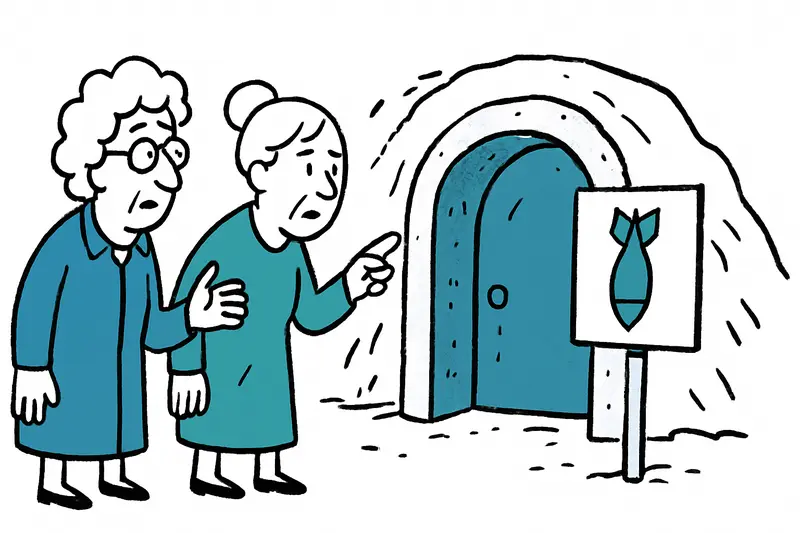
A small everyday scene from Palma: on the Plaça Major two pensioners discuss the construction site. They recall family stories about nights spent in the bunker. Their words show how personal this heritage is. If the city decides to open these places, the voices of such people must not be missing.
Concrete, grounded and feasible solutions:
1) Prioritization through technical mapping: Rapid survey of all catalogued sites; LIDAR scan and moisture measurement; result: red, yellow, green list (immediate action, medium term, document only).
2) Legal protection & responsibilities: Protect selected sites under heritage law, establish clear responsibility for maintenance (Consell/Ajuntament in combination with the cultural authority) and a transparent budget model, mindful of tensions between conservation and human needs documented at Occupied and Crumbling: Illetes Fort.
3) Restoration with minimally invasive interventions: Structural stabilization, dehumidification, retain original material where possible. No overly polished museum rooms; the patina belongs to history, rather than wholesale replacement as in Demolition in Palma: Bennazar House from 1926 is being taken down.
4) Interpretation instead of sensationalism: Guided tours with limited visitor numbers, accompaniment by historians and oral-history projects, information panels in German, Catalan and Spanish. Involve schools.
5) Community monitoring and small revenue models: Volunteer-led tours, admission fees for mixed financing, approach EU cultural funds and foundations – but with clear rules for the use of funds.
Conclusion: Palma stands at a threshold. The underground shelters are more than potential photo spots; they are witnesses to a troubled time and could become places of living remembrance. But before printing tourism brochures, mapping, technical work, ethical guidelines and the involvement of the people connected to these sites are needed. Otherwise a silent witness of history will be turned into an empty attraction.
Frequently asked questions
Should Palma open underground bunkers as places of remembrance or keep them permanently closed?
What are the main safety concerns with opening Palma's underground shelters?
How is Mallorca documenting and protecting these bunkers?
What would respectful interpretation look like for Palma’s wartime bunkers?
Who would be responsible for maintaining and funding access to Palma's bunkers?
Are any of Palma’s bunkers currently accessible to the public?
Why is community input important in deciding whether to open these bunkers?
What might a practical plan look like to move from mapping to safe, meaningful access in Palma?
Similar News

FC Germania Mallorca: Why does the lead always slip away in stoppage time?
After the 1-2 at C.A. Pal ne da Tesa questions arise: are these coincidences, a shortage of personnel, or a deeper probl...

Death in the Gorge: Key Questions on the Safety of Rallies on the Ma-10
A Porsche plunged into a ravine during the 550 Challenge near Mortitx. Who bears responsibility, what safety gaps were r...

Eighth BAF surge: Why freight costs in Mallorca are rising now — and what it means for us
Fuel surcharges (BAF) for ferries between the mainland and the Balearic Islands rose by around eight percent in October....
O'zapft is! Island Oktoberfest in Santa Ponca: Ten Days of Bavaria on Mallorca
From October 23 to November 1, Santa Ponca will turn blue and white again: Hofbräu beer, Schuhplatteln, a dirndl contest...
Sudden end at the gate: A 70-year-old dies at Palma airport — what now?
A 70-year-old French tourist collapsed at the gate of Palma airport and died despite resuscitation. Who is responsible f...
More to explore
Discover more interesting content

Can Cap de Bou

Townhouse Lleo 72
