
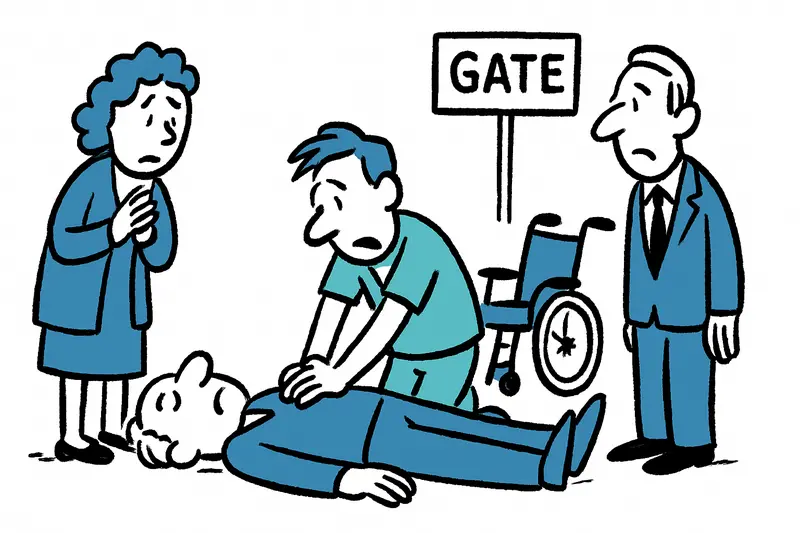
Sudden end at the gate: A 70-year-old dies at Palma airport — what now?
Sudden end at the gate: A 70-year-old dies at Palma airport — what now?
A 70-year-old French tourist collapsed at the gate of Palma airport and died despite resuscitation. Who is responsible for the procedures, what is missing at the airport — and how can such cases be managed better in the future?
Sudden end at the gate: A 70-year-old dies at Palma airport — what now?
Key question: Could this death have been prevented?
On Thursday around 12:30 p.m., a roughly 70-year-old tourist lost consciousness at the gate of Palma airport and died despite immediate resuscitation efforts. He had been waiting with his family to board a flight to France. On-site medical staff began resuscitation, and shortly afterwards personnel from the Balearic emergency service SAMU 061 took over. The attempts were unsuccessful; the man was declared dead. His relatives remained at the airport and were left in shock.
Such reports are always brief, factual and hard to read. But anyone who asks between the sober lines what actually happened at the gate arrives at practical questions: How quickly was staff on the scene? Was a defibrillator within reach? How is coordination between airport doctors, SAMU and flight personnel organised? And not least: are the procedures for the waiting family arranged with dignity?
The facts as they stand are: resuscitation began on site, SAMU 061 continued it, and yet death could not be prevented. That is a bitter reality that can happen, especially with older people who have undiagnosed heart conditions. Nevertheless, we must not stop at fatalism. Public debate often lacks a focus on procedures and prevention, as seen in Dead Tourist at Playa de Palma: An Accident Raises Many Questions.
One can imagine the scene: the soft rumble of rolling suitcases, announcements over the loudspeakers, a row of waiting passengers — some impatient, some on their phones. Nearby the café, where the smell of latte and pastries mixes into the air. Then suddenly a cry, helpers, a chair pulled away, the empty gate becomes an emergency site. The image sticks — for the family, for bystanders, and for the staff who must continue working afterwards.
What is concretely missing now in public discourse and practice? First: transparency about the availability of automated external defibrillators (AEDs). Where are they located? Who is allowed to use them? Second: regular, realistic emergency drills at busy gates, not just on paper. Other incidents, like Cardiac Arrest on Can Picafort Beach: Questions Remain and Ideas for the Future, underline that beaches and terminals alike face sudden emergencies. Third: clear, multilingual guidance for passengers on how they can help in an emergency — because first responders are often fellow travellers, not only professionals. Fourth: concrete offers for immediate psychological support for relatives at the airport.
Concrete solutions can be implemented relatively quickly. A map of AED locations in the airport app and clearly visible markings in front of each gate would save time. Regular training sessions for ground staff, gate agents and security personnel — including during peak shifts — build routine. Simulated exercises together with SAMU 061 and airlines strengthen communication in the critical first minute. Finally: staff trained in crisis communication or dedicated crisis rooms in the terminal can offer relatives a protected space immediately.
On Mallorca, between Passeig Mallorca and the access road to the terminal, you see daily the mix of hurry and relaxation: taxi drivers hauling suitcases, families saying goodbye, business travellers killing time with an espresso. In this everyday setting it becomes clear: emergencies are not peripheral, as another case on the Paseo shows in Sudden drama on Paseo Mallorca: a death in the rain – and the questions that remain.
Conclusion: The death of the senior is tragic and devastating on a personal level. But it also highlights clear areas for action: AED availability, practical training, communication and care for relatives. The island is not defenseless — but it could be better organised. That requires not only money but above all planning and the will to derive systemic improvements from an individual case; past events such as Tourist Dies at Port de Sóller: When Everyday Holiday Life Reaches Its Limits illustrate the stakes. For the relatives this remains a poor consolation; for the community it should be a reason to learn lessons.
Frequently asked questions
What happens at Palma de Mallorca Airport when someone collapses and needs medical help?
Are AEDs available at Palma de Mallorca Airport, and who can use them?
What concrete steps could improve emergency response at Mallorca's gates?
How can passengers help during an airport medical emergency in Mallorca?
How is support for relatives handled at Mallorca airport during an emergency?
What should travelers know about Mallorca's weather and safety when visiting, particularly for outdoor activities?
What resources are available to learn about emergency procedures at Mallorca's airports?
Who coordinates the emergency response at Mallorca's airports, and how do teams work together?
Similar News
Rafa Nadal brings tennis greats to dinner in Port Verd – an evening at Sa Punta
For the anniversary of his academy, Rafa Nadal invited international tennis stars to his favourite restaurant on the eas...
Affordable Haircut on Vacation: Why More Germans Are Going to the Hairdresser in Mallorca
A salon visit in your suitcase: low prices and high quality attract holidaymakers to the island – a small boost for loca...
Pilot fell ill over the sea: Why the return to Liverpool raises more questions than answers
An EasyJet flight bound for Fuerteventura turned back minutes after departure when a pilot suddenly fell ill. What happe...
Eight Years After the Torrentada: Can the New Bypass Really Protect Sant Llorenç?
Work on the Sant Llorenç bypass is half finished. Are the measures — larger culverts, 200 metres of walls, 500 tonnes/s ...
Occupied hotel in s'Arenal: Who protects the neighborhood?
An empty hotel in s'Arenal has been inhabited for weeks. Rubbish by the pool, open access points and fear among resident...
More to explore
Discover more interesting content

Can Cap de Bou

Townhouse Lleo 72
