
Eight Years After the Torrentada: Can the New Bypass Really Protect Sant Llorenç?
Eight Years After the Torrentada: Can the New Bypass Really Protect Sant Llorenç?
Work on the Sant Llorenç bypass is half finished. Are the measures — larger culverts, 200 metres of walls, 500 tonnes/s capacity — enough to prevent a repeat of the 2018 disaster?
Eight Years After the Torrentada: Can the New Bypass Really Protect Sant Llorenç?
Key question: Are concrete and bigger pipes enough, or is a whole strategy still missing?
On 9 October 2018 the flood in eastern Mallorca swept lives away; 13 people died. Eight years later Sant Llorenç is full of concrete, construction fences and roadblocks – and the constant drone of excavators, the rattle of gravel on bulldozers. Since April the bypass has been closed; according to the island council the work is half completed. The project costs around nine million euros and is intended to protect the town from new floods.
What exactly is being done: Under the new carriageway the number of culverts over the Ses Planes stream increases from four to ten; each opening measures 5.7 metres wide and 4.4 metres high. Reinforced walls are being built over more than 200 metres. Experts now speak of a theoretical channel capacity of up to 500 tonnes of water per second. Island Council president Llorenç Galmés and mayor Jaume Soler have presented the progress as an important step; the road is scheduled to reopen in early 2027.
Critical analysis: Numbers and dimensions are important, but they are only part of the answer. Larger culverts and stronger bank walls often shift the danger downstream or into side channels. A flow capacity of 500 tonnes per second sounds impressive — but what does that mean during prolonged rainfall, when drains are clogged, or when wood and debris block the openings? Technical values must be accompanied by operational concepts: Who inspects and clears the culverts before each autumn storm? Who pays for regular maintenance? And how are residents integrated into evacuation plans?
What is missing from the public debate: There is much talk about construction progress and costs, less about long-term upkeep, responsibilities and transparency in safety assessments; the wider torrent-clearing campaign is discussed in When the Torrents Are Cleared: Cleaning Up Against Heavy Rain — Is That Enough?. There is no open register documenting which tests the site and the finished section have undergone, a problem also raised in After the Rain: Who Cleans the Streams — and Is It Enough?. A second blind spot is nature: sealed banks and hard walls may shorten the channel, but they interrupt the natural retention areas of river landscapes.
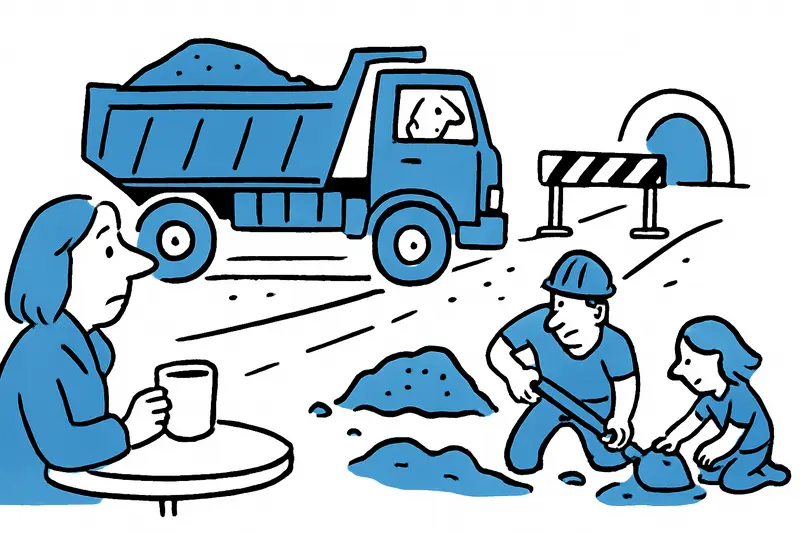
Everyday scene from Sant Llorenç: In front of the small café on the village square a woman in a coat sits drinking coffee and tilts her head curiously when a lorry rolls by. Children play with a stone at the edge of a dry side stream, an old man is still clearing leaves from his driveway. The closure has diverted traffic, weekend visitors must take detours, deliveries arrive later – the construction site has suddenly become part of the village rhythm. This normality shows: protection measures touch daily life directly. People here need not only structural safety but also reliable information and prompt decisions.
Concrete solutions beyond the concrete: First, an annual inspection plan with clear responsibilities and a transparent budget that is available online. Second, anti-blockage protection for the culverts — controllable grating systems that can be cleaned quickly in an emergency. Third, retention areas and catchment basins in higher zones, where possible as near-natural buffers that delay water instead of merely accelerating it; some local projects have explored alternative methods, for example Donkeys Instead of Excavators: What Esporles’ Torrent Operation Really Means. Fourth, early-warning systems with local sirens, SMS alerts and clearly marked evacuation routes; regular drills with residents. Fifth, riverbank maintenance — removal of driftwood and coordination with landowners so that trees, shrubs and fields do not become unexpected obstacles. Sixth, a monitoring system (gauge measurements, cameras) for rapid situational awareness during a storm and open reports after each critical event.
Why this matters: Construction projects are only as good as their follow-up processes. A road that is stronger than the water is of little use if access points clog or if the water rises higher elsewhere. The people of Sant Llorenç remember the night eight years ago; today they expect not only new figures but security in everyday life, clear responsibilities and rapid responses in crises.
Concise conclusion: The bypass is a necessary building block — but not a guarantee. Those who truly want to be prepared for future disasters must complement the concrete with organization, maintenance and thinking in terms of nature. Otherwise, the same water will stand somewhere else eventually.
Frequently asked questions
What’s the best time of year to visit Mallorca for warm weather?
Can I swim in the sea in Mallorca year-round?
What should I pack for a trip to Mallorca?
What outdoor activities are best in Mallorca?
How can I get around Mallorca without renting a car?
What should I know about Mallorca’s weather across the year?
Is Mallorca a good destination for families or couples?
How can I plan a short itinerary to sample beaches and culture in Mallorca?
Similar News

O'zapft is! Island Oktoberfest in Santa Ponca: Ten Days of Bavaria on Mallorca
From October 23 to November 1, Santa Ponca will turn blue and white again: Hofbräu beer, Schuhplatteln, a dirndl contest...
Sudden end at the gate: A 70-year-old dies at Palma airport — what now?
A 70-year-old French tourist collapsed at the gate of Palma airport and died despite resuscitation. Who is responsible f...

Rafa Nadal brings tennis greats to dinner in Port Verd – an evening at Sa Punta
For the anniversary of his academy, Rafa Nadal invited international tennis stars to his favourite restaurant on the eas...
Affordable Haircut on Vacation: Why More Germans Are Going to the Hairdresser in Mallorca
A salon visit in your suitcase: low prices and high quality attract holidaymakers to the island – a small boost for loca...
Pilot fell ill over the sea: Why the return to Liverpool raises more questions than answers
An EasyJet flight bound for Fuerteventura turned back minutes after departure when a pilot suddenly fell ill. What happe...
More to explore
Discover more interesting content

Can Cap de Bou

Townhouse Lleo 72
