
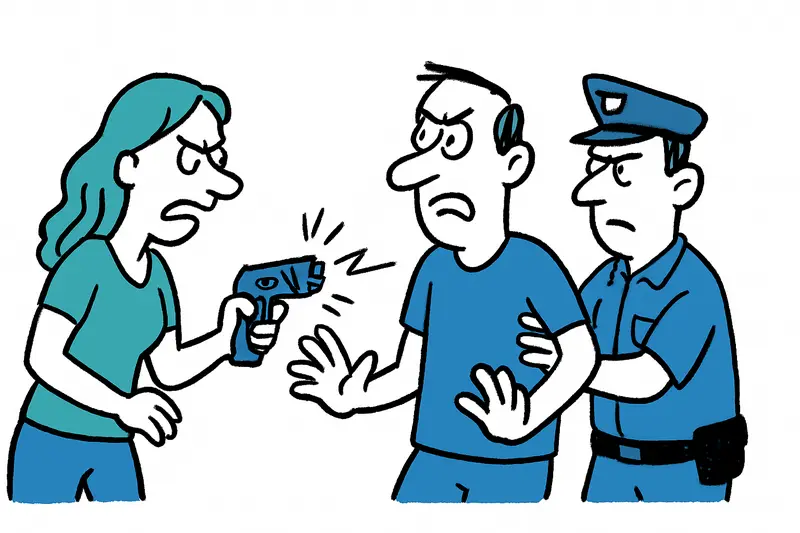
Jealousy dispute in Cala en Blanes: A taser turns a neighbor quarrel into a police case
In Cala en Blanes a marital conflict escalated: a woman used a stun gun, and both parties were detained by the National Police. A reality check on violence, weapon access and prevention.
Jealousy dispute in Cala en Blanes: A taser turns a neighbor quarrel into a police case
Why do private conflicts so quickly end in violence — and what's missing in the public debate?
Early in the morning in Cala en Blanes, when the sun still lies low over the bay and the garbage truck rattles its metal containers down the street, a dispute that should have remained private escalated. A 49-year-old woman returned to her apartment that morning and found her husband with another woman. The situation got out of hand: there were scuffles, and the alleged third party pulled a stun gun from her handbag and delivered an electric shock to the returning woman's neck, leaving a small burn. Officers of the National Police in Menorca intervened, confiscated the device and arrested both women. The next day they were brought before the examining magistrate and released. Similar early-morning escalations have occurred elsewhere, for example the Brawl at Playa de Palma: Why a verbal exchange could have ended fatally.
The bare facts are quick to tell. But several questions lie behind them that concern us as a society: How easy is access to such devices? How does the police respond to domestic conflicts, and how is it that those involved are released despite obvious aggression? And last but not least: Why does a relationship dispute become physical so quickly — despite the proximity of neighbors and open streets in a residential area?
Critical analysis: three levels of the problem
First: the object. A stun gun turns a scuffle into a potentially dangerous incident. The police considered possession a criminal offense; this is not a mere formal argument. Devices that temporarily numb pain or cause convulsions can have health consequences — especially for people with heart problems, but also in cases of panic attacks or falls. Whether a device was used in self-defense or to attack is legally difficult to separate; in practice it does not change the escalation.
Second: police handling of the situation. National police officers arrested both women and confiscated the device. That both were later released is part of a legal process: reports had to be taken, initial assessments made and investigations launched. What is often lacking is transparency afterwards: How is protection ensured if contact between those involved continues? Are there complaints, protection orders or mediation offers? Other cases show how routine checks or controls can escalate, as in the Tumults at Playa de Palma: When Controls Threaten the Beach Scene.
Third: the social dimension. People from the everyday life of a small town meet here: couples, neighbors, cafés that lay out the morning paper. In such close quarters relationship dramas sound louder but are also more vulnerable. The people involved may be newcomers, as age and nationalities can indicate; migration, work pressure and language barriers often play a role in coexistence — not as causes but as amplifiers of conflicts and isolation.
What is missing in public discourse
Public debate often focuses only on the spectacular detail — the taser, the arrest. Less attention is paid to preventive questions: education about illegal weapons and their risks, low-threshold counseling services for relationship conflicts, and local engagement that strengthens points of contact in residential areas. Also rarely discussed is how neighborhoods react. In Cala en Blanes some neighbors heard the altercation but were unsure when and how to intervene.
A scene from everyday life
Imagine the small plaça a few steps from the sea, where the baker has been delivering the first bread of the day for years. People greet each other, children cycle by. In such an environment violence seems alien — but it is precisely here that small conflicts can become volatile if no one de-escalates in time. These are the same streets that also bear witness to how we want to live together.
Concrete approaches to solutions
- Clearer communication from authorities about legal steps and protection options after domestic incidents; affected persons must know what local help is available (victim support, counseling centers, translation services).
- Information campaigns in communities and neighborhoods about the dangers of stun guns and the legality of such devices; cooperation with neighborhood associations and supermarkets so flyers actually reach people.
- Expansion of de-escalation services: neighborhood mediators, low-threshold conflict resolution by town halls or social services, especially in summer destinations with many newcomers.
- Police training in handling relationship disputes: greater focus on linking with social services instead of purely legal processing.
Conclusion
The incident in Cala en Blanes is a stark image of a larger problem: private conflicts can quickly become public safety issues when dangerous objects are involved and preventive infrastructure is lacking. The National Police in this case secured the device and launched an investigation. What is now crucial is not only to carry out criminal proceedings, but to strengthen structures that intercept such escalations early. Otherwise the morning chat at the baker's will leave only the feeling that a small island community needs to come closer together — before something else explodes.
Frequently asked questions
What is the weather like in Mallorca in December?
Can you swim in Mallorca in winter?
Is December a good time to visit Mallorca?
What should I pack for Mallorca in December?
What is Palma de Mallorca like in December?
Is Mallorca busy in December?
What can you do in Mallorca in winter?
Is the sea cold in Mallorca in December?
Similar News
More water than last year: Mallorca's reservoirs breathe easier
September rain refilled the Tramuntana's reserves: overall fill around 35 percent, Cúber at 40.42 percent, Gorg Blau at ...
Three Luxury Hotels in Banyalbufar: Lots of Money, Many Questions
A Danish investor plans three exclusive accommodations in Banyalbufar — including the historic Son Valentí. The announce...
2.1 tonnes of cocaine on sailing yacht off Spain's coast – a reality check for the coastguard
A 14-metre yacht was seized with 2.1 tonnes of cocaine. Who monitors the ports, how does the international hunt succeed ...
Heat Bonus in Mallorca: 100 Euros Extra for Outdoor Staff at MarSenses
MarSenses pays employees who worked outdoors in August an extra €100 as recognition. Lighter uniforms, reduced hours for...
Renovating in Mallorca: What You Really Can Do Without Neighbour Consent
Many think they can do whatever they want in their apartment. That's partly true — but only as long as structural elemen...
More to explore
Discover more interesting content

Can Cap de Bou

Townhouse Lleo 72
