
Vivid Color in La Llotja: Katharina Grosse Makes Palma's Sea Exchange Walkable
Vivid Color in La Llotja: Katharina Grosse Makes Palma's Sea Exchange Walkable
In the heart of Palma Katharina Grosse has turned the Gothic La Llotja into a walkable landscape of color. The work "Arrels" makes the historic hall itself part of the art — an experience that attracts both tourists and locals.
Vivid Color in La Llotja: Katharina Grosse Makes Palma's Sea Exchange Walkable
"Arrels" connects painting, sculpture and architecture in the Gothic hall
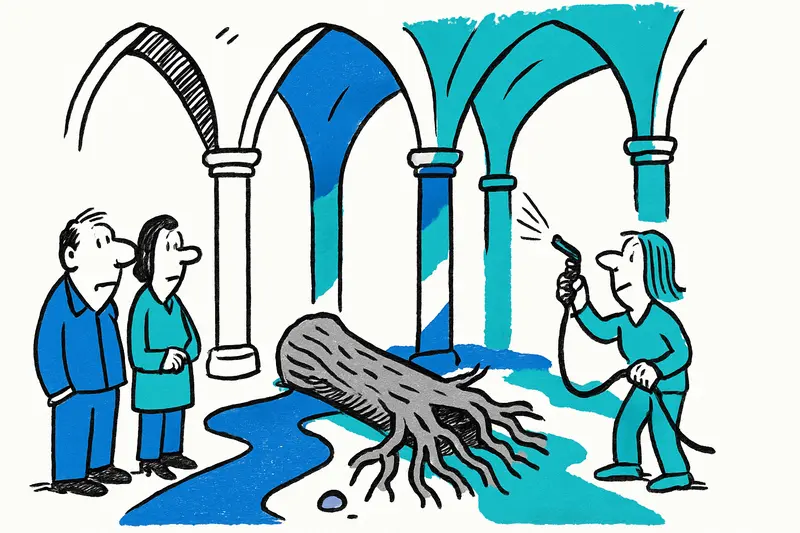
If you stroll through Palma's old town to the Passeig del Born on a warm spring afternoon these days, your eye almost automatically lingers on La Llotja: the centuries-old columns not only hold up the vaults, they now also carry color. With her installation "Arrels" Katharina Grosse has turned the large hall into a walkable pictorial landscape.
In the space lies a massive tree trunk with a visible root ball, at the base of which sand and stones are piled up. From this centre layers of color pour out like streams across the stone floor, nestle against the columns and set the vaults in new tones. The result feels like a single, very large painting that you can enter, circle and discover in sections.
The exhibition was realised in cooperation between the Balearic government and the Es Baluard art museum; the project was curated by David Barro. For the long, squat hall of La Llotja the work means more than a temporary stage: the architecture responds to the color, and the color makes the architecture newly tangible. The artist herself describes her approach of leaving flat surfaces behind and treating spaces with a spraying technique, repeatedly reinventing it over decades.
Katharina Grosse, born in Freiburg in 1961, is one of the internationally significant contemporary artists. Since the 1990s she has worked with large-scale spray paint, often applied with an industrial spray gun. The technique transforms walls, floors and objects into a diffuse, flowing surface; boundaries between painting, sculpture and architecture blur. In "Arrels" this method becomes a means to make the historical function of La Llotja as a place of trade and assembly perceptible.
For the city the exhibition is an asset. Visitors who would otherwise only stroll briefly through the old town stop for longer. Locals use the quiet morning hour to meet near the site with a coffee and experience the altered hall. The colorful intervention creates talking points: tourists with cameras, older residents, school groups who suddenly connect historic stone with luminous color – thus a new closeness between the audience and the place emerges.
"Arrels" is also a play with time in terms of content: a transient work in a permanent building. The paint reacts to light and perspective, you see different details when the late afternoon sun shines through the windows. In this combination of the ephemeral and the historic lies a small lesson in perception: a familiar place can change without losing its history.
The exhibition runs until 31 January 2027; La Llotja is open Monday to Sunday from 10:30 to 13:00 and from 16:00 to 21:00 (from November until 19:00). If you come on foot, La Llotja is easily reached from the old town; if you stand on Passeig Mallorca you may hear the city sounds – the ringing of a tram, the murmur of market days – and find a very different tone inside: the quiet presence of painting that you can walk around.
Practical: Exhibition: "Arrels" by Katharina Grosse; Venue: La Llotja, Palma; Duration until 31 January 2027; Opening hours: 10:30–13:00 and 16:00–21:00 (from November until 19:00).
Frequently asked questions
When is the best time to visit Mallorca for good weather and fewer crowds?
Can you swim in Mallorca in spring and autumn?
What should I pack for a trip to Mallorca?
Is Mallorca still worth visiting outside the summer season?
What is Cala Major like for a beach day in Mallorca?
Is Soller a good place to stay in Mallorca?
What can you do in Port de Pollença besides go to the beach?
How hot does Mallorca get in summer?
Similar News

Magaluf: Watchtower Alarm – Lifeguards Pull Unconscious Beachgoer from the Water
After a drama in the late afternoon, two lifeguards at Magaluf beach rescued an unconscious 44-year-old man. He was stab...
Turquoise in the City: How dangerous is the color play of the Sa Riera?
The Sa Riera in Palma suddenly turned turquoise — a pretty motif, but behind the effect lies a discharge of saline waste...

Jeckliner at Sunnesching: Cologne spirit sets sail from Palma
In September 2027 the Mein Schiff 2 briefly becomes a floating carnival stage: four days with Cologne bands, comedy and ...
Finally Home: Mike and Leyla Heiter Buy Villa with Sea View in Mallorca
The reality TV couple Mike and Leyla Heiter have bought a house in Mallorca with a roof terrace and sea view. An Instagr...

Arrest after series in Palma: Who protects apartments from repeat offenders?
The National Police arrested a man in Palma who investigators say may have broken into several apartments. In one incide...
More to explore
Discover more interesting content

Can Cap de Bou

Townhouse Lleo 72
