
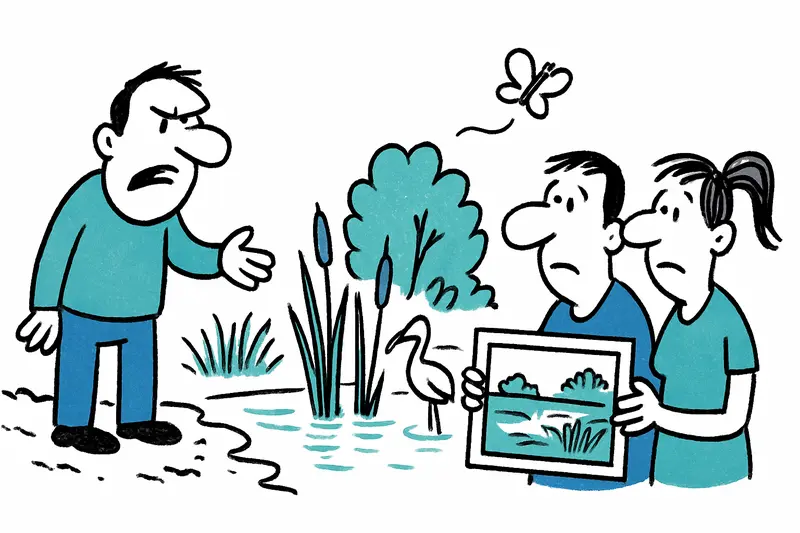
Magaluf’s Quiet Wetland: Nature Needs More Than a Pretty Picture
A wetland beside a well-known holiday resort is an asset—but not proof of effective conservation. What matters is ongoing care, water quality and a clear approach to visitors.
Magaluf’s wetland: What matters when the cameras are gone?
Can a place best known for beaches, bars and lively nights also take nature conservation seriously? Of course. But a wetland near Magaluf is not protected simply because it appears in a brochure or a film. What matters is the work done on ordinary days: when nobody is watching, when it has not rained for a long time and when the season begins again.
That is the less glamorous side of a story that can easily be told as a picturesque contrast: the promenade on one side, the reeds on the other; the holiday setting here, quiet nature there. On Mallorca, these worlds are often closer than they look on a map. A few minutes on foot can be enough for the sound to shift from rolling suitcases and music to wind in the grass and birdsong. But this proximity is not only appealing. It also brings pressure.
A protected area does not look after itself
Wetlands are valuable in a dry Mediterranean landscape because they provide habitat and can hold water. They can help absorb rainfall and slow runoff. But this does not happen independently of the surrounding area. Waterways, drainage, pollution and changes along the edges can all affect conditions in a small site. Without reliable measurements, it would not be responsible to claim exactly how strongly each of these factors affects Magaluf. But precisely this kind of data belongs in the public debate.
A sign by the path is a start, not a maintenance plan. Protecting a habitat requires clear lines of responsibility, regular inspections and a plan for dry months as well as heavy rainfall. It also means deciding where visitors may walk and which areas must remain undisturbed. Not because restrictions are desirable in themselves, but because footpaths, off-leash dogs and carelessly discarded rubbish in sensitive areas are more than just an eyesore.
The tourist setting should not lead to the simplistic conclusion that the beach is bad and the habitat is good. Many people who work or live in Magaluf have little in common with the old stereotypes. And caring for nature is not a punishment for a holiday resort. It is a task for the local council, businesses, property owners and visitors—with costs, staff and measurable targets. Anyone who talks about a successful transformation should also be able to show how that success is measured.
What is often missing from the conversation
Nature projects are often discussed in images: a green patch, a rare bird, a new walking route. Less visible are the questions that make the difference. How is water quality monitored? Which species are tracked over several years? Who reports damage, and how quickly is it addressed? Is there a public report that does more than list measures—that also says what has not worked?
Funding also deserves close scrutiny. One-off grants can get a restoration project started; they cannot replace ongoing care. If maintenance tails off after the first visible success, the result may be an attractive site with unresolved problems. The local council could publish a clear annual update covering the condition of the area, work completed, pressures identified and next steps. Such a report would be less photogenic than a nature film. It would be more useful for building trust.
Everyday choices at the edge of the path matter
Picture an ordinary afternoon: dishes clatter and suitcases roll along the promenade; somewhere, a sun umbrella is being folded away. A few steps further on, someone slows down as a bird takes flight at the edge of the path. It is not a dramatic scene. That is exactly why it makes a useful measure. Are visitors given clear explanations so they understand why they should stay on the path? Are rubbish bins available where they are needed? Is the information understandable to people who are only on the island for a week?
Good rules have to work in everyday life. Small, sturdy signs in several languages, clearly marked paths and seasonal inspections would be more practical than general appeals. Local schools and clubs could contribute observations, provided experts review the data. And when construction or infrastructure decisions are made around the site, it should be clear from an early stage what impacts on water and habitats have been assessed. This will not guarantee that every conflict disappears. At least it will make those conflicts possible to scrutinize.
Not a backdrop, but a responsibility
Magaluf does not have to choose between being a holiday resort and a natural area. Both can coexist if the rules are clear and maintenance does not depend on the tourist season. The key question is not whether the wetland gets attention. Attention is welcome. The question is whether it leads to lasting work—with measurements, clear responsibilities and an open approach to setbacks.
A habitat is not proof that a place has already solved its problems. It is a piece of nature that deserves protection and needs ongoing care. The best advertisement for Magaluf’s wetland would therefore not be the most beautiful picture, but a condition that can be demonstrated year after year.
Frequently asked questions
Why are wetlands important in Mallorca’s dry Mediterranean climate?
How can visitors help protect wetlands in Mallorca?
Do wetlands in Mallorca need care during dry weather?
How can people tell whether wetland conservation in Mallorca is working?
Can visitors walk through Magaluf’s wetland?
Should dogs be kept on a lead near Magaluf’s wetland?
Who is responsible for looking after Magaluf’s wetland?
Can Magaluf balance tourism with nature conservation?
Similar News

Gospel Evening in El Arenal Combines Music with Support for Older People
The Palma Gospel Singers will give a benefit concert at the Porciúncula Church on November 28. Proceeds will go to herzt...

What a Set Lunch Menu Really Costs in Mallorca—and What the Price Doesn’t Tell You
A set lunch menu is part of everyday life for many island residents, while for others it means doing a little mental ari...

When an Evening in Mallorca Turns into a Love Story
A public appearance, a photo, a few posts: on Mallorca, encounters between celebrities quickly get spun into romances. B...
El Arenal and the Graffiti: What Happens After It Is Reported?
Residents of El Arenal have drawn attention to graffiti on building facades, public spaces and an old water reservoir. T...

Traffic Violations in Mallorca: What EU-Wide Enforcement Really Means
A new EU rule is intended to make it easier to share information about certain traffic violations. For drivers in Mallor...
More to explore
Discover more interesting content

Can Cap de Bou

Townhouse Lleo 72
