
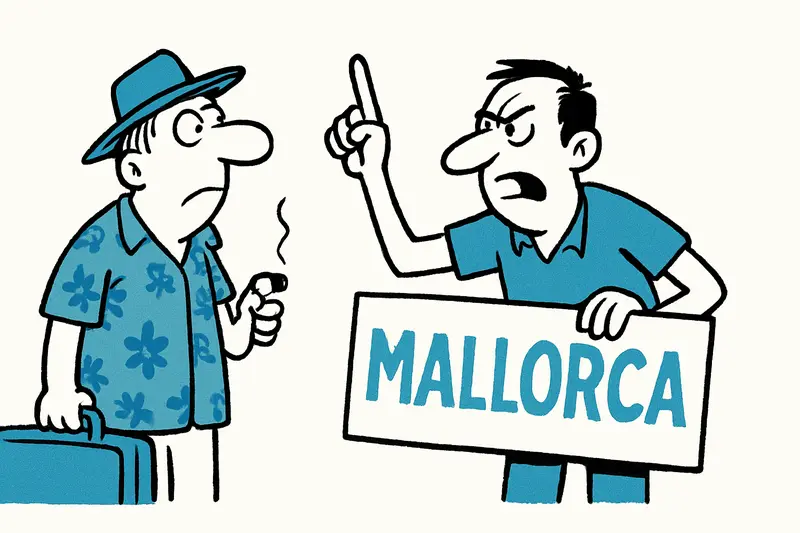
Mallorca and the Germans: When Does Tourism Become a Power Factor?
German visitors, second homes and capital are often lumped together in a single debate. But what matters is not the passport—it is who gets to shape housing, businesses and everyday life on the island.
From Holidaymaker to Owner: The Passport Is Not the Key Question
A German holidaymaker on the beach, a family with a second home, a buyer who rents out a house: these very different roles tend to blur together in debates about Mallorca. The result is a compelling narrative: first came the visitors, then some stayed, and now they are buying everything. But is that really what is happening? And does this picture help us understand the island’s problems?
The sober answer is that it describes one possible development, but it is not a complete explanation. Tourism has been part of Mallorca’s economy and everyday life for decades. People from Germany are among the island’s visitors and residents. But their country of origin alone tells us neither how much economic influence they have nor what responsibility they bear. What matters is ownership, how property is used and the rules that apply to everyone.
Who Benefits—and Who Bears the Consequences?
A business can remain in family hands, be sold to a company on the island or be taken over by a buyer based elsewhere. In everyday life, neighbors often care less about the owner’s passport than whether the house is occupied, a shop keeps operating and employees have reliable work. With property, too, it makes a difference whether someone moves in permanently, visits for just a few weeks a year or uses the accommodation commercially.
A sale is not automatically a loss for the island, either. Owners can receive a fair price, and a business can continue operating with new investment. Conversely, a foreign buyer is not automatically an investor seeking a quick return. Putting everyone in the same box turns a complex economic question into a dispute about nationalities. That may make noise, but it solves neither the housing shortage nor the dependence of many jobs on a short season.
Criticism is justified when capital buys up scarce resources, changes how they are used and takes profits elsewhere while the costs remain local. High housing costs affect workers as well as young families. If a business is treated only as an investment asset, long-standing neighborhood ties can disappear. These are real concerns—but they require specific evidence: Who owns what? How is it being used? What effect does it have on rents, jobs and access to services? Without that information, talk of “the Germans” or “foreigners” is a crude substitute for careful analysis.
What Often Gets Lost in the Debate
People too rarely make a clear distinction between holidays, residence and business. Nor do they ask who benefits from a sale: the seller, broker, operator or fund. And who will later foot the bill for roads, water, waste collection and public services? These questions cannot be settled by passing moral judgment on individual buyers.
Not every change can be attributed to foreign capital, either. Decisions by property owners on the island, construction and planning policies, lending conditions and strong demand all play a role. If we point the finger at just one group, we overlook the institutions and market rules that make these deals possible. The easiest person to blame is rarely the most accurate one.
An Ordinary Morning in Palma
On a street near the city center, a baker rolls up the shop’s metal shutter. An employee searches for an apartment on her phone as delivery vans and scooters weave past outside. Across the street, windows open on a balcony—perhaps for everyday living, perhaps just for a few days. From the street, it is impossible to tell. But for the neighborhood, it makes a difference whether someone lives there permanently, the apartment sits empty or guests come and go all the time.
Scenes like these explain why the issue is so emotionally charged. Housing is not an abstract statistic: it is the commute to work, the rental contract, the question of whether a son or daughter can stay nearby. At the same time, many people’s incomes depend on visitors. An island that dismisses tourism across the board would undermine the livelihoods of many people. An island that accepts every side effect as inevitable leaves its residents alone to deal with the consequences.
What Could Be Changed in Practice
First, we need clear, verifiable data: housing by actual use, changes in ownership, tourist rentals and rent trends—presented in a way that residents and local councils can understand. Second, rules for short-term rentals and commercial use should be consistently enforced. Anyone who needs a permit must comply with its conditions; those who break the rules should not be able to assume that nobody is watching.
Third, Mallorca needs more permanently affordable housing and reliable ways to create it. This includes municipal planning, long-term rental options and the use of suitable existing buildings where legally and structurally possible. Fourth, when larger businesses and properties are sold, the effects on employees and local services should be made visible. Not every transaction can be prevented—but transparency and clear social and tax rules can help ensure that profits are not privatized while the costs are left to the public.
Finally, the debate should not sort people by their origins, but by their actions and their impact. That is less convenient than having a scapegoat. But it is the only basis for fair rules that apply equally to Mallorcan owners and buyers from Germany or elsewhere.
The changes taking place in Mallorca cannot be reduced to a succession of German holidaymakers who eventually become investors. The real question is who gets to make decisions about scarce housing and local businesses—and whether the island confidently sets the rules. A buyer’s passport is not the measure. What matters is whether Mallorca still has room for the people who live and work here.
Frequently asked questions
Are German property buyers responsible for Mallorca’s housing problems?
How does tourism affect jobs and everyday life in Mallorca?
Why does it matter whether a Mallorca home is lived in or used for holidays?
How can Mallorca create more affordable homes for residents?
Why is consistent enforcement of holiday rental rules important in Mallorca?
What information does Mallorca need to understand its housing market?
Does selling a Mallorca business to a foreign buyer harm the local community?
Who bears the local costs when property investment profits leave Mallorca?
Similar News

Cinnamon Rolls Instead of Ensaimada? Palma’s Tiny Bakery Draws the World
A Swedish-inspired microbakery near Plaça Coll has climbed high on an international ranking. The crowds show how quickly...

The Trapeze Monkey Is Back at Palma City Hall
A mechanical monkey from the window of the former Babelín toy shop is swinging around again—this time in the City Hall f...
Mallorca Needs a Tourism Plan—but Not Just from the Hotel Industry’s Perspective
An island-wide tourism strategy sounds sensible. What matters is who writes it, which costs it makes visible, and whethe...
Christmas Flights to Mallorca: Who Pays the Island Premium?
Travel around the holidays becomes a question of cost. But without comparable booking data, it remains unclear whether M...

Sobrasada from Porreres in the Lab: What Six Pigs Can Really Tell Us
A project in Porreres is examining traditionally made sobrasada. The first samples have been taken, but that is not yet ...
More to explore
Discover more interesting content

Can Cap de Bou

Townhouse Lleo 72
