
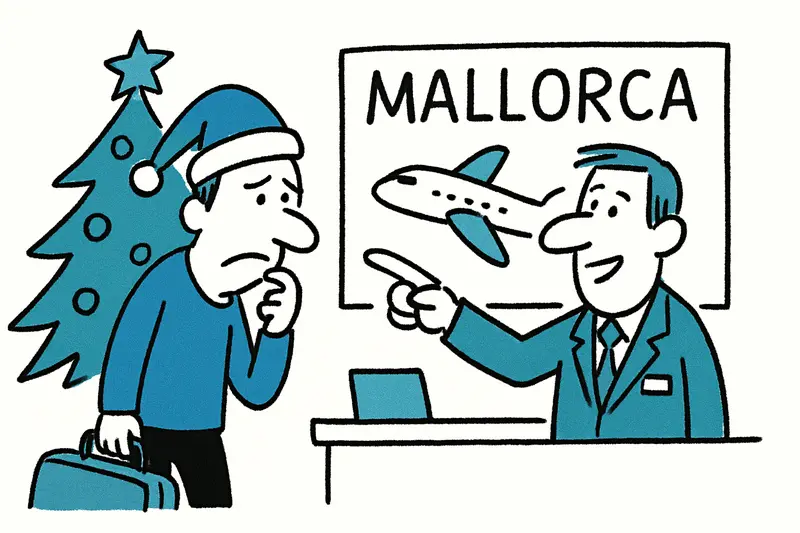
Christmas Flights to Mallorca: Who Pays the Island Premium?
Travel around the holidays becomes a question of cost. But without comparable booking data, it remains unclear whether Mallorca is particularly expensive—and what could help.
Christmas Flights to Mallorca: Who Pays the Island Premium?
A flight home, to visit relatives or to spend a few days on the island should not require a calculator and a calendar. Around Christmas, that is exactly what it becomes for many people. But the key question is not just why individual tickets are expensive. It is also whether we can even tell if Mallorca’s air links are under particular strain—and who could respond.
A few high fares can quickly spark outrage. On their own, however, they prove neither that prices have generally surged nor that every route to Palma is unusually expensive. Airfares change depending on when you book, the day of the week, the number of seats left, baggage and fare conditions. So when people compare two search results, they are often not comparing the same product. That does not make the concern unfounded, but it does make it hard to assess.
An island has fewer alternatives
For Mallorca, the issue is especially tangible. People who live on the mainland can sometimes choose another airport, take a train or drive. For the island, those are not real alternatives. The ferry may work for some travellers, but it is not a practical replacement for everyone, on every date, with every schedule and itinerary. If your family expects you at the table on December 24, a theoretically cheaper flight three days later is of limited help.
That does not automatically mean an airline has free rein on every route. Where several carriers operate, competition can put pressure on prices; where choices are limited, that leverage is weaker. But the number of airlines alone does not tell the whole story: flight times, frequency, connections and fares that are actually available all matter. A route listed on paper is not necessarily a viable alternative for people with jobs, children or fixed holiday plans.
Passengers have little insight into how fares are set. Airlines adjust prices continuously; fuel, staffing, aircraft availability and demand may all factor into their calculations. But from the outside, it is impossible to tell which factor is driving the price of a particular ticket. Anyone citing rising costs as an explanation should therefore also show how those costs affect specific routes and periods. Otherwise, “everything has become more expensive” remains an explanation that cannot be checked.
What is often missing from the debate
Above all, comparable data are missing. How have prices on the same route changed between tickets booked well in advance and those bought at short notice? What does a one-way flight cost, and what does a return ticket with baggage cost? How many seats were actually available at the advertised starting fares? And how do holiday periods compare with ordinary weeks? Without this information, an important everyday concern quickly turns into a clash between industries, leaving travellers little better informed than before.
The question of who finds a fare “unaffordable” also deserves a precise answer. A ticket may be manageable for one person but blow a family of four’s holiday budget once baggage is included. Conversely, an expensive fare shown by a search engine is not automatically the price most people pay. We need not just the highest prices, but transparent averages broken down by booking time and fare type.
In the evening in Palma, as the bus rattles over wet paving on Passeig Mallorca and the first Christmas presents are already appearing on café tables, the question comes up without any industry analysis: When are we going to see the grandparents—and can we afford it? For people who live on the island, this is not about a spontaneous weekend break. It is about staying close to family and friends. The same is true for relatives on the mainland. Anyone who treats the route as merely a seasonal travel product overlooks this part of everyday life.
What could be done
A public airfare-monitoring system could help, provided it uses a sound methodology. It should regularly check the same routes and travel dates, track different booking lead times and list extra costs such as baggage separately. Its findings should be clear and permanently accessible. That would help distinguish an expensive search result at a particular moment from a pattern on specific routes. A watchdog alone will not lower fares, but it can make them more transparent.
The regional government could commission this data collection together with consumer organisations and independent experts, and publish the findings regularly. That would provide a more concrete basis for discussions with airlines and airports. It would also make sense to track available capacity and actual flight times: adding flights is of little use if they run at times that do not work for many travellers. Where competition is lacking, policymakers should not jump to conclusions about the cause, but should examine which legal and practical options are available.
Passengers can also protect themselves when their plans allow: compare fares early, factor in baggage rules and look beyond the first price shown on a search page. That is useful everyday advice, but it is not a policy response. Families cannot move their plans around at will, and people who need to travel at short notice rarely have ten convenient options to choose from.
The point is not to treat every expensive Christmas trip as proof of excessive fares. The point is that Mallorca’s links to the mainland are too important to be discussed through anecdotes alone. Only reliable comparisons can show whether a genuine structural problem is growing. Until then, the island premium remains a plausible concern—but not a rigorously measured fact.
Frequently asked questions
Why can flights to Mallorca be expensive at Christmas?
Should I book Christmas flights to Mallorca early?
How can I compare flight prices to Mallorca fairly?
Why are flight prices especially important for people living in Mallorca?
Can the ferry replace a flight from Mallorca to the mainland?
Does having several airlines guarantee cheaper flights to Mallorca?
How can I tell whether flights to Mallorca are unusually expensive?
Can Mallorca’s regional government do anything about high flight prices?
Similar News

Sobrasada from Porreres in the Lab: What Six Pigs Can Really Tell Us
A project in Porreres is examining traditionally made sobrasada. The first samples have been taken, but that is not yet ...

EU Traffic Rules: What Really Changes for Drivers in Mallorca
From 2027, cross-border information sharing is set to cover additional traffic offences. But that does not mean every ti...

Beyond Manacor: Mallorca’s Balloon Pilot and His Craft
For decades, Ricardo Aracil has taken people over Mallorca in a hot-air balloon. The view from above is the highlight—bu...

Passport Checks in Menorca: Suspicion Is Not a Verdict
An unusual travel document can prompt an inspection. What happens next is often hard for travellers to see—and calls for...
When a Baby Suddenly Stops Breathing: Palma’s Emergency Response Put to the Test
Every minute counts in a medical emergency involving an infant. What matters is not only who arrives first, but also whe...
More to explore
Discover more interesting content

Can Cap de Bou

Townhouse Lleo 72
