
Control with a Mask in Santanyí: Protest, Culture or Administrative Offense?
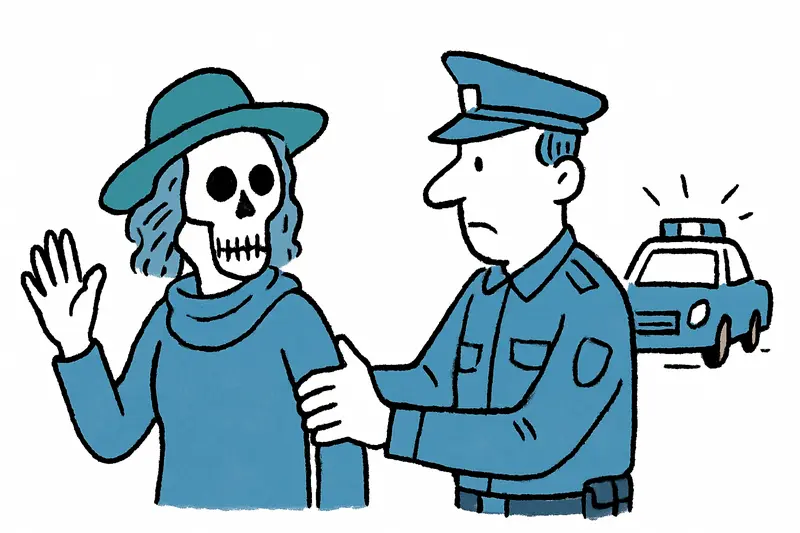
In Santanyí the local police escorted a traditionally masked activist away. Was it an identity check, an administrative measure, or an act against freedom of expression?
Control with a Mask in Santanyí: Protest, Culture or Administrative Offense?
Main question: Does the intervention serve danger prevention — or does it affect an artist's freedom of expression?
On market day in Santanyí, when vendors set out baskets of figs and olives, the church bells gently mark time over the Plaça and tourists in autumn jackets stroll between the stalls, a well-known masked activist was stopped by the local police and led into a service vehicle. The scene felt like two worlds colliding: a rural fair and a formal exercise of state order.
The key facts are brief: posters had been placed in several parts of the town center, including on the historic Porta Murada. The police asked the woman to identify herself. She refused to remove her skull mask in public and asked to do so inside the police vehicle. The formalities were then carried out. The city administration described the action as a response to breaches of rules on putting up signs; the activist places the incident in the context of her tourism-critical work.
Critical analysis: In such cases, different legal interests collide. On one side is the municipality's interest in preserving protected sites and a tidy streetscape; on the other, the freedoms of assembly and expression and the cultural expression of a person who deliberately appears in disguise. The law on identity checks allows police to ask people to show ID. How far a refusal can go and when an identity check may take place in a vehicle is not legally mysterious, but it depends on practice.
What is often missing in public debate is a sober separation between an administrative issue and the signal that police measures send when applied to protest acts. Simply the visible escort of a known activist by uniformed officers reinforces the impression that criticism is being criminalized — regardless of whether the actual aim was enforcing a regulation. Also rarely discussed is how heritage protection rules and protest culture can reasonably complement one another in tight town centers without the former appearing to be used as a pretext to restrict expression.
A mundane scene that shows the tension: a café on Carrer Major, regulars sip café con leche, conversation pauses briefly when the police stop at the Porta Murada with hazard lights on. No one shouts, but conversations fall silent; the atmosphere cools noticeably. Such small moments shape how citizens perceive the relationship between administration and public space.
Concrete proposals:
1. Duty of transparency in identity checks: Officers should briefly, clearly and in simple language explain why an identity check is taking place and what legal basis applies. If possible, an operation report should be made immediately available to the person affected.
2. Special committee for historic areas and protests: Municipalities could set up a local roundtable (heritage protection, public order office, civil society representatives, cultural groups). There a consensus can be reached on where temporary creative expressions are allowed and where protected zones exist.
3. De-escalation training: Training for local police that increases sensitivity to artistic and political actions and shows alternatives to public unmasking, such as identity checks in separate, respectful spaces.
4. Clear rules for posters and sanctions: Uniform, well-communicated guidelines on how and where informational material may be posted. Those who violate the rules should be sanctioned in a comprehensible way — with links to a complaint mechanism.
Punchy conclusion: A woman with headwear and a skull mask is not an automatic trigger for public outrage, and a police check is not automatically repressive. But without clear rules, mistrust grows. Santanyí now needs fewer symbolic displays of power and more transparent procedures that take culture, heritage protection and the right to demonstrate seriously at the same time.
What remains is the question of how an island community can tolerate lively criticism without turning its squares into museums — or into a stage for enforcement actions. The answer does not lie in quick references but in practical agreements between authorities and civil society that must be negotiated on equal terms.
Frequently asked questions
What’s Mallorca’s autumn weather like and how should I dress for outdoor markets in Santanyí?
Are there rules for posting posters or signs in Mallorca’s historic town centers?
What happened in Santanyí when a masked activist was stopped, and why did it spark debate about protest and heritage?
What role do historic sites like Porta Murada play in Mallorca when it comes to street demonstrations and postings?
How do identity checks work in Mallorca, and when can police ask for ID?
What proposals were suggested to Santanyí for handling protests and balancing culture with heritage protection?
How can Mallorca towns balance culture, heritage protection, and the right to demonstrate in busy town centers?
What lessons can be learned about transparency and public space from Mallorca’s approach to protests like the Santanyí incident?
Similar News

Up to €9,000 Fine in Inca: Why Wet Wipes Can Blow Up the Sewers — and What We Should Really Do
The municipality of Inca warns of blockages caused by wet wipes — fines of €300 to €9,000 are possible. A reality check:...

World Cup Trophy in Palma: Two Days Up Close
The World Cup trophy is coming to Palma at the end of October: two days on display at City Hall, and on 31 October photo...

End of October: Can you still swim in the sea in Mallorca?
The late-autumn sun still warms the air and the sea has retained its summer heat—many people don't pack away their swimw...
Years of abuse in Costa de la Calma – Neighbor calls Guardia Civil
In a villa in Costa de la Calma a neighbor alerted the Guardia Civil: a 19-year-old woman reported years of violence by ...

Schauinsland Takes Over Management of the Morito in Cala Millor – a Reality Check
From March 2027 the German tour operator Schauinsland will manage the Morito hotel in Cala Millor. The Batle Erikson fam...
More to explore
Discover more interesting content

Can Cap de Bou

Townhouse Lleo 72
