
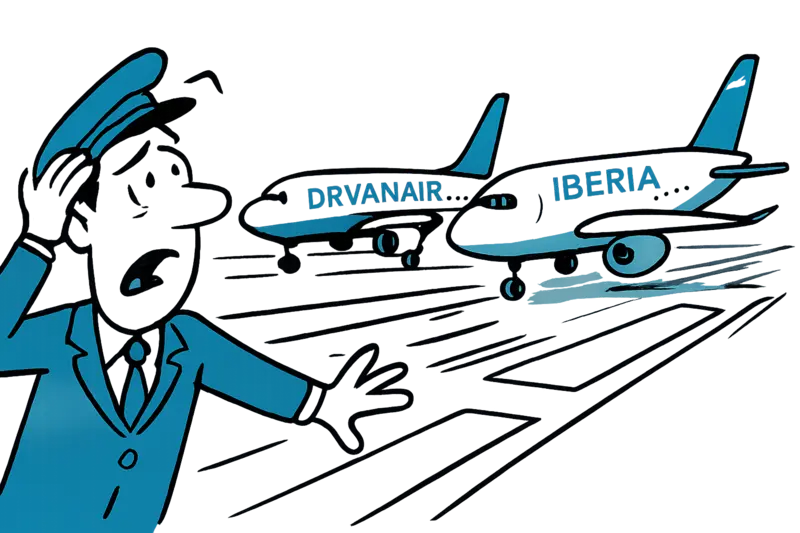
Near-miss on Lanzarote: Landing Ryanair Jet and Iberia Takeoff — what really went wrong
Near-miss on Lanzarote: Landing Ryanair Jet and Iberia Takeoff — what really went wrong
On Lanzarote there was a dangerous incident: A Ryanair flight (FR5910) from Dublin landed on runway 03 while an Iberia Express aircraft (IB1502) rolled via exit E1 onto the same runway. Why this could happen and what lessons Mallorca should draw.
Near-miss on Lanzarote: Landing Ryanair Jet and Iberia Takeoff — what really went wrong
At César Manrique-Lanzarote Airport a maneuver in the morning narrowly missed becoming a serious incident. The Ryanair aircraft (flight FR5910 from Dublin) touched down on runway 03. Shortly before it had vacated the runway, an Iberia Express flight (IB1502, bound for Madrid) rolled via exit E1 onto the same runway/takeoff area. The landing aircraft had to brake immediately and only left the runway via exit E2 — a situation known as a runway incursion, which is considered highly risky in flight operations.
Key question: Why are two aircraft allowed to occupy the same runway at the same time, and how likely is it that something like this could happen again in the Balearics?
In short: It must not happen. Coordination between the tower and ground control is meant to sequence landings and departures smoothly. In this case, landing and runway clearance coincided so unfortunately that two aircraft were on the same surface at the same time. The facts — runway 03, exits E1 and E2, FR5910 and IB1502 — are established. I do not have official statements from the airlines involved or air traffic control; the investigation will be the responsibility of the competent aviation authority.
What is often overlooked here: safety is determined not only by technical systems but also by human reactions measured in fractions of a second. Pilots brake, controllers give instructions, locks, signals and markings must be unambiguous. A braking aircraft on the runway is always a risk. That the Ryanair aircraft was able to stop in time was luck and good reactions, not automatically proof of flawless procedures.
Public debate often lacks perspective on root causes. Reports say something "went wrong." But what does that mean concretely? Missing or ambiguous clearance, faulty communication, unclear ground signage, overload in the tower, staff shift changes or technical gaps like no ground radar — all of these are possible factors. And: small airports with heavy holiday traffic have tight schedules; pressure to be on time is real.
A picture from the island: Morning in Palma, on Passeig Mallorca, the coffee tastes bittersweet, taxi drivers at Son Sant Joan Airport shake their heads and talk about flights arriving "every five minutes." The ground control shift on a sunny Tuesday is long; a young controller changes shift, the neighbouring controller has to keep two runways in his head at once. This is not an accusation, this is everyday life — and this is where gaps occur.
Concrete solutions relevant for Mallorca and the smaller island airports:
1) Upgrade technology: Ground movement radar (ASDE) or improved ground surveillance, automated Runway Status Lights (RWSL) and warning systems that prevent a clearance if a landing aircraft is still occupying the runway.
2) Clear procedures and hotspot maps: Dangerous intersection points and exits must be identified, emphasized and practiced regularly. Clearances should only be issued with confirmed situational awareness.
3) Radio discipline & standard phraseology: Misunderstandings often arise from abbreviated or unclear radio calls. Uniform phraseology, mandatory read-back routines and recording checks help.
4) Staffing relief and training: Tower staff must not be permanently overburdened. Simulation training for emergency and near-miss scenarios should occur more frequently.
5) Transparency and follow-up: A prompt, independent investigation by the national aviation authority (AESA) with clearly communicated findings and measures is necessary. If disclosure is omitted, mistrust among passengers and staff will grow.
For Mallorca: our islands live off air traffic. Every incident quickly affects the mood — taxi drivers, hoteliers and passengers notice. Safety must not only sound expensive, it must be made tangible. Small airports need appropriate technology and human relief, not just operational directives from Madrid or Dublin.
What is often missing in public discourse is the demand for binding upgrades: Who will quickly cover the costs for ground radar or RWSL? Who is accountable if staffing quotas are too low? These are questions for authorities and operators, not just talk shows.
Conclusion: This incident was a warning sign. Luck prevented worse outcomes. It would be better if visible measures followed quickly from this warning — clearer procedures, more technology, honest personnel management. Only then will the trust of island residents and guests be preserved.
Frequently asked questions
When is the best time to visit Mallorca for beach weather?
Is it safe to swim in Mallorca, and what should I watch for in the sea?
What should I pack for a Mallorca trip?
What are family-friendly activities to do in Mallorca?
How can I get around Mallorca from the airport or Palma?
Are there tipping practices or local etiquette to know in Mallorca?
What are the must-see beaches or coastal spots in Mallorca?
What is Mallorca's weather like across the seasons?
Similar News
Eurowings introduces new Premium Business seats on Mallorca routes
From December 1, selected Eurowings flights to Palma and other destinations will feature eight particularly generous sea...
Car on MA-13 near Inca in flames – a safety check for the island
A vehicle caught fire on the MA-13 towards Alcúdia on Tuesday afternoon. The driver was uninjured, the car was destroyed...
Real Estate in Mallorca: Fewer Buyers, Higher Prices — What's Behind It?
Sales on Mallorca are falling, yet prices continue to climb. Why fewer transactions do not equal relief — and what shoul...
Just Bought — Already Trouble: Water Damage in the Heiters' Villa and What Owners in Mallorca Should Know Now
A newly purchased sea-view property — and within days a water damage. What risks lurk in new properties in Mallorca, and...

Rich, Richer, Mallorca? A critical look at the growing super-rich bubble
Numbers: Around 3,600 millionaires in the Balearic Islands hold a combined €27.6 billion. What this concentration of wea...
More to explore
Discover more interesting content

Can Cap de Bou

Townhouse Lleo 72
