
Nighttime Crash in Palma: Red Light, Alcohol and the Question of Effective Prevention
A car ran a red light at the intersection of 31 de Desembre and Antoni Marquès. The driver had a preliminary breath-alcohol reading of 0.85 mg/l and refused further tests. One person was injured. Time for a reality check.
Nighttime Crash in Palma: Red Light, Alcohol and the Question of Effective Prevention
Why does this keep happening on our streets — and is punishment alone enough?
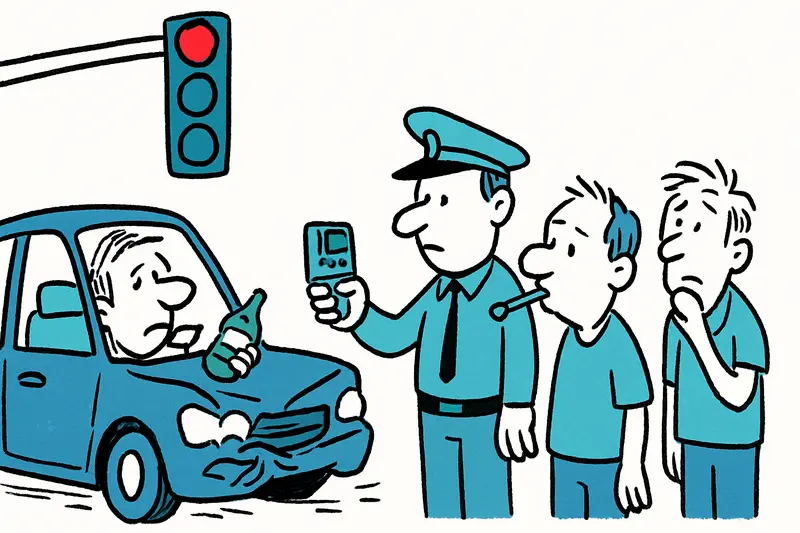
At the end of March, around 2:15 a.m., a car crashed into another vehicle at the intersection of 31 de Desembre and Antoni Marquès. According to the police report: the 31-year-old driver, a Chinese national, is said to have overtaken on the right lane and crossed the traffic light despite it being red. The victim suffered several bruises and trauma to the left leg and was taken to a hospital. Both vehicles sustained significant property damage. This incident is one among several recent nighttime crashes reported in the city, such as Nighttime Escape on the Camí dels Reis: An Accident, Many Questions.
Officers observed clear signs of alcohol on the driver. A preliminary breath test at the scene showed 0.85 mg/l breath alcohol — roughly 1.7‰. He refused the legally required official tests; the file was forwarded to the competent on-call court, and an administrative report was filed for disregarding the traffic light, as in other cases such as Nighttime Accident in Sóller: Alcohol, No Driver's License — How the Situation Escalated.
Key question: Why do such accidents repeatedly occur in Palma even though the rules are clear? This question is far from academic. Anyone driving through the city at night knows the mix of festive atmosphere, dim streetlights and the occasional red light that some seem not to heed. A taxi passes by, a small group of shops close, and somewhere decisions about how to get home go off the rails.
Critical analysis: At first glance there is the simple trinity of cause, act and punishment. Driving under the influence is illegal, red lights must be obeyed — both were ignored here. Yet practical enforcement lags. A preliminary test gives an indication, but refusal of the officially required, multilingual samples complicates evidence gathering and delays measures. Victims are left with damage: physical, financial and often psychological.
What is missing from the public debate: discussion quickly focuses on individual blame — and sometimes the origin of the person involved. That helps no one. Far less often do we talk about structural questions: Why are certain nighttime hours particularly risky? Are random checks enough? Is there enough visible policing in neighborhoods with late-night activity? Local coverage of crashes, such as Nighttime Accident in Son Oliva: More Than Just a Drunk Driver, raises the same questions. Who bears responsibility: the driver, nightlife venue operators, car rental companies, or the city administration?
An everyday scene from Palma: It is late, Passeig de Born has grown quiet, a small group walks singing toward the night bus. Nearby, an ambulance's flashing lights throw patterns on the asphalt; a police officer notes details. Such images stick in the mind — and should form the basis for decisions, not just the next police report.
Concrete solutions that could help here:
1) Visible nighttime checks — not only spot checks, but regular, recurring patrols at known hotspots. Visibility works as a deterrent.
2) Use technology — more red-light and traffic cameras at problem intersections, paired with swift administrative procedures, reduce opportunities for offenders.
3) Multilingual prevention — information sheets at car rental agencies, in bars and at tourist hotspots; many drivers are guests or newcomers and may not know local rules well enough.
4) Expand night mobility — more reliable night buses, additional taxis during peak hours and coordinated taxi lanes so the last trip home isn’t made by a private car at increased risk.
5) Cooperation with hospitality businesses — we are not against night owls, but bar and club operators can contribute through responsible serving practices and cooperation with taxi services.
These measures are not cure-alls. They require money, personnel and organization. But the wheel of prevention can be turned: fewer chances to offend, faster intervention, better information for users — these are tangible levers.
Concise conclusion: A single crash is a personal tragedy and at the same time a public wake-up call. Anyone in Palma who ignores traffic lights and alcohol risks more than a fine. We should ask how the city ensures that the next 2:15 a.m. ride ends more quietly — not only through sanctions, but also through smart prevention.
Frequently asked questions
Why do late-night traffic accidents keep happening in Palma?
What should I do if a driver in Mallorca refuses a breath test after a crash?
Is drink driving treated seriously in Mallorca at night?
What are the most effective ways to prevent night crashes in Palma?
Why are red-light crashes such a problem in Palma?
What makes 31 de Desembre and Antoni Marquès a risky junction in Palma?
Does Palma need more night buses and taxis to reduce drink driving?
What can bars and clubs in Mallorca do to help prevent drunk driving?
Similar News
More water than last year: Mallorca's reservoirs breathe easier
September rain refilled the Tramuntana's reserves: overall fill around 35 percent, Cúber at 40.42 percent, Gorg Blau at ...
Three Luxury Hotels in Banyalbufar: Lots of Money, Many Questions
A Danish investor plans three exclusive accommodations in Banyalbufar — including the historic Son Valentí. The announce...
2.1 tonnes of cocaine on sailing yacht off Spain's coast – a reality check for the coastguard
A 14-metre yacht was seized with 2.1 tonnes of cocaine. Who monitors the ports, how does the international hunt succeed ...
Heat Bonus in Mallorca: 100 Euros Extra for Outdoor Staff at MarSenses
MarSenses pays employees who worked outdoors in August an extra €100 as recognition. Lighter uniforms, reduced hours for...
Renovating in Mallorca: What You Really Can Do Without Neighbour Consent
Many think they can do whatever they want in their apartment. That's partly true — but only as long as structural elemen...
More to explore
Discover more interesting content

Can Cap de Bou

Townhouse Lleo 72
