
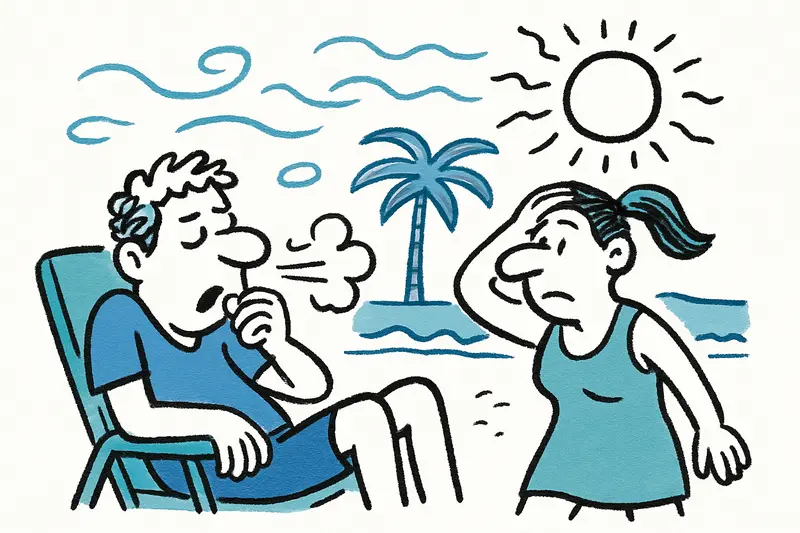
Ozone Alarm 2025 in the Balearic Islands: Heat, Traffic and the Question of Effective Countermeasures
This summer, ground-level ozone concentrations on the Balearic Islands rose noticeably — evoking memories of 2018. What is behind this, who is at risk, and which concrete steps could provide short- and long-term relief for the islands?
The air feels heavy: Ozone alarm between the promenade and the airport
Anyone who walked through Palma this summer knows the feeling: blue sky, glaring sun, yet the air hangs heavier over the city. Cicadas cry, pavement cafés are full, and on the Vía de Cintura cars, scooters and delivery vans stop and go with the traffic lights — perfect ingredients for ground-level ozone. Measurements reaching levels last seen in 2018 confirm: 2025 was an ozone year. Heat alert on Mallorca shows how serious the situation is.
Central question: Can the islands still get ozone peaks under control?
The simple answer is: not with a single recipe. Ground-level ozone is not a directly emitted poison but a child of sun, heat and precursor substances from combustion engines. Several heat waves, little wind and crowded roads acted together this summer. 40 Degrees This Weekend: Mallorca Faces a Heat Test – What Matters Now When Mallorca sizzles — the answers are needed.
What is often overlooked
It is not just cars. Airport activity, ferries in the harbors, delivery traffic for hotels and restaurants as well as construction sites also emit the chemical precursors. In Palma you hear the rumble of PM-12 in the morning, the diesel smell along delivery zones and the honking on hot afternoons. Urban heat islands amplify the effect: dark road surfaces and lack of trees store heat and favor ozone formation. There was also a breather in August, but the pressure remains.
Another point: monitoring networks are patchy. On Menorca, especially in towns like Maó and Es Mercadal, values were often above recommended guidance levels — yet many municipalities have only a few monitoring stations. Mobile sensors are scarce, so those affected often only notice the air is poor when their eyes burn or coughing begins.
Who is affected — and why this is not just a health issue but also a social one
Most affected are children, older people and those with asthma or cardiovascular disease. For families living in courtyards without air conditioning, a hot afternoon with high ozone levels means closing windows and enduring the heat indoors. For field workers or delivery drivers it means prolonged exposure to fine particles and ozone. Air quality is therefore also a matter of social justice — those with longer commutes or who live in densely populated areas bear the burden. Initial tourism figures for summer 2025 illustrate the links.
Concrete measures with short-term effects
There are measures that could take effect relatively quickly if implemented consistently:
1. Warning systems and behavioral guidance: Daily alerts via SMS, WhatsApp or local radio, clear recommendations for schools and sports clubs and targeted advice for older people.
2. Temporary traffic rules on heat days: Time-limited bans on through-traffic for heavy delivery vehicles in city centers, reduced speed limits to avoid stop-and-go traffic and thus fewer emissions.
3. Mobile monitoring stations: Rapidly deployable sensors in affected communities such as Maó and Es Mercadal would create transparency and allow targeted warnings.
Long-term levers — what Mallorca would really need to change
In the long run, structural changes are necessary: electrification of taxis, buses and delivery fleets; expansion of public transport to the outskirts of the islands; creation of more shady green corridors in cities; reflective alternatives to asphalt and smart urban planning that counteracts heat islands. Subsidies for small businesses switching to electric delivery vehicles could have a quicker impact than large projects. Heat alert on Mallorca: How well is the island prepared for infernal heat days?
Another often neglected lever is coordination between island governments, municipalities, airport operators and port authorities. Ozone does not stop at municipal boundaries — and therefore the response must be regionally coordinated.
Outlook: Don’t put everything on the weather
Yes, the weather makes many things easier or harder — but the concentration of emissions and urban conditions contribute decisively. An elderly neighbor in Palma sums it up pragmatically: “We always have sun — but the air must not be the price.” Small everyday changes, like fewer short trips, biking instead of driving for short distances and being considerate with delivery times, help immediately. Sustainable solutions, however, require planning, money and political will.
The Balearic Islands face a dual challenge: short-term protection for people this summer and long-term strategies against recurring ozone events. The question remains open — and pressing: do we only want to react or start making the islands more resilient before the next hot summer arrives?
Frequently asked questions
Why is ozone a problem in Mallorca during hot weather?
What can I do on a high-ozone day in Mallorca?
Is it still safe to swim or go to the beach in Mallorca when ozone is high?
What should I pack for Mallorca if there is an ozone alert?
Why is Palma especially affected by ozone in summer?
Why are airport and port traffic part of the ozone problem in Mallorca?
Are ozone levels monitored everywhere in Mallorca and Menorca?
What long-term changes could help reduce ozone in Mallorca?
Similar News

Who will clean up? Illegal rubbish heaps on the highway near Son Gual drive residents onto the streets
For months, construction debris and household waste have piled up along the highway between Palma and Manacor near Son G...

Amundi takes over Bikini Island & Mountain Port in Sóller – many questions remain open
The French asset manager Amundi has acquired the four-star Bikini Island & Mountain Port hotel in Sóller from an Austria...

Silvia was allowed to see the sea once more – a small farewell in Port de Soller
A team from the Balearic health service IB-Salut fulfilled a terminally ill woman's wish: one last trip to the water in ...
Magaluf: Imprisonment for Beach Club Employee after Theft of a Bag — What the Ruling Overlooks
A former dishwasher received a one-year prison sentence for stealing a Louis‑Vuitton bag. The appellate court upheld the...

Road collapse at Port de Valldemossa: Who will pay for the next wave of damage?
A section of the MA-1131 near Port de Valldemossa slipped after heavy rains from cold front "Adam". Residents are strand...
More to explore
Discover more interesting content

Can Cap de Bou

Townhouse Lleo 72
